
What Should an Industrial Security Labels Manufacturer Actually Provide?
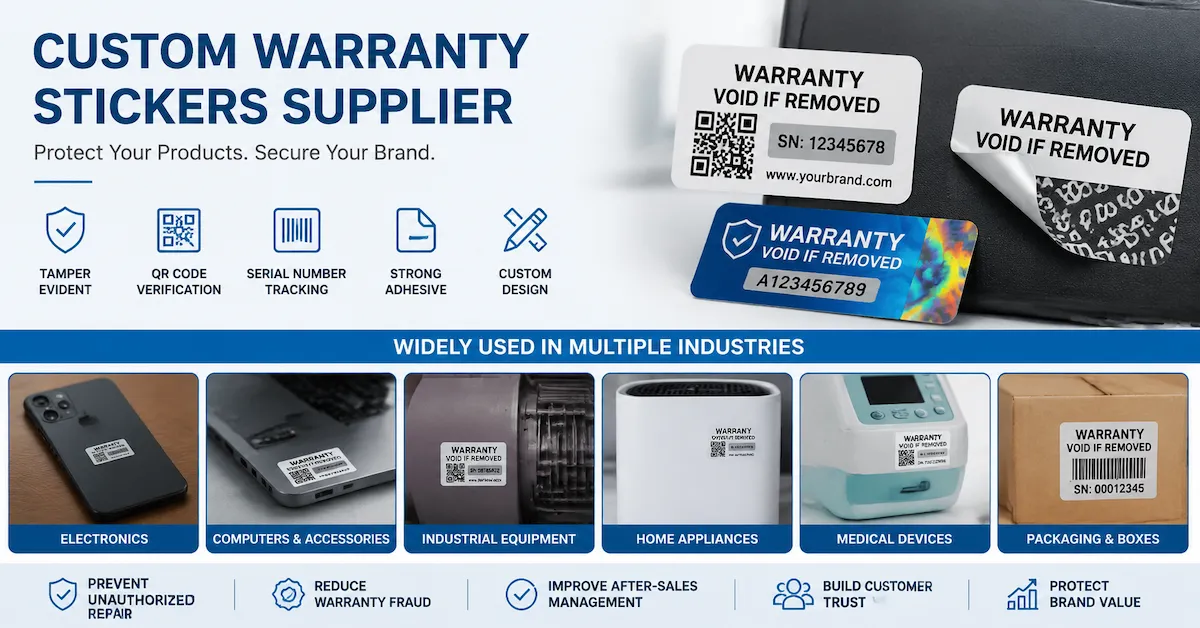
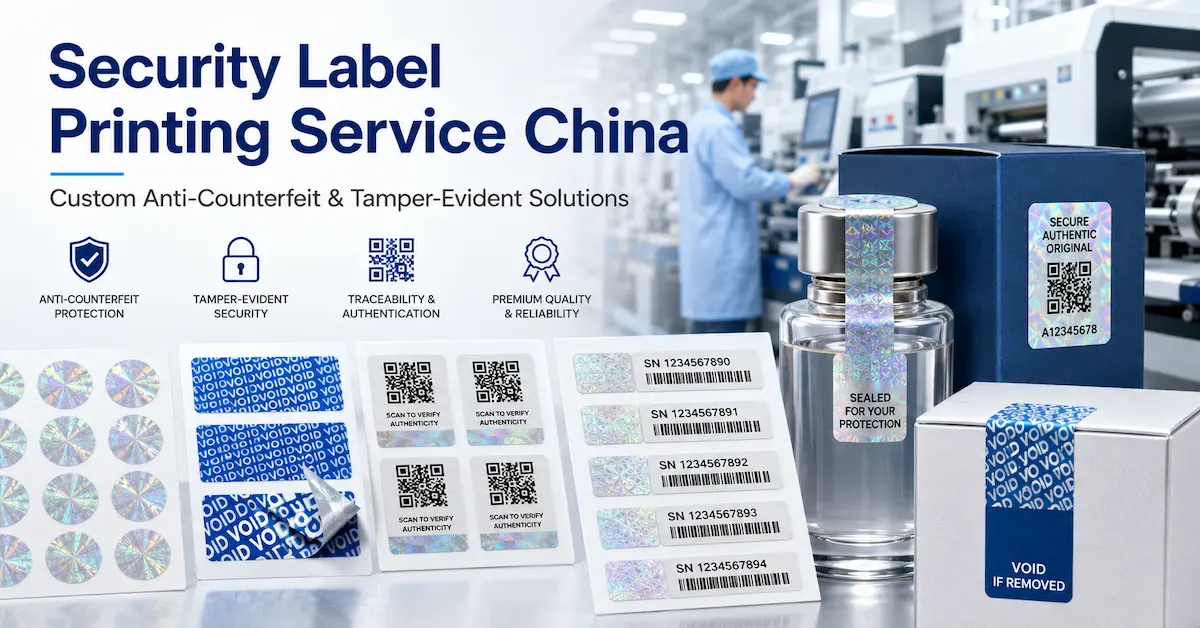
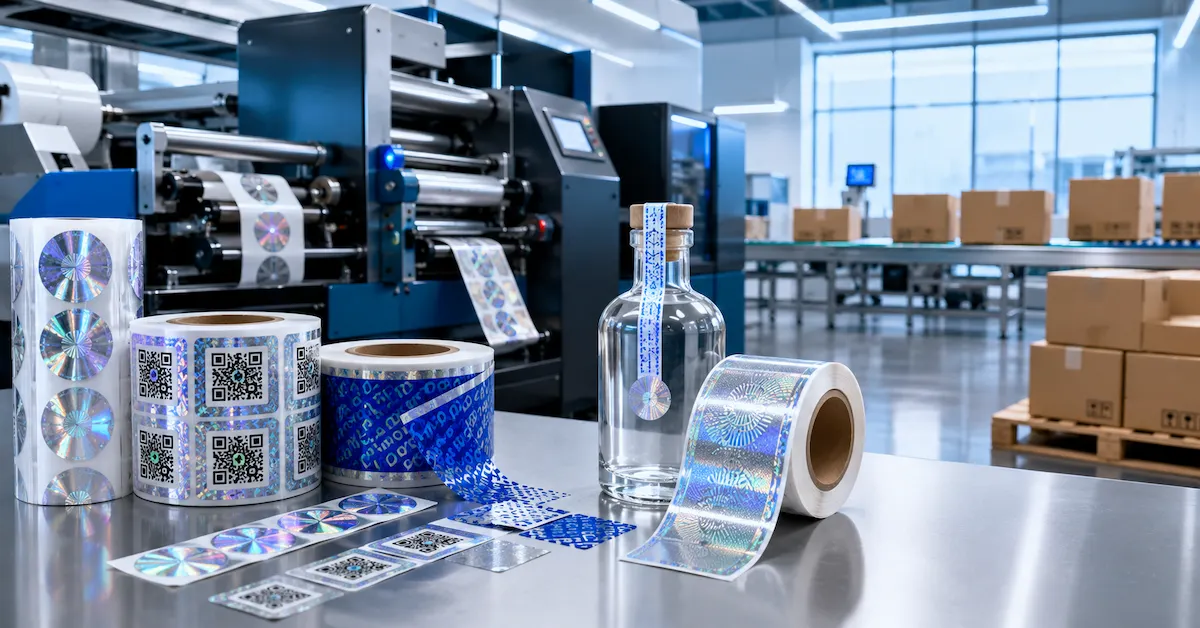
An industrial security labels manufacturer should do more than print a logo on an adhesive sticker. Industrial equipment, electronics, components, machinery, appliances, medical devices, and high-value products may require labels that provide evidence of opening, prevent label reuse, support product authentication, identify individual units, or connect physical products with digital records.
For this reason, the correct industrial security label should be engineered around the product risk rather than selected only by appearance or price.
A typical project may require several protection layers:
- Tamper evidence to show unauthorized opening
- Holographic authentication for visible product verification
- VOID or destructible structures to discourage label transfer
- QR codes or serial numbers for digital verification
- Barcodes for product identification or internal management
- Latent or hidden features for secondary inspection
- Custom adhesives and materials matched to the application surface
- Variable data printing for product-level identification
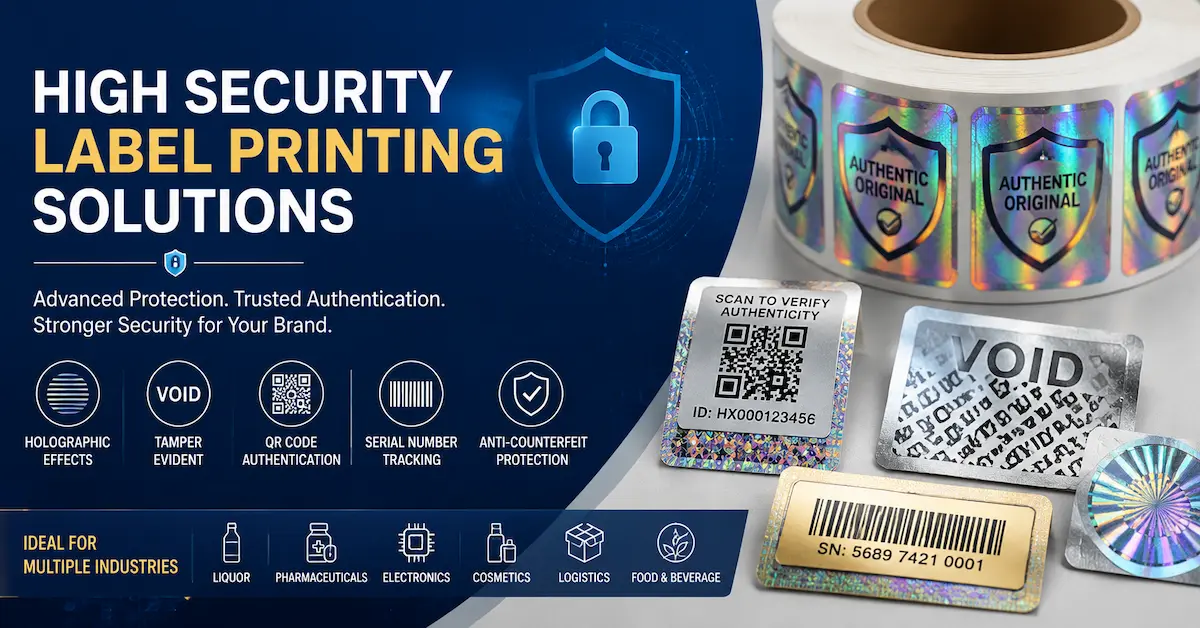
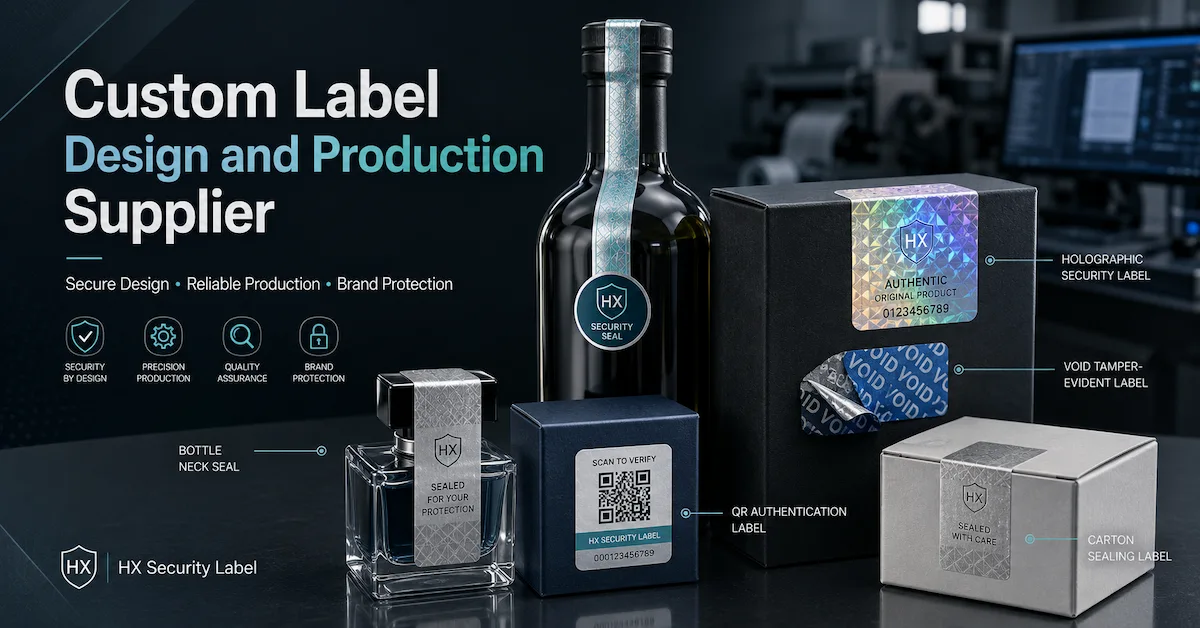
HX currently provides product directions including holographic labels, VOID open labels, wine tax stamps, latent image labels, and other customized security labels.
The important point for industrial buyers is that security should be designed as a system. One label does not automatically need every available feature, but the selected features should correspond to a defined threat such as unauthorized opening, warranty fraud, counterfeiting, component replacement, product diversion, or label reuse.
Which Industrial Buyers Need Security Labels?
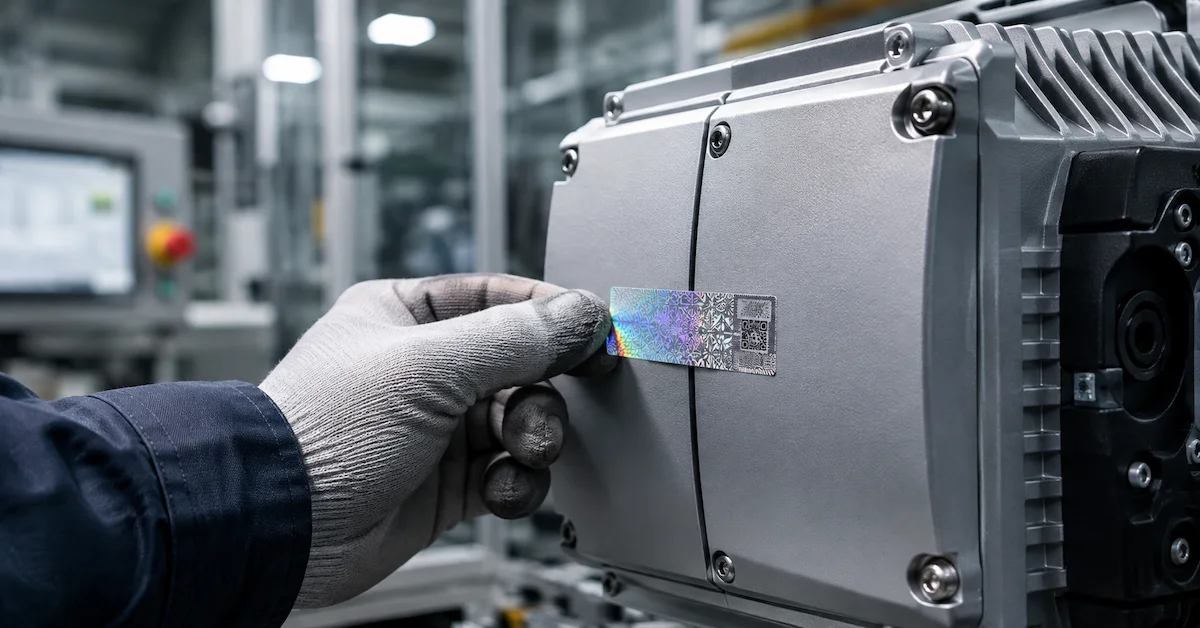
Industrial security labels are particularly relevant when product integrity has commercial, warranty, safety, traceability, or brand-protection consequences.
Typical buyer groups include:
| Buyer Type | Main Concern | Common Security Requirement |
|---|---|---|
| Industrial equipment manufacturers | Unauthorized opening or service | VOID or destructible seals |
| Electronics manufacturers | Warranty fraud and component replacement | VOID + serial number |
| OEM/ODM manufacturers | Product identification and brand protection | Custom hologram + variable data |
| Automotive component suppliers | Part identification and diversion | Serial number + QR/barcode |
| Medical device suppliers | Product integrity and traceability | Tamper evidence + identification |
| Appliance manufacturers | After-sales warranty control | Warranty seals |
| Machinery suppliers | Unauthorized maintenance | Equipment security seals |
| Distributors | Counterfeit replacement and channel control | Serialized authentication |
| Brand owners | Product copying | Holographic + covert features |
| Packaging operations | Opening and replacement | Tamper-evident packaging labels |
HX’s existing warranty-security guidance specifically identifies electronics, industrial equipment, medical devices, automotive components, appliances, and other high-value products as relevant applications for tamper-evident and warranty labels.
When a Security Label May Be Unnecessary
Not every industrial label should become a complex anti-counterfeit label.
If a label is only needed for temporary warehouse identification, simple instruction marking, non-sensitive internal inventory, or decorative branding, a conventional industrial label may be more economical.
The additional cost and complexity of security features should correspond to an actual business risk.
That distinction matters when selecting an industrial security labels manufacturer: a qualified supplier should help determine which security functions are necessary and which are not.
Start With the Threat, Not the Label Technology
A common procurement mistake is asking for a “high-security label” before defining what the label must prevent.
A better approach is to identify the attack or failure scenario first.
Risk 1: Unauthorized Opening
If the main concern is whether a machine housing, controller, component enclosure, or electronic product has been opened, visible tamper evidence is usually more important than an elaborate holographic effect.
Possible options include:
- VOID transfer
- OPEN transfer
- Destructible material
- Fragmenting labels
- Tamper-evident sealing structures
VOID open labels are designed around this type of requirement. HX’s existing industrial warranty guidance also recommends VOID and tamper-evident structures where buyers need evidence that equipment has been opened or modified.
Risk 2: Label Reuse
A conventional adhesive label may sometimes be removed and transferred to another product.
Where that creates a security risk, buyers should consider structures that make successful removal difficult or visibly alter the label.
Possible approaches include:
- Destructible substrates
- VOID transfer layers
- Anti-transfer designs
- Security die cuts
- Tamper-sensitive materials
Risk 3: Counterfeit Products
If counterfeit products are the main concern, tamper evidence alone may not be enough.
The label can combine visible and hidden authentication features such as:
- Holographic effects
- Microtext
- Special optical patterns
- Latent images
- UV-verifiable elements
- Serial numbers
- Digital verification
WIPO’s 2026 review of anti-counterfeiting technologies distinguishes visible technologies such as optical security labels and VOID seals from tool-assisted or digital technologies such as UV features and digitally verifiable elements. That supports a layered rather than single-feature approach to product authentication. See WIPO’s anti-counterfeiting technology overview.
Risk 4: Product or Component Substitution
For expensive assemblies and replacement parts, physical tamper evidence can be combined with unique product identity.
Useful options include:
- Unique serial numbers
- QR codes
- Barcodes
- Batch codes
- Model identifiers
- Variable data
This allows a company to connect the label with a specific product, production lot, service record, distributor, or market.
How to Build a Multi-Layer Industrial Security Label
A strong industrial security architecture usually combines different verification levels instead of relying on one feature.
| Security Layer | Typical Feature | Main Purpose | Suitable Users |
|---|---|---|---|
| Visible security | Hologram, optical pattern | Fast visual check | Customers, distributors |
| Tamper evidence | VOID, destructible material | Detect opening or transfer | Service teams, inspectors |
| Covert security | Latent image, UV, microtext | Secondary authentication | Trained personnel |
| Digital security | QR, serial number | Digital verification | Customers, service teams |
| Identification | Barcode, variable data | Product-level identification | Warehouse, factory, distributor |
ISO 22383 provides guidance on performance criteria and evaluation methodology for authentication solutions intended to establish authenticity. This reinforces an important procurement principle: security performance should be evaluated according to the authentication objective, rather than assuming that a visually complex label is automatically secure. Learn about ISO 22383.
For some projects, a single VOID label may be sufficient.
For higher-risk equipment, a better configuration may be:
VOID tamper evidence + holographic authentication + unique serial number + QR verification.
The right architecture depends on product value, counterfeit risk, warranty policy, distribution model, inspection method, and operating environment.
Which Material and Adhesive Should You Choose?
Material selection is one of the most important technical decisions in industrial security label projects.
A label that performs well on a coated carton may perform differently on powder-coated metal, textured plastic, painted machinery, glass, or a small electronic component.
HX’s existing technical guidance identifies surfaces including plastic housings, metal casings, painted surfaces, glass, coated packaging, and electronic components, while also warning that unsuitable adhesive selection can cause peeling, weak tamper performance, surface damage, or storage failure.
Surface Conditions to Tell Your Manufacturer
Before requesting a quotation, provide the actual surface information:
| Application Surface | Factors to Evaluate |
|---|---|
| Smooth metal | Adhesion, residue, tamper pattern |
| Powder-coated metal | Surface texture and bonding |
| ABS/PC plastic | Adhesive compatibility |
| Painted housing | Risk of unwanted coating damage |
| Glass | Bond strength and removal behavior |
| Coated carton | Fiber tear or seal integrity |
| Small electronic component | Die-cut accuracy and label size |
| Curved housing | Flexibility and edge lifting |
A professional industrial security labels manufacturer should preferably evaluate the actual substrate, not simply ask whether the customer needs “strong adhesive.”
Environmental Conditions Matter
Industrial labels may experience:
- Heat
- Cold
- Humidity
- Condensation
- Dust
- Vibration
- Transportation
- Long-term warehouse storage
- Repeated handling
HX states on its About Us page that material selection within its production process can address specified extreme-condition requirements, and its process includes material selection and physical sample confirmation before production. Any temperature claim for a specific project should still be verified against the selected material and adhesive rather than treated as a universal specification for every label.
VOID vs Destructible vs Holographic Labels
Different industrial security labels solve different problems.
| Label Type | Main Function | Key Advantage | Best-Fit Application |
|---|---|---|---|
| VOID label | Reveals opening | Clear removal evidence | Equipment, electronics |
| Destructible label | Breaks during removal | Difficult to transfer intact | Warranty protection |
| Holographic label | Visual authentication | Fast authenticity check | Branded industrial products |
| QR security label | Digital interaction | Verification and data access | Smart equipment |
| Serial number label | Unique identification | Unit-level management | Components, machinery |
| Latent image label | Hidden authentication | Secondary verification | Higher-security products |
A buyer should therefore avoid asking, “Which security label is best?”
The better question is:
Which label behavior best matches the security problem we are trying to control?
For example, if unauthorized servicing is the main issue, a hologram without tamper evidence may look sophisticated but may not provide the evidence required by the service department.
If counterfeit replacement is the larger risk, a basic VOID seal may need to be combined with authentication or serialization.
What Technical Information Should Be Defined Before Production?
One of the easiest ways to reduce project delays is to prepare a clear specification before requesting samples.
A practical industrial security label specification should include:
| Specification Item | Information to Provide |
|---|---|
| Product | Machine, electronics, component, appliance, device |
| Security objective | Tamper evidence, authentication, tracking |
| Surface | Metal, plastic, glass, carton, painted surface |
| Label size | Width × height |
| Shape | Rectangle, circle, custom die cut |
| Security behavior | VOID, destructible, holographic, covert |
| Variable data | QR, barcode, serial number |
| Application | Manual or automatic |
| Format | Sheet or roll |
| Environment | Temperature, humidity, transport conditions |
| Order quantity | Sample and expected bulk volume |
| Artwork | Logo, color, model information |
| Packaging requirement | Roll orientation, core, carton requirements |
HX’s own warranty project checklist follows a similar approach, asking customers to clarify product type, purpose, surface, size, security feature, quantity, application method, environment, and design files before production.
Why Sample Testing Is More Important Than a Low Unit Price
Price matters, but failed labels can create costs that are much larger than the price difference between two suppliers.
Potential failures include:
- Labels lifting from the surface
- VOID patterns appearing inconsistently
- Labels breaking during normal application
- QR codes becoming difficult to scan
- Variable serial numbers being incorrect
- Labels being too stiff for curved surfaces
- Die-cut dimensions interfering with assembly
- Roll direction being incompatible with automatic labeling
- Tamper evidence being too weak or too aggressive
For this reason, approval should be based on a physical sample whenever the application is critical.
HX publishes a six-stage development process covering requirements confirmation, design drafting, physical product proofing, material selection, sample confirmation, and logistics/packaging. Its product-proof stage specifically calls for physical proofs before mass production.
What Should Be Tested on a Sample?
At minimum, consider testing:
- Initial adhesion
- Adhesion after storage
- Removal behavior
- VOID or destructible effect
- Visual security feature clarity
- QR/barcode readability
- Size and die-cut accuracy
- Application on the real product
- Exposure to the intended environment
- Compatibility with manual or automatic labeling
The exact test plan should reflect the real product environment rather than a generic laboratory checklist.
How QR Codes and Serial Numbers Add Digital Control
Industrial security labels increasingly combine physical tamper evidence with variable digital identity.
A unique identifier can support applications such as:
- Product registration
- Warranty management
- Service history
- Distributor management
- Batch identification
- Product verification
- Internal traceability
HX already supports security-label projects involving QR codes, serial numbers, barcodes, and variable information, including warranty applications where physical label integrity is linked to after-sales management.
For formal supply-chain traceability programs, buyers should also consider how product identity is structured and exchanged between systems. The GS1 Global Traceability Standard focuses on requirements for capturing and sharing traceability data across supply chains.
A QR code printed on a label does not by itself create a complete traceability system. The manufacturer and brand should also define:
- Who generates the codes
- Whether every code is unique
- How duplicate codes are detected
- What database the code connects to
- What users see after scanning
- How production data is imported
- How rejected labels are handled
- How repeat orders maintain data integrity
How to Evaluate an Industrial Security Labels Manufacturer
When comparing manufacturers, focus on capability rather than only price.
1. Security Technology Depth
Ask whether the supplier provides only conventional printed labels or can integrate:
- Holographic security
- VOID technology
- Destructible materials
- Microtext
- Hidden images
- Fluorescent features
- QR codes
- Serial numbers
- Variable data
HX states that it possesses more than 60 anti-counterfeiting technologies and 40 anti-counterfeiting patents, including four invention patents. Its disclosed technology portfolio includes ultra-micro positioning, laser color-shifting elements, and specialized fluorescent technologies.
2. Material Engineering
The supplier should understand the relationship between:
surface + adhesive + security structure + environment.
A security design cannot compensate for an unsuitable adhesive.
3. Proofing Capability
Ask whether you can test an actual physical sample on the real product before approving bulk production.
4. Variable Data Control
If you require QR codes or serial numbers, evaluate the supplier’s ability to handle:
- Unique data
- Data import
- Printing accuracy
- Code readability
- Sequence control
- Repeat-order consistency
5. OEM/ODM Customization
Industrial programs often include multiple product families.
A manufacturer may need to support:
- Different sizes
- Multiple models
- Regional versions
- Different serial ranges
- Multiple logos
- Variable QR data
- Different roll configurations
- Repeat production
6. Long-Term Repeatability
Industrial buyers frequently need repeat orders rather than a single label batch.
The challenge is not simply producing the first order correctly. It is maintaining consistent artwork, security behavior, materials, variable-data logic, and packaging specifications over repeated production.
Common Procurement Mistakes
Choosing by Unit Price Alone
The cheapest label can become expensive if it fails during assembly, transport, or warranty inspection.
Evaluate total risk, not only price per piece.
Selecting a Security Feature Before Defining the Threat
A hologram is not automatically better than VOID technology.
The correct feature depends on whether the problem is counterfeiting, unauthorized opening, label transfer, warranty fraud, or traceability.
Ignoring the Product Surface
Do not approve adhesive performance based only on a supplier’s standard sample board.
Test it on the actual housing or packaging material.
Adding QR Codes Without a Data Strategy
A QR code is useful only when its identity, database, verification logic, and long-term management are clearly defined.
Skipping Sample Testing
Bulk production should not be the first time you discover whether the label adheres correctly or produces the intended tamper effect.
How HX Supports Industrial Security Label Projects
HX Security Label positions itself as an anti-counterfeiting technology company rather than only a general label printer. The company states that it was established in Shenzhen in 2008 and specializes in the R&D, production, and sales of anti-counterfeiting labels.
Its current security label product range includes holographic labels, VOID open labels, wine tax stamps, other-use security labels, and latent image labels.
Depending on project requirements, industrial applications can combine:
- Holographic security labels
- VOID open labels
- QR authentication
- Serial numbers
- Barcodes
- Destructible structures
- Variable data
- Hidden authentication features
- Latent image labels
Buyers can review HX’s company and R&D background, browse its security label FAQ, or contact HX Security Label with the intended product, surface, security goal, label size, quantity, and environmental requirements.
FAQ About Industrial Security Labels Manufacturers
1. What is an industrial security labels manufacturer?
An industrial security labels manufacturer develops labels designed for applications where product authentication, tamper evidence, warranty protection, identification, or traceability is required.
Unlike a conventional label printer, the manufacturer may need to integrate security materials, tamper structures, holographic features, variable data, and application-specific adhesives.
2. What security label is best for industrial equipment?
There is no universal best option.
VOID or destructible labels are suitable when unauthorized opening must be visible. Holographic or covert features are more appropriate when authentication is important, while QR codes and serial numbers can support digital identification.
3. Can industrial security labels be applied to metal?
Yes, but the exact adhesive and construction should be tested on the actual metal surface.
Smooth metal, painted metal, anodized surfaces, and powder-coated housings can require different adhesive behavior.
4. What is the difference between VOID and destructible labels?
A VOID label creates a visible message or transfer effect when removed.
A destructible label is designed to break apart during attempted removal. The better choice depends on the substrate, desired evidence, and inspection process.
5. Can security labels include our company logo?
Yes. Custom projects can integrate logos, colors, model information, holographic patterns, serial numbers, QR codes, barcodes, and custom shapes depending on the project specification. HX lists these types of customization across its current security-label solutions.
6. Can every industrial security label have a unique serial number?
Variable-data production can assign unique serial numbers or codes to individual labels.
Before ordering, define data generation, sequence control, database requirements, duplicate handling, and verification logic.
7. Should we test security label samples before bulk production?
Yes, particularly for industrial equipment or electronics.
Testing should confirm adhesion, tamper behavior, label dimensions, QR or barcode readability, visual security features, and environmental compatibility.
HX’s published development process includes physical proofing and final sample confirmation before mass production.
8. What information should I provide for a quotation?
Prepare:
- Product type
- Application surface
- Security objective
- Label dimensions
- Quantity
- Artwork
- Required security technology
- QR/barcode/serial requirements
- Manual or automatic application
- Environmental conditions
This helps the manufacturer recommend a more suitable label construction.
9. Can one label combine hologram, VOID and QR technologies?
Yes, multiple protection functions can be combined when the project requires layered authentication and tamper evidence.
However, additional complexity should serve a real security objective rather than simply making the label look more sophisticated. WIPO’s current anti-counterfeiting guidance similarly distinguishes visible, tool-assisted, and higher-level authentication technologies according to verification requirements.
10. How do I choose a reliable industrial security labels manufacturer?
Evaluate the supplier’s security technologies, material expertise, sample-testing process, variable-data capability, customization support, repeat-order management, and ability to understand the actual security threat.
For a custom project, you can contact HX Security Label with your application surface, security requirement, expected quantity, and artwork for technical evaluation.
Conclusion
Choosing an industrial security labels manufacturer is ultimately a risk-engineering decision rather than a simple printing purchase.
Industrial buyers should first define what must be protected: unauthorized opening, counterfeit replacement, warranty fraud, label transfer, product identity, or supply-chain traceability. The manufacturer can then determine whether the application requires VOID technology, destructible materials, holographic authentication, covert features, QR codes, serial numbers, or a combination of several layers.
Material and adhesive compatibility are equally important. A technically advanced label still fails if it does not bond correctly to the real metal, plastic, glass, painted housing, or packaging surface.
For higher-risk projects, request physical samples, test them under the intended operating conditions, verify tamper behavior and code readability, and only then approve mass production.
If you are developing security labels for industrial equipment, electronics, components, appliances, medical devices, or other high-value products, explore HX Security Label’s product solutions or contact HX to discuss the application surface, security objective, customization requirements, and project quantity.