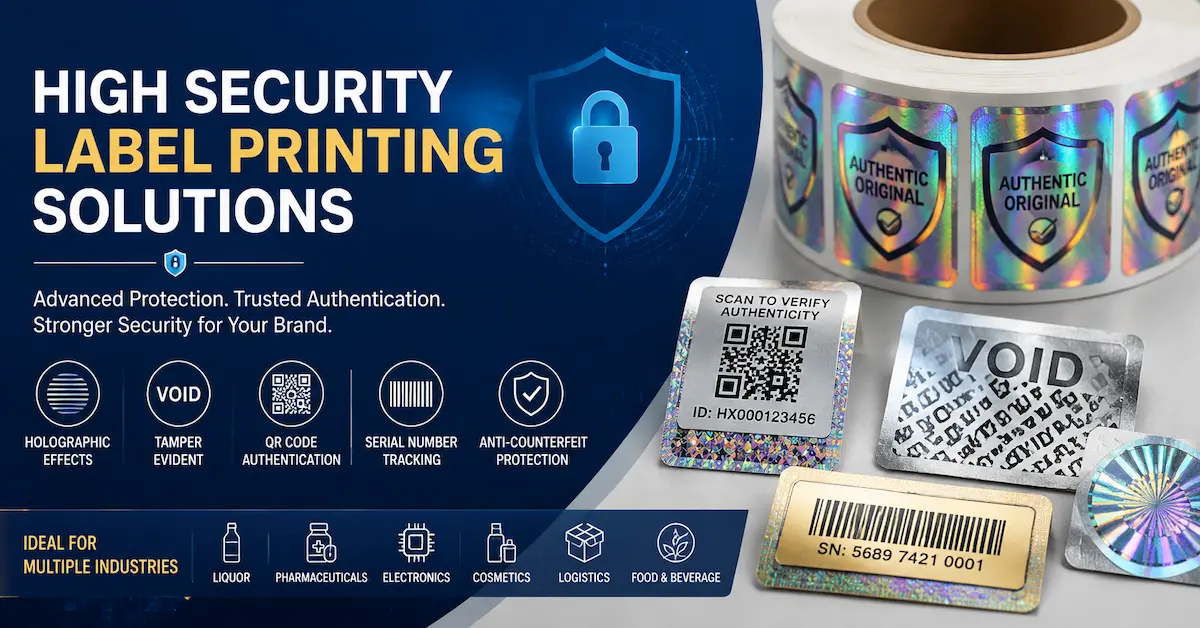

An anti counterfeit label manufacturer should deliver more than visually attractive security stickers. For brand owners, packaging converters, and procurement managers, the real challenge is ensuring that holographic effects, tamper-evident structures, variable codes, and finished labels consistently match an approved specification across production batches.
A security label may look convincing in a sales sample but become ineffective if its optical pattern changes, adhesive performs poorly, QR codes cannot be read, or die-cutting dimensions vary during mass production.
The most reliable way to qualify an anti counterfeit label manufacturer is to evaluate three things: an approved functional sample, measurable production acceptance criteria, and documented controls for releasing finished batches.
This guide explains how B2B buyers can establish these requirements, compare security label constructions, inspect manufacturing quality, and prepare a technically complete request for quotation.
For a starting point, explore the HX Security Label product catalog.
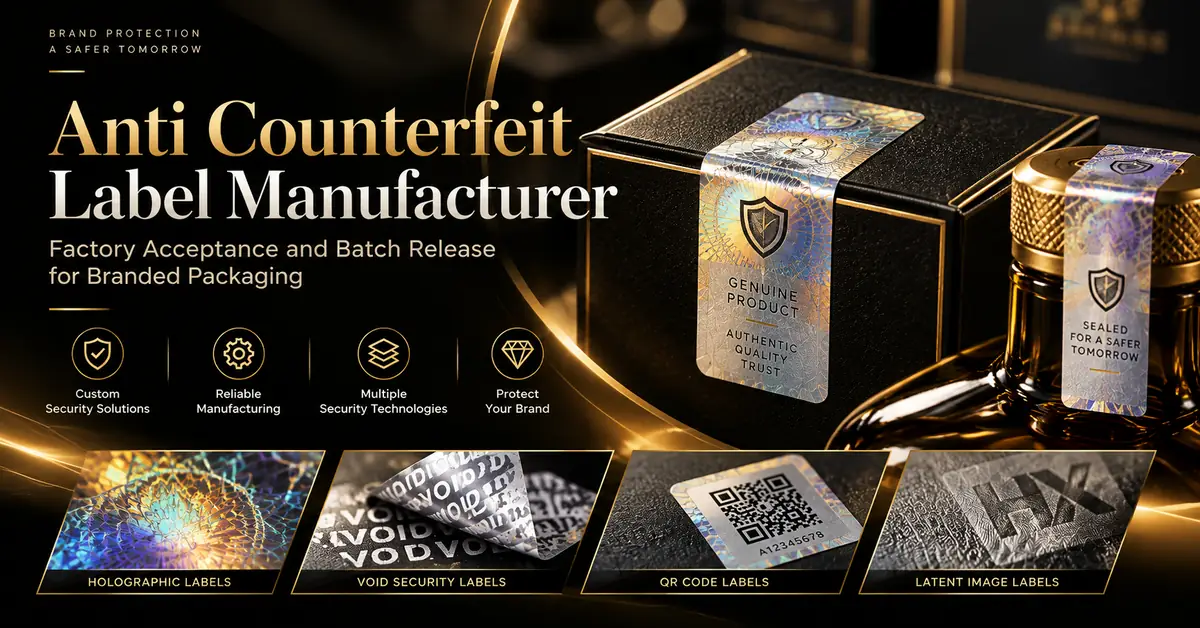
Why Factory Acceptance Matters for Anti-Counterfeit Labels
Unlike ordinary decorative labels, anti-counterfeit labels may perform several security functions simultaneously.
A holographic feature provides a recognizable optical effect. A VOID structure reveals removal. A hidden feature supports controlled inspection. Serialized identification connects a physical item to a defined data record.
These functions can fail independently.
For example, a label with accurate printing may still be unsuitable if its tamper-evident adhesive does not behave correctly on the actual packaging surface.
Similarly, a perfectly readable QR code does not establish authenticity unless the connected verification process and data controls are appropriate.
What Does Factory Acceptance Mean?
Factory acceptance is the process of confirming that manufactured labels meet the buyer's approved product specification before shipment or release for packaging production.
It should address:
-
Correct security design and artwork.
-
Consistency of optical and hidden security features.
-
Material and adhesive suitability.
-
Dimensional accuracy and die-cutting quality.
-
Tamper-evidence performance, where applicable.
-
QR code or serial-number accuracy.
-
Roll or sheet compatibility with packaging operations.
-
Traceability and repeat-order consistency.
The purpose is to identify discrepancies before thousands of labels enter a production line.
Which Security Label Construction Should Your Manufacturer Produce?
Before establishing quality checks, buyers must define the security function required.
The European Union Intellectual Property Office's Anti-Counterfeiting Technology Guide (2021) outlines multiple approaches to intellectual-property protection, including physical markers, electronic identification, and other security technologies.
For packaging buyers, different technologies should be treated as complementary options rather than interchangeable products.
| Security label type | Primary function | Important factory acceptance check | Typical application |
|---|---|---|---|
| Holographic label | Visual authentication | Approved optical effect and appearance | Cosmetics, electronics, luxury packaging |
| VOID security label | Removal evidence | Defined tamper pattern after peeling | Product closures, warranty points |
| Latent image label | Secondary verification | Hidden feature visible under intended conditions | Brand protection and distributor inspection |
| Serialized security label | Individual identification | Code accuracy and sequence integrity | Equipment, consumer products |
| QR authentication label | Digital information access or verification | Scan quality and data destination | Retail goods and export packaging |
| Combined security label | Multiple defined security functions | Independent verification of each feature | Higher-risk branded products |
Not every manufacturer offers every construction, and not every label requires multiple security features.
An appropriate design begins with a clear understanding of the expected threat and verification process.
Explore the HX Holographic Label category and VOID Open Label category to review relevant product directions.
What Should Be Included in a Security Label Manufacturing Specification?
A written manufacturing specification turns a security concept into something that can be inspected consistently.
Without it, different suppliers may quote different materials, production processes, or security features under the same general product name.
Recommended Technical Specification Table
| Specification area | Information to define |
|---|---|
| Product application | Cosmetics carton, electronics housing, bottle closure, industrial product |
| Security objective | Authentication, tamper evidence, identification, or combined protection |
| Label dimensions | Finished width, height, shape, and allowable tolerances |
| Face material | Specified film, paper, or alternative construction |
| Adhesive system | Compatibility with the actual product surface |
| Security features | Hologram, latent pattern, VOID message, serial code, or QR code |
| Printing | Artwork, colors, text, registration, and security graphics |
| Variable data | Code format, numbering rules, and ownership responsibilities |
| Application method | Manual or automatic |
| Supply format | Roll or sheet; winding direction, core, and spacing where relevant |
| Application environment | Temperature, humidity, abrasion, condensation, and storage |
| Acceptance criteria | Approved samples, inspection methods, and defect classification |
These fields are recommended procurement requirements, not fixed specifications for all products.
Why Should Buyers Approve Both Artwork and Functional Samples?
A digital artwork proof confirms layout, text, color placement, and graphic positioning.
A functional sample confirms how the finished construction behaves.
For example, approving a VOID label's graphic design does not confirm whether its removal pattern will appear correctly on a varnished carton.
Likewise, approving a hologram image does not confirm whether the finished optical effect matches expectations under normal inspection lighting.
Both approvals should be documented.
How to Qualify an Anti Counterfeit Label Manufacturer Before Production
A practical approval process can be divided into six quality gates.
Gate 1: Confirm the Security Requirement
Define what the label must accomplish.
Should it help customers recognize a genuine brand package? Reveal unauthorized opening? Discourage intact transfer? Support digital identity verification?
Identify who will inspect the label and how that person should recognize a suspicious result.
This requirement determines the appropriate security construction.
Gate 2: Approve the Master Sample
Obtain representative samples that demonstrate the intended design and security response.
For a holographic label, retain a reference showing the approved optical appearance.
For a VOID label, record both the intact label and the expected result after removal.
For serialized labels, include examples of finished printed codes and corresponding approved data.
Gate 3: Validate the Actual Packaging Surface
Test on the intended carton, plastic enclosure, glass bottle, metal surface, or other product material.
A label that performs correctly on a smooth demonstration panel may behave differently on a coated or textured production surface.
Record application conditions and inspect samples after the relevant bonding and handling periods.
Gate 4: Check the First Production Output
Before full-scale production, compare initial manufactured labels against the approved master sample.
Check printing, optical effects, dimensions, die cutting, material construction, and any variable information.
If discrepancies appear, resolve them before the manufacturing run continues.
Gate 5: Conduct In-Process Quality Checks
Quality inspection should continue during production rather than occur only at the end.
Relevant checkpoints may include print registration, security-feature appearance, die-cut positioning, code readability, and roll presentation.
The frequency of checks should be agreed according to the product's risk and manufacturing process.
Gate 6: Approve Finished Batch Release
Before shipment, confirm that the batch meets its agreed acceptance criteria.
Review the finished label appearance, functional performance, quantity, packaging format, and any required inspection records.
A successful initial sample is not sufficient evidence that every subsequent production batch will perform identically.
How Do Materials and Adhesives Affect Security Label Quality?
Material compatibility is fundamental to anti-counterfeit label performance.
Depending on the selected construction, a security label may use a polymer film, specialty paper, optical layer, pressure-sensitive adhesive, release coating, and protective liner.
Each component has a different function.
For example, the face material influences appearance and handling. The adhesive affects bonding. A controlled-release structure determines the intended tamper-evident response.
Important Application Surfaces
| Surface | Potential concern | Recommended validation |
|---|---|---|
| Coated paperboard | Varnish and coating compatibility | Adhesion and surface appearance |
| Corrugated carton | Roughness and paper-fiber strength | Bonding and removal behavior |
| Plastic housing | Polymer type and surface texture | Adhesive compatibility |
| Glass bottle | Curvature and condensation | Edge lifting and security response |
| Painted metal | Coating compatibility | Adhesion and finish integrity |
| Flexible packaging | Movement and deformation | Label stability during handling |
For pressure-sensitive constructions, ASTM D3330/D3330M-04(2025) describes methods for evaluating peel adhesion.
However, adhesive peel strength alone does not determine whether a tamper-evident security feature performs correctly.
Buyers should combine appropriate adhesive measurements with application-specific security-function testing.
How Should Holographic and VOID Security Features Be Inspected?
Different security functions require different inspection procedures.
Holographic Security Features
A holographic label may contain angle-dependent patterns, optical effects, microtext, or other specialized visual elements.
Inspectors should compare finished labels against the approved reference under defined lighting and viewing conditions.
Useful checks include optical consistency, graphic alignment, surface defects, and whether the intended feature can be recognized.
VOID and Tamper-Evident Structures
A VOID security label is intended to produce visible evidence when removed.
Its expected response may involve full transfer, partial transfer, non-transfer, or another engineered material change.
Buyers should specify exactly what the inspector must observe.
A label that removes without the required security response may fail its primary purpose even when the printed appearance is flawless.
Hidden Authentication Features
Latent images and other controlled-verification elements require an agreed inspection method.
The supplier and buyer should document who performs the check, which observation conditions are necessary, and what constitutes an acceptable result.
Review the HX Latent Image Label category for this type of security-label application.
How Can Manufacturers Control QR Codes and Serial Numbers?
Digital identification introduces an additional quality-control requirement: the relationship between the physical label and its data.
A manufacturer may print codes accurately while the underlying data remains incomplete, duplicated, or incorrectly assigned.
Buyers should therefore define both print-quality controls and data controls.
Recommended Variable-Data Checks
-
Confirm the approved code format and intended application.
-
Define how unique numbers are generated and allocated.
-
Verify that printed information matches the approved data.
-
Establish how rejected or unused codes are handled.
-
Check finished code readability on the actual label material.
-
Confirm the correct verification destination or database process, where included.
-
Retain agreed records for batch identification and reconciliation.
GS1's barcode-quality guidance emphasizes factors such as symbol size, contrast, positioning, quiet zones, and printing defects.
For applicable two-dimensional barcode symbologies, ISO/IEC 15415:2024 provides methods for measuring and grading symbol print quality.
A code that scans successfully with one smartphone has not necessarily passed a complete production-quality verification process.
Also, a printed QR code alone does not prove that a product is authentic. Any authentication claim must be supported by the relevant verification system and security design.
For related identification applications, explore HX's Other Uses Label category.
How to Classify Security Label Defects Before Batch Release
A practical quality agreement should distinguish between defects that undermine security and those that primarily affect appearance.
The following is an illustrative classification framework, not a universal acceptance standard.
| Defect level | Example | Recommended response |
|---|---|---|
| Critical | Required VOID pattern fails; wrong authentication data; missing essential security feature | Hold affected material and investigate |
| Major | Unreadable code; substantial die-cut misalignment; incorrect roll orientation | Reject, rework, or disposition under agreed procedures |
| Minor | Small cosmetic variation that does not affect approved security or functional requirements | Evaluate against agreed limits |
Acceptance limits and sampling plans should be approved before production.
A quality system should also define how nonconforming material is identified, segregated, investigated, and prevented from being mixed with approved stock.
For security labels, incorrect data or security features can be more consequential than ordinary cosmetic printing defects.
What Affects Production Cost, MOQ, and Lead Time?
Choosing the lowest unit price is not always the most economical purchasing decision.
Security-label cost can be influenced by:
-
Custom holographic design and tooling.
-
Security-film and adhesive construction.
-
Printing complexity and color requirements.
-
Variable-code generation and inspection.
-
Label dimensions and die-cutting requirements.
-
Sample development and functional testing.
-
Order quantity and converting format.
-
Quality documentation and packaging requirements.
Lead time can also change according to artwork revisions, material availability, sampling requirements, and production scheduling.
There is no reliable universal MOQ or production timeline for every customized security-label construction.
For more information, see HX's guide to custom label manufacturing lead times.
Why Does Total Procurement Cost Matter?
An inexpensive label may create additional costs if it cannot be applied reliably or fails the required security inspection.
Potential consequences include packaging downtime, rejected batches, manual rework, wasted materials, and delayed shipment.
Buyers should therefore compare suppliers based on approved specifications and total implementation requirements—not price alone.
What Should Buyers Ask Before Approving Repeat Orders?
Repeat orders require careful change control.
A manufacturer may have produced an acceptable first batch, but later changes to materials, artwork, coatings, variable data, or die-cutting can affect performance.
Before placing a repeat order, confirm:
-
Is the original approved construction still being used?
-
Have any materials or security features changed?
-
Does the artwork match the current authorized revision?
-
Are new serial-number ranges properly controlled?
-
Are roll specifications unchanged?
-
Will the same functional acceptance criteria apply?
-
What inspection records will accompany the shipment?
These questions are particularly important for distributors, packaging converters, and brands sourcing labels for multiple markets.
Working With HX Security Label on Custom Manufacturing Projects
HX Security Label is operated by Shenzhen Huaxin Anti-Counterfeiting Technology Co., Ltd., a China-based company specializing in anti-counterfeiting label research, development, production, and customized security solutions.
Established in 2008, the company presents a portfolio covering holographic labels, VOID-related labels, latent image labels, wine tax stamp-related products, and other security applications.
Its published service process includes requirements confirmation, design drafting, product proofing, material selection, sample confirmation, and logistics.
These stages provide a starting point for developing a documented custom security-label project.
For buyers evaluating an anti counterfeit label manufacturer, the next step should be to define the application-specific acceptance requirements before requesting a production quotation.
What to Include in Your RFQ
| Required information | What to provide |
|---|---|
| Product application | Industry and finished packaging type |
| Security objective | Authentication, tamper evidence, serialization, or combination |
| Packaging substrate | Material, finish, coating, and application position |
| Label specification | Dimensions, artwork, and desired security features |
| Application process | Manual or automated labeling |
| Quality requirements | Functional tests, reference samples, and acceptance criteria |
| Quantity | Sample, initial order, and repeat-order estimate |
| Data requirements | Code format and verification-system responsibilities |
| Delivery requirements | Destination and requested project schedule |
For further background, review HX's company information.
Request a Custom Anti-Counterfeit Label Quotation
Share your packaging specifications, intended security function, estimated order quantity, and quality requirements to discuss suitable options and sample evaluation.
Frequently Asked Questions About Anti Counterfeit Label Manufacturers
1. What does an anti counterfeit label manufacturer do?
An anti counterfeit label manufacturer develops and produces security labels for product authentication, tamper evidence, identification, and brand protection. Depending on its capabilities, production may involve holographic effects, specialized printing, security films, custom graphics, and variable codes. Buyers should confirm which functions are available for their specific project.
2. What is the difference between a security label manufacturer and a regular label printer?
A regular label printer primarily focuses on information, decoration, and identification. A security label manufacturer may also develop engineered features that support authentication, tamper evidence, or controlled verification. The key distinction is whether the finished label provides the specified security function and can be manufactured consistently.
3. How can buyers verify anti-counterfeit label manufacturing quality?
Buyers should compare production samples against approved references, inspect critical security functions, verify dimensions and printing, and review relevant production records. Where adhesive behavior or digital identification is involved, those functions should be tested separately under defined conditions.
4. Which anti-counterfeit label is best for premium packaging?
The appropriate choice depends on the identified risk. Holographic designs can support visual authentication, while VOID constructions can provide evidence of opening. Premium brands may combine visual and physical features when justified, provided that the finished design is compatible with the packaging.
5. Can anti-counterfeit labels include customized logos?
Custom graphics, text, shapes, and security patterns may be available depending on the selected construction. Buyers should supply artwork and define security requirements before approving samples. The manufacturer should confirm that customization does not compromise the intended security effect.
6. Are holographic labels impossible to counterfeit?
No security label should be described as impossible to reproduce. Holographic features can increase design complexity and provide recognizable optical details, but effective protection depends on the selected technology, verification procedures, and appropriate controls against duplication or reuse.
7. Can anti-counterfeit labels work with automatic packaging machines?
Selected constructions may be suitable for automated labeling when supplied in compatible formats. Buyers should confirm roll direction, core dimensions, label spacing, liner properties, and dispensing requirements. Production-line trials can identify compatibility problems before bulk purchasing.
8. How are QR code security labels inspected?
Inspection should address symbol readability, printed data accuracy, sequence control where applicable, and the intended verification process. If the project uses GS1-compliant symbols, the relevant GS1 requirements should be followed. Scannability alone does not guarantee a secure authentication system.
9. What information affects MOQ and manufacturing lead time?
Order quantity, materials, security complexity, custom tooling, artwork approval, variable-data requirements, sample development, and production scheduling may affect MOQ and lead time. These terms should be confirmed after the project requirements have been defined.
10. How can I start a custom project with HX Security Label?
Prepare photographs or samples of your packaging, the required label dimensions, intended security effect, artwork, application method, estimated quantity, and quality requirements. Submit those details through the HX Contact Us page to discuss available solutions, sampling, and quotation requirements.
Conclusion
Selecting a reliable anti counterfeit label manufacturer requires more than reviewing product photographs or negotiating a competitive unit price. Successful B2B sourcing depends on clear security objectives, approved functional samples, material compatibility, production quality control, and documented batch acceptance.
Holographic features, VOID structures, latent images, and serialized labels each solve different security problems. Their value depends on whether the manufacturer can reproduce the intended function consistently and whether the buyer has a practical method for verifying it.
For packaging manufacturers, brand owners, and international procurement teams, a well-defined specification reduces uncertainty, supports more consistent repeat orders, and makes supplier quotations easier to compare.
HX Security Label offers a portfolio of custom anti-counterfeiting label solutions for businesses evaluating product authentication, packaging security, and brand protection.
Contact HX Security Label with your product application, security requirements, and estimated quantity to discuss an appropriate customized solution and sample evaluation.