

Selecting the right hologram security labels supplier is not simply about choosing a holographic sticker with an attractive rainbow effect. For brand owners, packaging manufacturers, and international procurement teams, the real challenge is combining visual authentication, digital identification, and tamper evidence without compromising packaging appearance or production efficiency.
Holographic security labels can incorporate custom optical designs, QR codes, serial numbers, and tamper-evident structures. However, these functions must be specified and tested individually. A QR code printed on reflective material may suffer scanning problems, while a holographic label without a suitable security adhesive may be removed without the intended evidence.
The best sourcing approach is to define what the label must protect, how customers will verify it, and which functional tests must pass before bulk production.
This guide explains how holographic security labels work, which configurations suit different industries, how to prevent scanning and adhesive problems, and what B2B buyers should request from a supplier.
Explore the HX Security Label holographic product collection for relevant security-label designs.
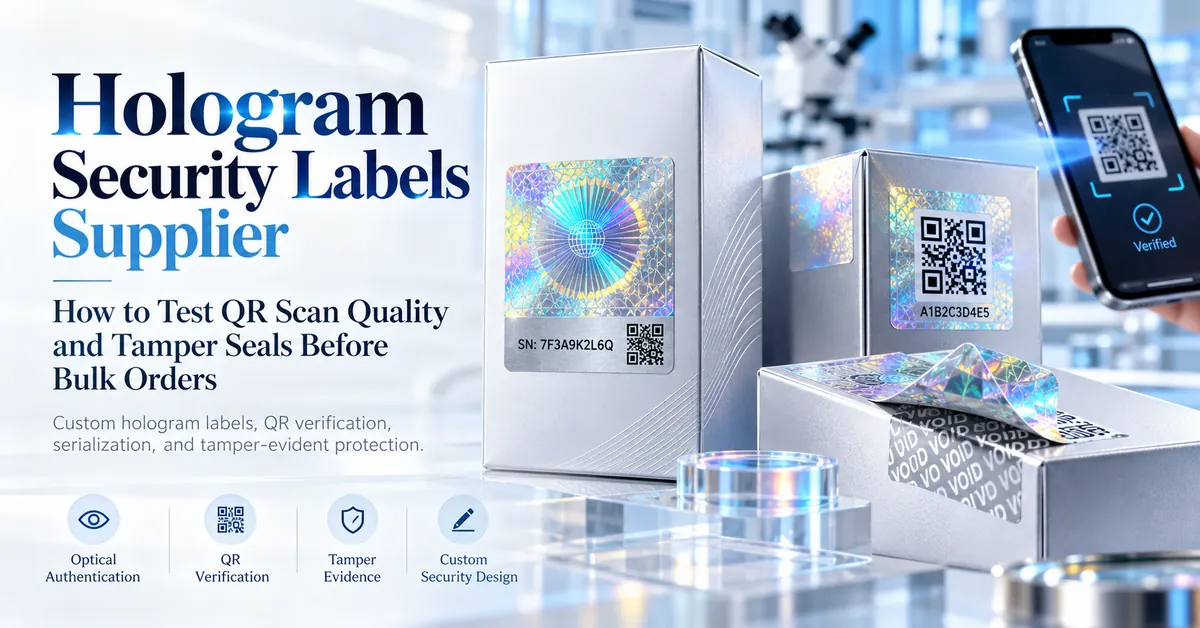
What Makes a Hologram Security Label Different From an Ordinary Sticker?
A hologram security label uses engineered optical features to create visual effects that ordinary printing cannot reproduce in the same way.
Depending on the design, these effects may include angle-dependent colors, diffractive patterns, fine security graphics, and recognizable brand-specific images.
The holographic feature can help inspectors compare a label against a genuine reference.
However, holographic appearance alone does not guarantee that the labeled product is authentic.
A complete security solution may require additional mechanisms.
Three Different Security Functions
1. Visual Authentication
The hologram provides a recognizable optical feature that can be inspected under appropriate lighting.
2. Digital Identification
A QR code or serial number can connect the label to product information, registration records, or a defined verification process.
3. Physical Tamper Evidence
A VOID, destructible, or other tamper-evident construction can reveal signs of label removal or packaging interference.
These functions should not be confused.
A standard QR code can be copied. A holographic label does not automatically indicate package opening. A VOID seal does not independently verify the product's manufacturing origin.
For higher-risk products, combining appropriate features can address different weaknesses within the same packaging program.
Which Businesses Benefit From Custom Hologram Security Labels?
Hologram security labels can serve a wide range of B2B applications, but requirements vary according to product value, packaging structure, and the people responsible for verification.
| Industry | Main security concern | Potential label configuration |
|---|---|---|
| Cosmetics and skincare | Counterfeit retail packaging | Custom hologram with optional QR verification |
| Electronics and accessories | Product identification and unauthorized opening | Hologram, serial number, and suitable tamper-evident structure |
| Wine and spirits | Package authenticity and closure interference | Holographic bottle seal with optional identification |
| Premium consumer products | Brand imitation and label copying | Brand-specific optical features and controlled verification |
| Industrial equipment | Unit identification and service access | Serialized hologram with an appropriate security seal |
| Healthcare packaging | Authentication and distribution control | Application-specific security labels with verified regulatory suitability |
| Packaging converters | Custom manufacturing and application compatibility | Hologram labels in approved roll or sheet formats |
When Is a Basic Hologram Enough?
A basic hologram may be appropriate when the primary objective is recognizable visual branding or a supplementary authentication cue.
When Is a Multi-Layer Label More Appropriate?
A combined construction is worth evaluating when the project must address several separate risks, such as product imitation, copied identification codes, unauthorized package opening, and label reuse.
Not every business needs the most complicated label.
The preferred design should match the actual risk and the intended verification procedure.
How Should Buyers Combine Holograms, QR Codes, and Tamper-Evident Features?
The first purchasing decision is choosing the correct security architecture.
A supplier should help clarify the relationship between the holographic layer, printed information, adhesive construction, and intended inspection method.
Compare Four Security Label Configurations
| Configuration | Main purpose | Key benefit | What must be tested |
|---|---|---|---|
| Custom hologram only | Visual authentication | Recognizable optical design | Hologram clarity and design consistency |
| Hologram + QR code | Optical and digital interaction | Visual inspection plus access to product information | QR readability and data destination |
| Hologram + unique serial number | Product-level identification | Individual unit reference | Number accuracy and duplicate control |
| Hologram + QR + tamper evidence | Multiple security functions | Combines identification and removal evidence | Optical quality, scanning, and tamper response |
A project may also incorporate covert features where the design and manufacturing capability support them.
The important requirement is that each feature has a clearly defined purpose.
For example, placing a QR code on a holographic label does not automatically create a secure authentication system. The digital verification process must be specified separately.
Why Can QR Codes Be Difficult to Scan on Holographic Labels?
One of the most important technical issues in custom holographic QR labels is the interaction between reflective material and printed barcode elements.
Holographic films are designed to reflect and diffract light.
QR codes, by contrast, depend on a scanner being able to distinguish the symbol's modules from its background.
If the code is positioned over an unsuitable optical pattern, glare or insufficient contrast may reduce reliable decoding.
Five Factors That Affect QR Scan Performance
1. Contrast
The printed QR code should provide sufficient visual contrast against its background.
For many applications, a dark code on a suitable light, nonreflective area offers a more predictable starting point than a symbol printed directly over strong metallic effects.
2. Quiet Zone
A QR code needs a clear margin around the symbol so a reader can distinguish it from surrounding artwork.
For standard QR codes, the quiet-zone requirement is generally four modules on each side.
3. Code Size
The physical size must be appropriate for the data density, print process, and intended scanning distance.
A highly detailed code printed too small can become difficult to read.
4. Surface Curvature
Labels applied to small cylindrical bottles or curved containers may distort the printed symbol.
5. Protective Finishes
Laminates, coatings, scratches, wrinkles, or strong surface reflections can influence readability.
What Standards Should Buyers Reference?
GS1's 2D Barcode Colour & Quality Guide (2025) explains the importance of color selection, quiet zones, print contrast, and symbol verification.
ISO/IEC 15415:2024 provides methods for measuring and grading the print quality of two-dimensional barcode symbols.
These references are useful when establishing inspection procedures, but the appropriate requirements depend on the barcode format and intended application.
A successful scan with one smartphone is not sufficient evidence that every finished label will perform reliably.
Practical Design Recommendation
For a holographic QR label, buyers should consider keeping the QR symbol within a clearly defined printing area with controlled background reflectivity.
The holographic feature can remain prominent elsewhere on the label without competing with the code's readability.
The final layout must be tested on actual printed samples under realistic lighting and scanning conditions.
What Role Do Unique Serial Numbers Play in Product Authentication?
A serial number identifies an individual label or product according to a defined numbering system.
When combined with a QR code, it can support product registration, batch identification, warranty records, or other digital processes.
However, the printed code is only one part of the system.
A supplier and buyer should establish who generates the numbers, how duplicates are prevented, and which organization manages the corresponding records.
Important Data-Control Requirements
-
Define the code format and numbering rules.
-
Assign code ranges to the correct products or batches.
-
Prevent accidental duplicate printing.
-
Identify rejected or unused codes.
-
Verify printed codes against approved source data.
-
Control access to sensitive authentication records.
-
Confirm the function of any verification website or database.
A genuine code copied onto multiple counterfeit packages can still appear technically valid unless the broader verification system includes appropriate controls.
For a deeper discussion of serialized security-label sourcing, read HX's Unique QR Code Labels Supplier Guide.
How Do Tamper-Evident Hologram Labels Protect Packaging?
Holographic visual authentication and tamper evidence serve different purposes.
A conventional hologram can remain visually intact after removal if its adhesive and material structure permit it.
Therefore, buyers concerned about unauthorized opening or label transfer should evaluate a security construction specifically designed to reveal interference.
Common Tamper-Evident Options
VOID Transfer Construction
A security message or pattern appears when the label is removed. The evidence may remain on the protected surface, the lifted label, or both, depending on the design.
Destructible Construction
The label material breaks or fragments during removal, making intact lifting and reuse more difficult.
Security Closure Seal
The label is positioned across a package opening or joint so that accessing the protected area is likely to disturb the seal.
How Should Buyers Choose?
If the main risk is an opened retail carton, a properly positioned tamper-evident closure may be suitable.
If the risk is an authentic-looking label being removed and transferred to another product, an anti-transfer construction should be evaluated.
If the product must remain free from visible residue, the buyer should consider whether a non-transfer design would be more appropriate.
The supplier should confirm that the chosen tamper-evident structure can be combined with the required holographic design.
Explore the HX VOID Open Label category when evaluating physical tamper-evidence requirements.
How Do Packaging Materials Affect Hologram Label Performance?
A hologram security label should be specified for its actual application surface.
The same adhesive construction may behave differently on coated cartons, glass, plastic, and metal.
| Surface | Potential problem | Recommended evaluation |
|---|---|---|
| Coated paperboard | Varnish affects adhesive bonding | Adhesion and removal behavior |
| Corrugated carton | Surface texture limits contact | Edge adhesion and security response |
| Glass bottle | Condensation or curvature | Bonding and scan performance |
| Plastic enclosure | Polymer and surface treatment | Adhesive compatibility |
| Painted metal | Coating interaction | Surface integrity and label performance |
| Flexible packaging | Bending and deformation | Wrinkling, label stability, and code readability |
Selecting the Best Label Position
A suitable label position should allow the intended user to inspect the security feature without damaging the product.
For QR-enabled labels, scanning accessibility is also important.
Avoid positioning the QR code directly across sharp folds, heavily curved areas, or locations where the symbol will be obscured during normal use.
For tamper-evident seals, the position should correspond to the protected opening or access point.
A visually attractive location is not necessarily the most effective security position.
How to Test Hologram Security Labels Before Bulk Production
A professional sample-validation process should evaluate optical appearance, digital information, adhesive compatibility, and production application.
Step 1: Confirm the Security Objective
Define whether the label must support visual authentication, individual identification, tamper evidence, or several functions.
Document what the customer, distributor, or inspector should observe.
Step 2: Approve the Optical Design
Inspect the holographic features under the intended viewing conditions.
Confirm artwork, image clarity, brand graphics, color effects, and any specialized optical details.
Keep an approved reference sample.
Step 3: Verify QR Codes and Serial Numbers
Test the printed symbol using the intended scanning equipment.
Confirm the encoded information, number allocation, data destination, and relevant readability requirements.
For serialized production, inspect both printing quality and data accuracy.
Step 4: Evaluate Adhesion
Apply samples to the actual packaging material.
Record application conditions, adhesive bonding behavior, and any edge lifting or surface compatibility problems.
Step 5: Test the Tamper Response
If the design includes a tamper-evident feature, remove samples under a documented procedure.
Confirm that the required evidence appears clearly and consistently.
Step 6: Evaluate Handling and Storage
Assess the label under representative transportation, storage, and environmental conditions.
Relevant factors may include humidity, temperature variation, friction, and packaging deformation.
Step 7: Test the Production Format
If the buyer uses automatic labeling equipment, test representative rolls.
Check winding direction, liner compatibility, label spacing, dispensing, and positioning accuracy.
Only approve the final construction after the required security and application functions have been demonstrated on representative samples.
What Quality-Control Checks Should a Hologram Security Labels Supplier Perform?
The finished label must remain consistent with the approved sample.
Quality control should include both visual and functional requirements.
Recommended Inspection Matrix
| Quality item | What to verify |
|---|---|
| Holographic appearance | Optical effect matches the approved reference |
| Artwork accuracy | Correct logo, text, colors, and layout |
| QR readability | Symbol meets agreed scanning requirements |
| Serial-number accuracy | Printed data matches approved records |
| Adhesion | Suitable bonding under defined conditions |
| Tamper evidence | Required removal response appears |
| Die-cutting quality | Correct shape and dimensions |
| Label placement | Compatible with packaging or equipment |
| Roll presentation | Agreed winding, spacing, and liner |
| Batch consistency | Finished product matches approved construction |
These are recommended inspection categories, not universal pass/fail limits.
Buyers should agree on acceptance criteria, sample sizes, and defect classification before mass production.
A product with a perfect holographic appearance may still fail if the QR code is unreadable or the intended tamper response does not occur.
What Customization Options Should Buyers Discuss?
Custom hologram security labels may require coordination between optical design, printing, material selection, and packaging application.
Possible project requirements include:
-
Custom brand logos and holographic graphics.
-
Label dimensions and die-cut shapes.
-
Security text or fine graphical details.
-
QR codes and serial numbers.
-
Selected tamper-evident structures.
-
Suitable materials and adhesives.
-
Roll or sheet supply formats.
-
Additional controlled-verification features.
Not every combination is technically suitable.
For example, reducing the label size may leave insufficient space for an easily scanned QR code and its required quiet zone.
Similarly, the required tamper-evident construction may influence the material and converting options.
A supplier should confirm technical feasibility before final quotation and sample approval.
How to Compare Hologram Security Label Quotations
Unit price should not be evaluated independently from label construction and functional requirements.
The cost of a custom security label may be affected by the holographic design, material specification, adhesive construction, printing complexity, code serialization, custom tooling, order quantity, and production format.
A standard optical label and a custom serialized tamper-evident hologram may have significantly different development requirements.
What Should Your RFQ Include?
| RFQ information | Details to provide |
|---|---|
| Target product | Cosmetics, electronics, beverage, industrial product, etc. |
| Security objective | Authentication, tamper evidence, traceability |
| Holographic design | Logo, pattern, optical effect |
| QR requirements | Static or unique code, intended destination |
| Serial numbers | Format, quantity, data ownership |
| Surface material | Carton, glass, plastic, metal |
| Label dimensions | Size, shape, and application area |
| Application process | Manual or automatic |
| Supply format | Roll or sheet |
| Order quantity | Trial, first production, annual estimate |
| Quality requirements | Scan tests, optical inspection, adhesive testing |
| Destination | Shipping country or region |
What About MOQ and Lead Time?
MOQ and production lead time depend on the confirmed design, materials, tooling, and manufacturing requirements.
A custom hologram may require additional preparation compared with a standard design.
Projects involving serialized information or special tamper-evident structures may also require additional validation.
Buyers should request project-specific MOQ, sample timing, and production scheduling rather than assuming one universal figure.
Why Consider HX Security Label for Custom Holographic Projects?
HX Security Label, operated by Shenzhen Huaxin Anti-Counterfeiting Technology Co., Ltd., specializes in anti-counterfeiting label research, development, production, and customized security solutions.
Established in Shenzhen in 2008, the company presents a product portfolio that includes holographic labels, VOID-related labels, latent image labels, and digital identification technologies.
Its published service process covers requirements confirmation, design drafting, product proofing, material selection, sample confirmation, and delivery coordination.
These capabilities provide a starting point for discussing custom security-label projects with international B2B buyers.
For applications involving holographic graphics, QR identification, and tamper evidence, the appropriate combination must be confirmed against the actual product requirements.
How to Start a Custom Project
A useful first inquiry should explain:
-
What product or packaging needs protection.
-
Which security risks are most important.
-
Whether consumers or inspectors will scan a QR code.
-
Whether each product needs a unique identity.
-
Whether opening or label removal must leave visible evidence.
-
Which surface will receive the label.
-
How many labels are required.
-
Whether automatic labeling is used.
Buyers can review the HX product range and company information before submitting their project specifications.
Request Custom Hologram Security Label Samples or a Quotation
Provide your application details, artwork, desired security features, and estimated order quantity to discuss feasible construction options and sample requirements.
Frequently Asked Questions About Hologram Security Labels
1. What is a hologram security label?
A hologram security label incorporates an optical security feature that produces a recognizable visual effect. Depending on the design, it may also include printed graphics, QR codes, serial numbers, or tamper-evident materials. The specific security function depends on the finished construction.
2. Can holographic security labels include unique QR codes?
Yes, unique QR codes can be incorporated into suitable custom constructions when variable-data printing and code management are properly specified. Buyers should confirm feasibility, printed-code quality, data allocation, and the verification process before production.
3. Why combine a hologram with a QR code?
The hologram provides a physical visual feature, while the QR code can provide access to product information or a defined digital verification service. Their combination supports different inspection methods, but the QR code requires appropriate data controls to contribute meaningfully to authentication.
4. Can hologram security labels show evidence of tampering?
Yes, if they incorporate a suitable tamper-evident structure. A conventional hologram does not automatically provide removal evidence. Buyers should specify the intended VOID, destructible, or other security response and validate it on the actual packaging.
5. Which packaging materials are suitable for hologram stickers?
Potential surfaces include coated paperboard, glass, plastic, and metal. Suitability depends on the adhesive, material construction, surface treatment, and environmental conditions. Testing on representative packaging is recommended before approval.
6. How can buyers prevent QR code scanning problems?
Use adequate contrast, appropriate symbol dimensions, a clear quiet zone, and a suitable label position. Avoid excessive reflection or distortion near the QR symbol. Test finished printed samples under realistic scanning conditions.
7. Can custom hologram labels include company logos?
Custom logos and brand-specific security graphics are common design requirements. Buyers should submit artwork, dimensions, and expected optical effects. The supplier must confirm which graphics and security features can be combined in the chosen construction.
8. How should hologram security labels be stored?
Storage conditions should follow the approved material and adhesive specifications. Buyers should protect labels from unsuitable temperatures, moisture, contamination, and mechanical damage. Shelf life should be confirmed for the actual product rather than assumed from general industry figures.
9. What affects the cost of custom hologram security labels?
Major factors include holographic artwork, security features, materials, adhesive structure, dimensions, printing, serialization, tooling, and order quantity. A complete technical RFQ allows suppliers to provide more meaningful quotations.
10. How do I choose a reliable hologram security labels supplier?
Evaluate the supplier's technical understanding, sample development process, material compatibility, code management, quality-control procedures, and ability to reproduce the approved construction. Ask for application-specific samples and confirm commercial terms before bulk purchasing.
Conclusion
Selecting a reliable hologram security labels supplier requires more than choosing an attractive holographic design or comparing unit prices.
For brands facing counterfeit products, unauthorized packaging access, and product-identification risks, an effective security-label strategy must consider visual authentication, QR-code reliability, serialization controls, and tamper-evident performance as separate but potentially complementary functions.
The most important purchasing decisions involve selecting the appropriate security architecture, confirming compatibility with the actual packaging, validating samples, and establishing measurable quality requirements before production.
HX Security Label provides customized anti-counterfeiting label solutions for businesses evaluating holographic security, product identification, and packaging protection.
To discuss your project, contact HX Security Label with your label dimensions, packaging material, required security features, and estimated quantity to explore suitable options and request a quotation.
