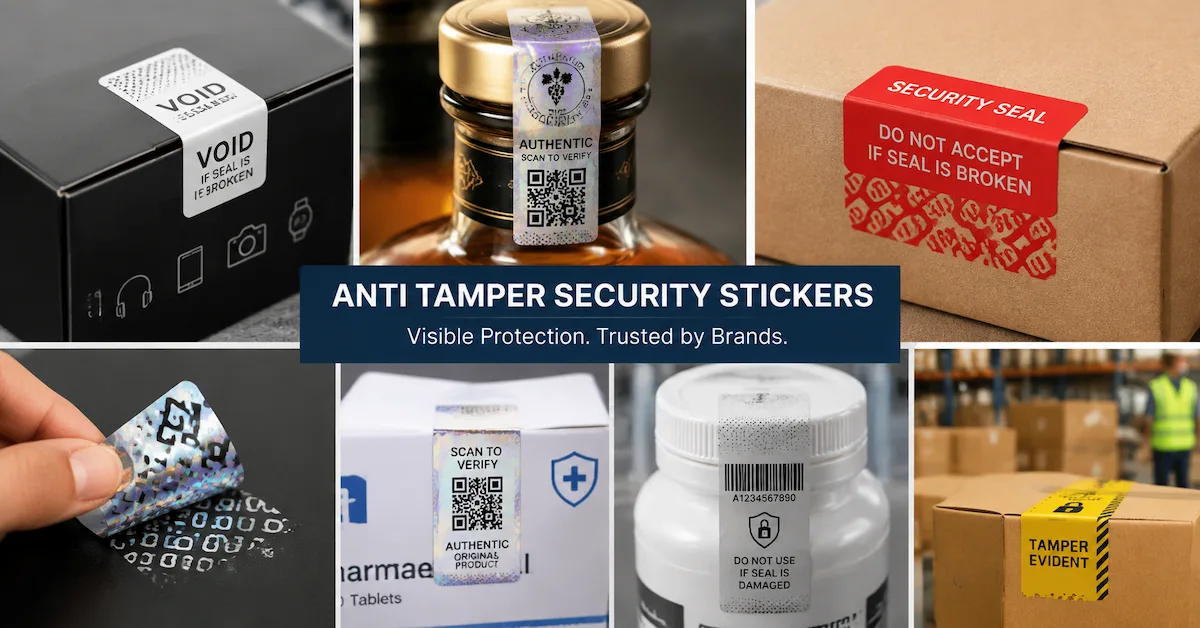

How Do You Choose a Custom VOID Labels Supplier?
A custom VOID labels supplier should help you create a tamper-evident label that performs correctly on your actual product, rather than simply placing your logo on a standard security sticker.
For brand owners, packaging engineers, electronics manufacturers, and OEM procurement teams, the critical decision is how the label behaves when someone attempts to remove it.
Should the word "VOID" appear on the packaging surface? Should the evidence remain inside the removed label? Must the product housing remain free from visible adhesive transfer? Does the label need to bridge a carton opening, protect an equipment access point, or carry a unique serial number?
These requirements influence the material construction, adhesive system, security pattern, artwork, dimensions, and testing process.
A visually attractive sample is not enough. The selected label must remain stable during normal handling and produce the intended evidence when removal occurs under the agreed test conditions.
The right custom VOID label is defined by three things: what it protects, how it reacts to removal, and how reliably that behavior can be reproduced.
Buyers evaluating customized solutions can begin with the VOID Open Label product category to understand the relevant product direction before discussing a specific construction.
This guide explains how to turn an initial security-label idea into an approved technical specification that a supplier can sample, quote, and manufacture.
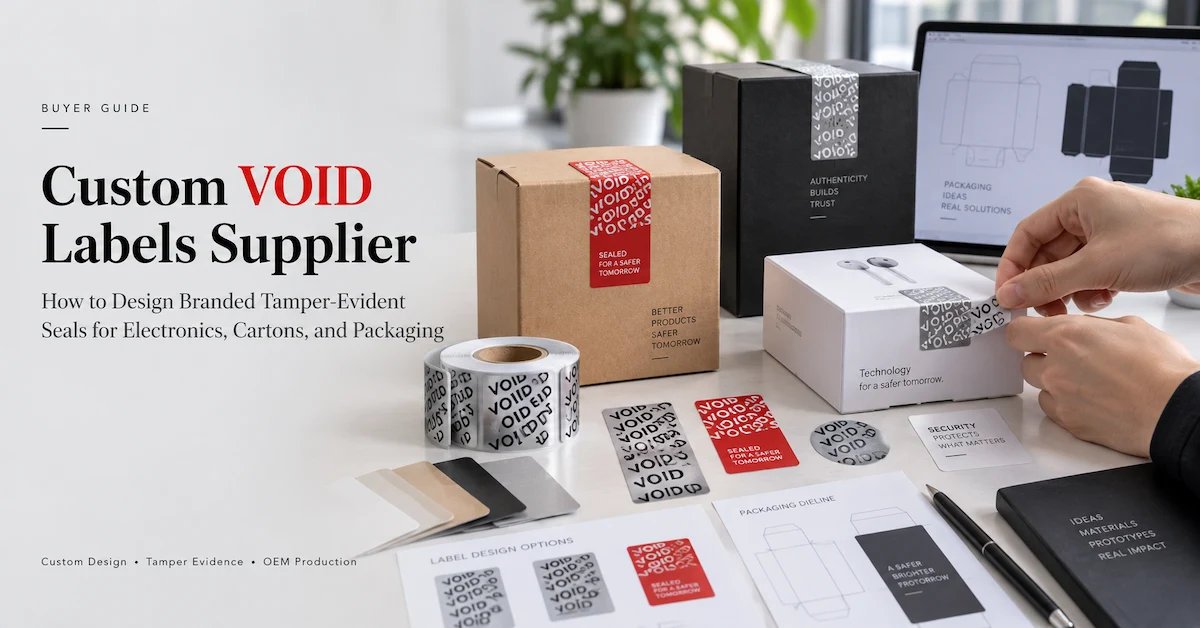
What Makes a Custom VOID Label Different From a Standard Security Sticker?
A standard security sticker typically uses an existing material, security message, and construction.
Customization may be limited to selecting a size or adding printed information.
A custom VOID label can involve more extensive design decisions, including:
-
Branded VOID messages or security patterns
-
Custom shapes and dimensions
-
Material and adhesive selection
-
Transfer or non-transfer tamper behavior
-
Printed logos and product information
-
Color and finishing requirements
-
Barcode or QR code integration
-
Variable serial numbers
-
Application-specific roll configurations
-
Controlled artwork and repeat-order specifications
The difference is important because changing the appearance of a label does not necessarily change its security performance.
For example, printing a company logo on standard VOID material may be sufficient for a straightforward carton-sealing application.
However, an electronics manufacturer using textured plastic housings may require a different construction to achieve the intended removal evidence.
A cosmetics brand may need a visually discreet seal that does not damage the appearance of premium packaging.
An industrial equipment manufacturer may require a compact tamper-evident label that fits a narrow access point and remains stable during storage and operation.
In these cases, customization becomes a technical development process rather than a purely graphic-design service.
When Is a Fully Customized Construction Necessary?
Not every application requires developing a new security material.
Buyers should consider a more specialized construction when:
-
Existing VOID materials do not work reliably on the application surface
-
The standard tamper message is unsuitable
-
Residue or surface appearance is critical
-
The label must fit an unusual closure or geometry
-
The project needs integrated physical and digital security
-
The security feature must match brand-specific artwork
-
Automatic application imposes special converting requirements
A capable supplier should recommend the simplest construction that meets the verified requirements.
Unnecessary complexity can increase development cost, approval time, and production risk without improving the security function.
Define the Intended Tamper Evidence Before Designing the Artwork
The first design decision should concern what the label must prove.
VOID labels are primarily tamper-evident products. Their purpose is to create a visible indication of removal or interference.
They should not be treated as a universal guarantee of product authenticity.
A custom VOID label may help identify that a protected area has been opened, but it does not automatically prove the contents are genuine or that no other form of interference occurred.
Before contacting suppliers, write a simple security objective.
For example:
"The label must provide clear evidence if the retail carton closure is opened."
Or:
"The warranty seal must show an irreversible change when removed from the approved equipment housing."
These statements are more useful than requesting a "high-security adhesive sticker."
They identify the expected result and allow the supplier to evaluate suitable constructions.
Four Questions That Determine the Design
1. What must be protected?
A carton closure, bottle cap, electronics housing, equipment panel, shipping package, or product identification area?
2. What action should trigger the security response?
Removal, opening, transfer, or another form of interference?
3. Who will inspect the result?
Consumers, warehouse operators, distributors, quality-control personnel, or after-sales service teams?
4. What evidence must remain?
A message on the original surface, a changed label, a transfer pattern, fragmentation, or a combination?
The answers establish the foundation for material selection, artwork development, and sample approval.
Which Custom VOID Label Construction Should You Choose?
VOID materials can be designed to create different responses during removal.
The general categories include transfer, partial-transfer, and non-transfer constructions.
Some projects may also use destructible materials or combine tamper evidence with holographic features.
The terminology can vary among suppliers, so buyers should define the expected result rather than relying only on a product name.
Full-Transfer VOID Labels
Full-transfer constructions are generally intended to leave substantial visible security evidence on the original application surface.
For example, a message or pattern may remain on a carton after the label has been removed.
This can be useful when inspectors need to identify tampering even if the original label is missing.
Potential applications include shipping cartons, retail packages, and selected equipment seals.
The main purchasing question is whether the transferred evidence is appropriate for the surface.
A visible message may be acceptable on a disposable carton but undesirable on a finished consumer product.
Partial-Transfer VOID Labels
Partial-transfer constructions distribute visible evidence between the original surface and the removed label.
Their purpose is to create a recognizable change without necessarily transferring the entire security pattern.
The exact effect depends on the material structure.
Buyers should test whether the result remains clear under ordinary inspection conditions.
Non-Transfer VOID Labels
Non-transfer designs are intended to reveal the main security message within the label while leaving the protected surface comparatively cleaner.
These may be suitable for certain electronics housings, coated surfaces, or premium products where visible residue is undesirable.
However, non-transfer should not automatically be interpreted as zero adhesive residue under every condition.
The actual result depends on the adhesive, substrate, dwell time, and removal conditions.
Destructible Security Labels
Destructible labels use materials intended to break into fragments during removal.
They are often considered when preventing intact label transfer is more important than leaving a conventional VOID message.
Their performance and inspection requirements differ from transfer-type VOID films.
Comparison of Custom Tamper-Evident Constructions
| Construction | Intended security behavior | Suitable purchasing scenario | Main point to verify |
|---|---|---|---|
| Full-transfer VOID | Evidence remains on the application surface | Carton closures, packaging seals | Message visibility and residue acceptance |
| Partial-transfer VOID | Evidence appears across label and surface | Selected branded packaging | Clarity and consistency of the pattern |
| Non-transfer VOID | Evidence appears mainly in the removed label | Finished housings, premium packaging | Surface condition and irreversible label change |
| Destructible label | Material fragments during removal | Warranty points, anti-transfer applications | Fragmentation and normal-use stability |
| Holographic VOID combination | Optical authentication with tamper indication | Branded products needing layered security | Both optical appearance and tamper response |
The best construction depends on the inspection objective, not on which material appears most sophisticated.
How Can You Customize the VOID Message and Security Pattern?
The visible security message is one of the most recognizable features of a custom VOID label.
Common examples include:
-
VOID
-
OPEN
-
Custom security text
-
Repeating geometric patterns
-
Brand-specific messages
-
Selected symbols or graphic elements
Some projects may require a custom message to match a product, inspection procedure, or brand identity.
However, designing a custom VOID message involves more than choosing the words.
Message Visibility
The message should be sufficiently recognizable when the label is removed under the agreed conditions.
Its appearance may depend on:
-
Message size
-
Pattern density
-
Contrast
-
Material structure
-
Label dimensions
-
Background surface
-
Viewing conditions
A complex message that is difficult to read may provide less practical value than a clear, simple pattern.
Message Position
The buyer should consider where the security evidence will appear after removal.
If the label crosses a carton closure, the location of the message can influence inspection.
A label applied to a small equipment access point may require a compact pattern.
Custom Text and Language
International brands may want a message in a particular language.
The supplier should confirm whether the requested message is technically feasible within the selected construction.
Very small or complicated artwork may be unsuitable for certain security-pattern designs.
Security Pattern vs. Printed Decoration
A printed company name and a functional VOID message are not necessarily produced by the same process.
Buyers should distinguish the visible printed design from the tamper-evident layer.
Approving the printed artwork does not mean the security message has passed functional testing.
Both elements should be evaluated independently.
How Should Brand Logos and Security Artwork Be Integrated?
For branded products, the VOID label may also be part of the packaging design.
A security label that looks inconsistent with the product can undermine the visual presentation, particularly for cosmetics, electronics, premium beverages, and high-value consumer goods.
The design must balance appearance and security.
Keep the Security Feature Functional
A logo, background color, or printed graphic should not interfere with the visibility of the tamper response.
Depending on the construction, printing location and finishing may influence the final appearance.
The supplier should check compatibility between artwork and security material before approving production files.
Define the Visual Hierarchy
A label may include:
-
Brand logo
-
Product information
-
Security indication
-
Serial number
-
QR code
-
Batch information
Not every element needs equal visual emphasis.
For consumer-facing packaging, the logo may be prominent while the technical information remains secondary.
For industrial applications, identification and readability may be more important than decorative effects.
Prepare Production-Ready Artwork
Useful artwork information includes:
-
Vector logo files
-
Required colors
-
Finished label dimensions
-
Text content
-
Layout direction
-
Printing requirements
-
Die-cut shape
-
Variable-data position
If exact brand colors are important, the buyer should define the approved reference or color requirements.
A PDF preview is useful for layout approval, but it does not replace physical sample confirmation.
Why Material and Adhesive Selection Are Critical
The correct security pattern cannot compensate for an unsuitable adhesive.
For VOID labels, adhesive behavior influences both normal-use stability and the response during removal.
A label must remain attached during intended use without generating false tamper evidence.
At the same time, it must produce the required irreversible change when removal occurs under the approved test conditions.
These are separate performance requirements.
Surface Compatibility
Custom VOID labels may be applied to:
-
Coated paperboard
-
Corrugated cartons
-
PET packaging
-
PP or PE plastics
-
ABS or PC housings
-
Glass
-
Painted metal
-
Powder-coated surfaces
-
Flexible packaging films
-
Textured materials
Different materials can affect bonding and removal.
Coatings, dust, contamination, curvature, and surface texture may also influence performance.
A supplier should not assume that a label tested on smooth glass will behave identically on coated paperboard or textured plastic.
Dwell Time
Pressure-sensitive adhesives may develop their bond over time.
A label tested immediately after application may behave differently after an agreed dwell period.
This matters when evaluating VOID activation.
The buyer and supplier should specify when the removal test will be performed.
Application and Service Conditions
Application temperature and service temperature should be considered separately.
A label applied inside a controlled factory may later experience cold storage, humidity, transportation, or temperature changes.
Material selection should reflect the real product lifecycle.
Peel Adhesion Is Not the Same as Tamper Performance
Peel-adhesion testing can help evaluate bonding behavior.
For reference, ASTM International's ASTM D3330/D3330M-04(2025) addresses peel adhesion of pressure-sensitive tapes under defined testing conditions.
Such methods can contribute to material evaluation and quality assurance.
However, a peel-force result does not independently prove that a VOID message will appear correctly.
A complete approval process must also test the intended tamper response.
Match the Custom VOID Label to the Actual Packaging Surface
One of the most important responsibilities of a custom VOID labels supplier is determining whether the proposed construction works on the intended product.
Consider the following application-specific questions.
| Application surface | Main engineering concern | What should be tested |
|---|---|---|
| Coated carton | Coating and adhesive interaction | VOID message visibility after removal |
| Corrugated board | Roughness and inconsistent contact | Adhesion and tamper-response reliability |
| PET packaging | Surface condition and curvature | Bonding and security activation |
| PP/PE plastic | Lower surface-energy challenges | Application stability and removal behavior |
| Glass bottle | Curvature, moisture, condensation | Seal stability and tamper evidence |
| Painted metal | Coating compatibility | Residue, finish protection, removal response |
| Textured housing | Reduced bonding contact | Edge lifting and irreversible evidence |
| Flexible packaging | Movement and deformation | Security stability during normal handling |
This matrix is intended to guide testing, not to prescribe a universal adhesive.
The final construction should be approved on the actual packaging material whenever possible.
Why Packaging Samples Are Valuable
A small sample of the intended substrate can answer questions that photographs cannot.
It allows the supplier to observe:
-
Surface texture
-
Coating
-
Curvature
-
Available bonding area
-
Label position
-
Removal response
For higher-risk projects, supplying the actual carton, bottle, device housing, or finished component can reduce uncertainty.
Design the Label Around the Opening Point
A security label can be technically correct but poorly positioned.
For example, a small VOID label placed on the side of a carton may provide branding without protecting the carton-opening seam.
The label should be located where interference with the protected area is likely to affect the seal.
Important design considerations include:
-
Closure geometry
-
Seam position
-
Bonding area on both sides
-
Label size and shape
-
Folding or curvature
-
Normal package movement
-
Application tolerances
-
Inspection visibility
A label that crosses two surfaces may experience different stresses on each side.
For bottle closures or curved equipment housings, the geometry may influence whether the material conforms correctly.
The supplier should evaluate placement together with material construction rather than treating position as a separate packaging decision.
Custom VOID Labels for Different B2B Applications
The following examples illustrate how requirements can differ by industry. They are application-design scenarios, not claims about completed customer projects.
Electronics Warranty Seals
An electronics manufacturer may need a small VOID label over a housing seam or access point.
The primary goal is to create evidence of unauthorized opening.
Important requirements include:
-
Housing material
-
Label placement
-
Residue acceptance
-
Available bonding area
-
Expected service conditions
-
Warranty inspection method
A non-transfer or destructible structure may be evaluated where preserving the product finish matters.
If each device also needs an identifier, a serial number or QR code may be added as a separate function.
For more detailed application considerations, review the custom warranty security sticker guide.
Retail Carton Security
A packaging company may need customized seals for coated cosmetic or electronics cartons.
The buyer wants evidence of opening while preserving the brand's visual design.
A transfer-type VOID construction may be appropriate if a visible message on the carton is acceptable.
The supplier should test the exact coating and label placement.
A label that performs on unfinished paperboard may behave differently on a laminated retail package.
Industrial Equipment Access Points
An equipment manufacturer may need a compact security seal over a service panel.
Potential concerns include:
-
Painted or textured metal
-
Long-term storage
-
Handling and vibration
-
Maintenance procedures
-
Surface appearance after removal
The supplier should understand which access point is protected and how service personnel will interpret the tamper result.
Premium Consumer Packaging
A premium brand may want a discreet security label that provides opening evidence without dominating the product design.
Possible requirements include custom dimensions, restrained colors, a brand logo, and controlled removal behavior.
If visible product authentication is also important, a holographic feature may be considered.
However, optical authentication and tamper evidence should have separate acceptance criteria.
Logistics and Distribution Packaging
For shipping cartons, clarity and consistency may matter more than sophisticated graphics.
Inspectors need to recognize whether a closure has been disturbed.
The supplier should evaluate carton material, handling conditions, label placement, and the visibility of the security message.
In high-volume operations, roll format and application-line compatibility may also be critical.
Can Custom VOID Labels Include QR Codes, Barcodes, or Serial Numbers?
Yes, certain custom security-label constructions can combine physical tamper evidence with machine-readable or human-readable identification.
The two functions should be specified independently.
VOID function: Creates visible evidence of removal or interference.
Identification function: Connects the label with a product, batch, warranty record, or other information.
A project may require:
-
Unique QR codes
-
Sequential serial numbers
-
Randomized identifiers
-
Batch numbers
-
Barcodes
-
SKU information
-
Matching human-readable data
However, not every supplier that prints variable data also provides database hosting or digital authentication software.
Buyers should clarify the exact scope.
Data-Control Questions
Who generates the identifiers?
Are the codes unique?
Who checks duplicates?
How are rejected labels handled?
Can reprints use the same identifier?
How are future orders prevented from duplicating previous data ranges?
What system will verify the QR code?
These questions help avoid confusion between printing services and a complete authentication system.
For additional technical detail, see the unique QR code label supplier guide.
A printed QR code alone should not be described as complete anti-counterfeit protection because visible codes may be copied.
Digital identity and physical security should work together when both are required.
What Should a Capable Custom VOID Labels Supplier Provide?
Supplier capability should be evaluated through the decisions the supplier can support.
A useful evaluation separates design capability, technical capability, proofing, manufacturing control, and commercial support.
1. Requirement Analysis
The supplier should ask what the label protects, how the packaging opens, who inspects it, and what evidence is required.
A recommendation made without discussing these questions may not address the real risk.
2. Security Construction Selection
The supplier should explain which tamper-evident structures are relevant to the project.
It should also identify where the proposed material may have limitations.
3. Custom Artwork Development
The supplier should be able to discuss logo positioning, security messages, printing constraints, artwork revisions, and approval requirements.
4. Material and Adhesive Evaluation
The supplier should ask about the actual substrate, coating, surface texture, environmental conditions, and application method.
5. Physical Proofing
A representative physical sample should be available for evaluation before commercial approval.
6. Production Control
The supplier should explain how approved dimensions, artwork, material construction, and security behavior are controlled.
7. Repeat-Order Management
Future orders should reference the approved specification and any authorized changes.
These capabilities are more meaningful than a generic statement that a supplier offers customized products.
From Design Brief to Approved Sample: A Practical Development Workflow
Custom security-label projects are more manageable when each approval stage has a defined purpose.
Step 1: Establish the Security Requirement
Identify what the label must reveal and how the result will be inspected.
Avoid starting with a preferred material unless the application has already been validated.
Step 2: Define the Packaging
Record the surface, coating, dimensions, curvature, closure location, and handling conditions.
Provide packaging photographs or physical samples.
Step 3: Choose a Candidate Construction
Compare relevant VOID transfer, non-transfer, or destructible options.
Document the intended tamper response.
Step 4: Develop the Artwork
Prepare the logo, printed content, dimensions, and other design elements.
Confirm whether any custom security message or additional feature is technically feasible.
Step 5: Produce Physical Samples
Samples should represent the intended material and construction as closely as practical.
A decorative mock-up should not be accepted as proof of functional security performance.
Step 6: Test on the Real Product
Apply the label using the intended method.
Observe normal-use behavior and perform agreed removal tests on separate samples.
Document the results.
Step 7: Approve and Control the Specification
Once the construction meets the agreed requirements, establish the approved version.
The record should identify material, adhesive, dimensions, artwork, security effect, and supply format.
If any critical element changes later, determine whether new testing is required.
This approach reduces the risk of approving a label based only on appearance.
How Should Custom VOID Label Samples Be Tested?
A good testing plan separates appearance, application, and security performance.
These functions should not be combined into one subjective judgment.
Visual Inspection
Confirm:
-
Label dimensions
-
Shape
-
Printed text
-
Logo placement
-
Color
-
Die-cut alignment
-
Security-pattern appearance
-
Variable-data readability, if applicable
Application Testing
Apply the sample to the intended surface.
Check whether it conforms correctly, whether edges lift, and whether handling causes unwanted changes.
Tamper-Response Testing
Use separate samples to evaluate removal.
Record whether the expected message, transfer pattern, or irreversible change appears.
The result should be compared with a defined acceptance reference.
Environmental Evaluation
Where relevant, repeat appropriate tests after representative exposure to:
-
Storage
-
Humidity
-
Condensation
-
Temperature variation
-
Transport handling
-
Abrasion
-
Product movement
Not every project needs every environmental test.
The test plan should match realistic conditions and purchasing risks.
Production-Line Testing
For automatic application, confirm dispensing and placement with a representative roll or pilot quantity.
A hand-applied sample does not prove that a label will run successfully on production equipment.
Suggested Custom VOID Label Approval Matrix
The following matrix can help buyers and suppliers establish a shared approval record.
| Approval item | Suggested evidence | Main acceptance question |
|---|---|---|
| Artwork | Approved design file | Is the correct version used? |
| Dimensions | Drawing and measured sample | Does it fit the intended location? |
| Material | Construction reference | Is the selected material approved? |
| Adhesion | Application test | Does the label remain stable during normal use? |
| VOID message | Removal-test sample | Is the intended evidence clearly visible? |
| Surface condition | Post-removal inspection | Is the remaining residue or marking acceptable? |
| Environmental behavior | Relevant exposure tests | Does normal use preserve the intended function? |
| QR or barcode | Scan and data checks | Are codes readable and correctly matched? |
| Roll presentation | Machine or format review | Is it compatible with the application process? |
| Sample approval | Signed or otherwise controlled record | Can production be compared with this reference? |
Specific tolerances and pass/fail limits should be agreed for each project.
There is no single universal test result that proves all VOID constructions work correctly on all surfaces.
Should You Use International Test Standards?
Standards can support a structured evaluation, but they must be relevant to the claim being made.
ASTM D3330/D3330M-04(2025) addresses peel adhesion of pressure-sensitive tapes. It may support suitable adhesive testing but does not independently certify VOID message performance.
ISO 22383:2020 provides guidance on selecting and evaluating authentication solutions for material goods based on authenticity and integrity requirements.
Its risk-based approach is relevant when a buyer is combining tamper evidence with broader product-authentication features.
Neither standard should be presented as proof that a particular supplier or label has passed testing unless that has been independently documented.
Custom VOID Label Production: What Happens After Sample Approval?
After the sample has been approved, the supplier must reproduce the agreed construction.
For procurement teams, the key concern is consistency.
Production requirements may include:
-
Correct material
-
Approved adhesive construction
-
Approved VOID message
-
Consistent printing
-
Accurate dimensions
-
Die-cut quality
-
Correct liner and roll configuration
-
Variable-data accuracy
-
Quantity control
-
Protective packaging
Quality control should reflect the label's intended function.
For example, checking print appearance alone would not adequately verify a tamper-evident label.
A buyer should also confirm how material substitutions, artwork revisions, or production changes are managed.
Why an Approved Construction Reference Matters
Consider a company ordering the same custom warranty label for several years.
The logo and dimensions may remain unchanged while materials or manufacturing processes evolve.
If the supplier cannot identify the approved construction, later orders may behave differently.
A controlled reference should include the critical specifications necessary for repeat production.
This helps buyers avoid confusion when placing orders for different product models, packaging versions, or markets.
Roll and Sheet Specifications for OEM Packaging Lines
Custom VOID labels may be supplied as sheets, individual pieces, or rolls depending on the application.
For manual application, the buyer should consider ease of handling and label removal from the liner.
For automatic labeling, the converting specification becomes more important.
Relevant parameters can include:
-
Core diameter
-
Maximum roll diameter
-
Winding direction
-
Label orientation
-
Web width
-
Label gap
-
Label pitch
-
Release liner
-
Quantity per roll
-
Machine sensor compatibility
The supplier should receive the packaging-line requirements before final quotation.
Otherwise, a label that meets the security specification may still be unsuitable for the customer's application equipment.
Roll and liner approval should be treated as part of the complete product specification.
OEM and Private-Label Projects: Who Owns the Design?
Custom security labels may contain confidential artwork, security patterns, product identifiers, or other sensitive information.
Before development begins, buyers should clarify responsibilities.
Questions include:
-
Who owns the original logo and artwork?
-
Who develops the final print-ready file?
-
Who approves changes?
-
Who may access security artwork?
-
How are obsolete designs handled?
-
Who owns serialized data?
-
How are rejected or unused labels controlled?
-
How are repeat-order files stored and identified?
The commercial agreement should reflect the project requirements.
For multi-brand packaging companies, artwork control is particularly important because different customers may require separate designs and security features.
A supplier that can organize these responsibilities helps reduce the risk of incorrect artwork, unauthorized revisions, and product-identification errors.
MOQ, Pricing, and Lead Time for Customized VOID Labels
Customization affects more than appearance.
It may also influence setup work, material availability, sample development, production efficiency, and inspection.
What Affects MOQ?
Minimum order quantity may depend on:
-
Standard or specialized VOID material
-
Custom security pattern
-
Label dimensions and shape
-
Printing requirements
-
Adhesive construction
-
Variable data
-
Die cutting
-
Roll configuration
A buyer should not assume that every customized VOID label has the same minimum quantity.
Request a quotation based on the actual specification.
What Affects Price?
Custom VOID label pricing can reflect material cost, construction complexity, printing, tooling, data preparation, inspection, quantity, and packaging.
A lower unit price does not necessarily indicate better commercial value.
If the sticker performs poorly on the intended surface, replacement and rework costs may exceed the initial savings.
For additional cost considerations, review the custom security label pricing guide.
What Affects Lead Time?
A first-time custom project may require:
-
Requirements analysis
-
Artwork development
-
Material selection
-
Physical proofing
-
Testing
-
Sample approval
-
Production
-
Inspection
-
Shipping
Repeat orders may follow a different schedule when the approved construction is unchanged.
Buyers should clarify when the quoted lead time begins and which approval stages are included.
How to Prepare a Complete RFQ for a Custom VOID Labels Supplier
An effective request for quotation should communicate the required performance, not just the requested price.
A useful technical brief can include the following information.
| RFQ field | Information to provide |
|---|---|
| Industry | Electronics, packaging, equipment, cosmetics, logistics |
| Protected product | Product name or general description |
| Security objective | Opening detection, anti-transfer, warranty control |
| Application surface | Material, coating, texture |
| Label position | Carton seam, housing, bottle closure, access point |
| Label size | Width, height, shape |
| VOID construction | Transfer, partial-transfer, non-transfer, or supplier recommendation |
| Tamper message | VOID, OPEN, custom text or pattern |
| Residue requirement | What may remain on the product surface |
| Artwork | Logo, colors, text, design files |
| Additional features | Serial number, QR, barcode, holographic element |
| Environment | Temperature, humidity, storage, transport |
| Application method | Manual or automatic |
| Supply format | Roll, sheet, or individual labels |
| Quantity | Samples, trial order, initial bulk order |
| Forecast | Expected repeat-order demand |
| Timeline | Target sample approval and delivery dates |
| Acceptance | Required visual and functional tests |
Buyers do not need to know every technical answer before submitting the inquiry.
If the construction or adhesive is unknown, describe the required result and ask the supplier for a recommendation.
Example RFQ for an Electronics Project
Application: Warranty seal for an electronic control unit
Surface: Textured ABS plastic housing
Security objective: Visible evidence of unauthorized opening
Preferred design: Custom logo and compact VOID message
Removal requirement: Irreversible tamper indication; surface residue to be evaluated
Identification: Printed product serial number
Application: Manual during assembly
Order plan: Physical samples followed by an initial production order
Environment: Indoor use, warehouse storage, normal transportation
Supplier request: Recommend a suitable construction and sample-testing plan
This type of inquiry allows a supplier to respond with relevant technical questions and a clearer quotation.
How to Compare Custom VOID Label Supplier Proposals
When several suppliers provide quotations, use a common evaluation framework.
The purpose is to compare equivalent requirements rather than different products that happen to carry the same name.
| Evaluation area | Strong proposal should explain | Potential concern |
|---|---|---|
| Security function | Expected tamper result and inspection method | Generic claim of being tamper-proof |
| Material selection | Why the construction fits the surface | No questions about substrate |
| Customization | Artwork and pattern feasibility | Assumes every design works unchanged |
| Sampling | What the physical proof will validate | Artwork approval only |
| Quality control | How approved behavior is checked | Appearance inspection only |
| Variable data | Code and revision responsibilities | Unclear data ownership |
| Production format | Roll or sheet specifications | No application-machine discussion |
| Commercial terms | MOQ, scope, milestones, delivery | Unclear quotation assumptions |
| Repeat supply | Version and material control | No approved construction reference |
A supplier does not need to offer every available security technology.
It needs to demonstrate that the selected construction is appropriate for the project and that production can follow the approved specification.
How HX Security Label Approaches Customized Security Projects
HX Security Label is the brand of Shenzhen Huaxin Anti-Counterfeiting Technology Co., Ltd., based in Shenzhen, China.
According to the company's published background and production information, Huaxin was established in February 2008 and specializes in the research, production, and sales of anti-counterfeiting labels.
The company reports 40 anti-counterfeiting patents, including four invention patents, and more than 60 anti-counterfeiting technologies.
Its public product portfolio covers holographic labels, VOID Open Labels, latent-image labels, and other customized security-label applications.
HX describes a six-stage development and delivery process:
Requirements Confirmation: Understanding the customer's intended application and technical needs.
Design Draft: Preparing the proposed security artwork and design.
Product Proof: Producing physical proofs for review.
Material Selection: Selecting materials appropriate to the application requirements.
Sample Confirmation: Obtaining approval of the final sample and security features.
Logistics & Packaging: Preparing and delivering the finished labels.
This workflow provides a relevant framework for custom security-label projects.
However, availability of a particular VOID transfer construction, custom message, adhesive, minimum quantity, or additional digital feature should be confirmed for the individual application.
Buyers should provide their actual packaging details and desired tamper response rather than assume that one construction is suitable for every product.
Frequently Asked Questions About Custom VOID Labels
1. What Is a Custom VOID Labels Supplier?
A custom VOID labels supplier provides tamper-evident adhesive labels designed around specific customer requirements.
Customization may involve size, shape, branding, security messages, materials, adhesives, variable data, and supply format.
The supplier should also help determine whether the proposed construction works on the intended packaging surface.
For B2B projects, physical sample testing and approved production specifications are important parts of the purchasing process.
2. Can VOID Labels Be Customized With My Company Logo?
Yes, depending on the construction and printing process.
Custom VOID labels may include a company logo, product information, colors, text, or identification details.
The supplier should confirm whether the artwork is compatible with the security material and whether printing affects the intended VOID visibility.
Branding and security performance should both be evaluated during sample approval.
3. Can I Create a Custom VOID Message Instead of the Standard Word?
Some projects may support customized text or patterns.
The feasibility depends on the selected security construction, message complexity, label dimensions, and manufacturing method.
The buyer should provide the proposed wording and describe the required result after removal.
A physical sample is important because a design that looks clear in artwork may not produce the same readability as a functional tamper-evident message.
4. What Is the Difference Between Transfer and Non-Transfer VOID Labels?
Transfer-type constructions are designed to leave visible evidence on the original surface after removal.
Non-transfer constructions generally reveal the main evidence within the removed label, leaving the application surface comparatively cleaner.
The appropriate choice depends on the substrate, residue requirements, and inspection method.
Neither construction should be selected solely by its name; buyers should compare physical samples on the actual product.
5. Are Custom VOID Labels Suitable for Electronics Warranty Seals?
VOID labels are commonly considered for electronics warranty and access-point protection.
However, the best construction depends on the housing material, available label area, expected removal evidence, and product environment.
Some devices may require a non-transfer or destructible construction.
Buyers should test the selected material on the actual housing before approving mass production.
6. Can Custom VOID Labels Work on Glass, Plastic, and Metal?
They may be designed for different surfaces, but performance is not identical across all materials.
Glass, PET, PP, ABS, coated paperboard, painted metal, and textured surfaces can create different adhesive and removal behavior.
A qualified supplier should ask for application details and recommend physical testing.
A label that works on one substrate should not automatically be approved for another.
7. Do Custom VOID Labels Leave Adhesive Residue?
The result depends on the construction, adhesive, substrate, and removal conditions.
Some transfer-type labels are designed to leave visible evidence on the surface.
Non-transfer designs aim to reveal the main message within the label itself.
However, the term "non-transfer" should not be interpreted as a guarantee of absolutely residue-free removal under every condition.
Buyers should specify what remaining marks are acceptable.
8. Can QR Codes or Serial Numbers Be Added to VOID Labels?
Certain custom constructions can include QR codes, barcodes, or serial numbers.
These elements can support product identification, warranty management, or traceability.
The supplier and buyer should define code generation, uniqueness, inspection, and repeat-order responsibilities.
A printed QR code alone does not guarantee product authenticity.
The physical tamper-evident function and digital verification process should be evaluated separately.
9. How Do I Test Custom VOID Label Samples?
Apply representative samples to the actual product or packaging surface.
Check appearance, adhesion, normal-use stability, and the intended tamper response.
Where relevant, evaluate performance after representative storage, humidity, temperature, or handling conditions.
For automated applications, confirm dispensing and roll compatibility.
The approved test result should become part of the production specification.
10. What Is the MOQ for Custom VOID Labels?
MOQ depends on the material, security construction, artwork, size, printing requirements, variable data, and converting format.
A standard material with simple customization may have different production requirements from a specialized construction.
Buyers should provide their expected sample, trial, and production quantities.
The supplier can then discuss a project-specific MOQ rather than relying on an unsupported universal minimum.
11. How Much Do Custom VOID Labels Cost?
Cost is influenced by material, adhesive, label size, security pattern, customization, printing, tooling, quantity, inspection, and packaging format.
More complex designs or additional data requirements may involve extra preparation and verification.
Buyers should compare proposals using the same technical specification.
A low-priced label that fails on the intended surface can create greater costs through rejected stock or production rework.
12. How Long Does Custom VOID Label Production Take?
Lead time varies with design complexity, material availability, sampling, approval, production quantity, inspection, and shipping.
A first-time custom project may require additional development and testing.
A repeat order using an unchanged approved construction may follow a different schedule.
Buyers should clarify when the quoted lead time begins and which stages are included.
13. Are Custom VOID Labels Completely Tamper-Proof?
No tamper-evident label should be assumed to prevent every possible form of interference.
VOID labels are designed to create observable evidence of removal or opening under defined conditions.
Their effectiveness depends on the construction, substrate, application, and inspection procedure.
For higher-risk projects, additional security features may be appropriate.
The objective should be a clearly defined and verifiable tamper-evidence function rather than an absolute security claim.
14. What Information Should I Send to a Custom VOID Labels Supplier?
Provide the protected product, security objective, application surface, label position, dimensions, preferred removal effect, artwork, order quantity, and environmental conditions.
If codes or serial numbers are required, include the data requirements.
For automatic application, provide the necessary roll specifications.
Packaging photographs or physical samples can help the supplier recommend a suitable construction and prepare a more accurate quotation.
Conclusion
Choosing a custom VOID labels supplier requires matching the tamper-evident construction, branded artwork, adhesive, and removal behavior to the real product. The most important purchasing step is approving functional samples on the intended surface before production.
For electronics, packaging, warranty, and industrial applications, buyers should define the expected VOID effect, provide material and artwork details, and agree on quality criteria.
Explore HX VOID Open Label solutions and request a custom VOID label quotation with your packaging specifications, application photos, preferred security effect, and order quantity.