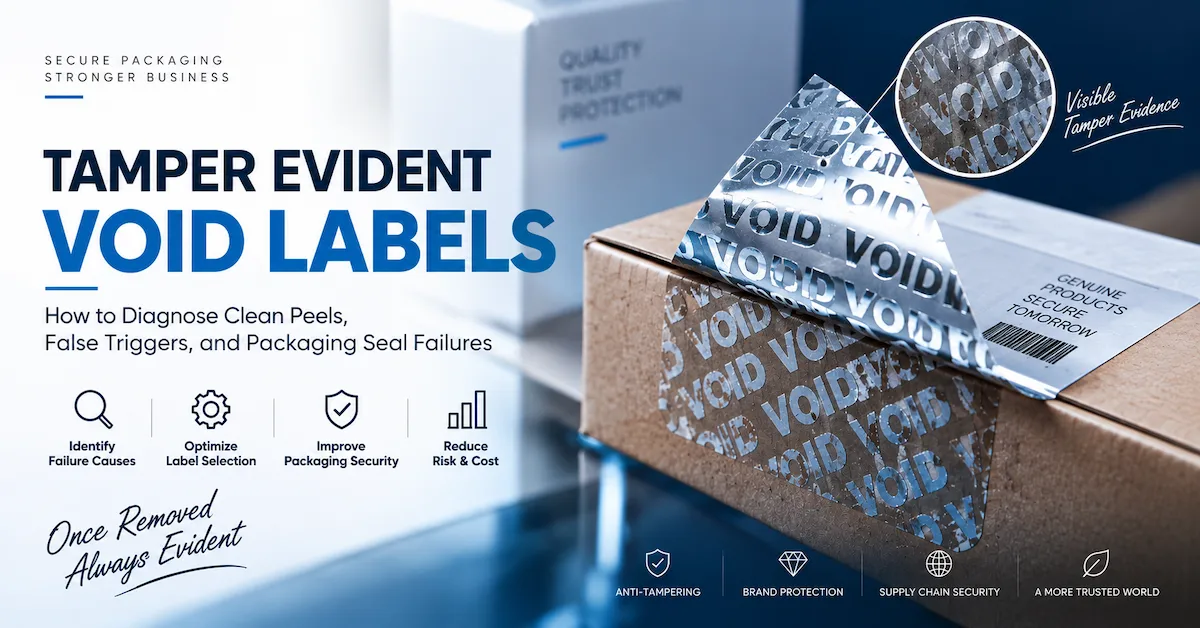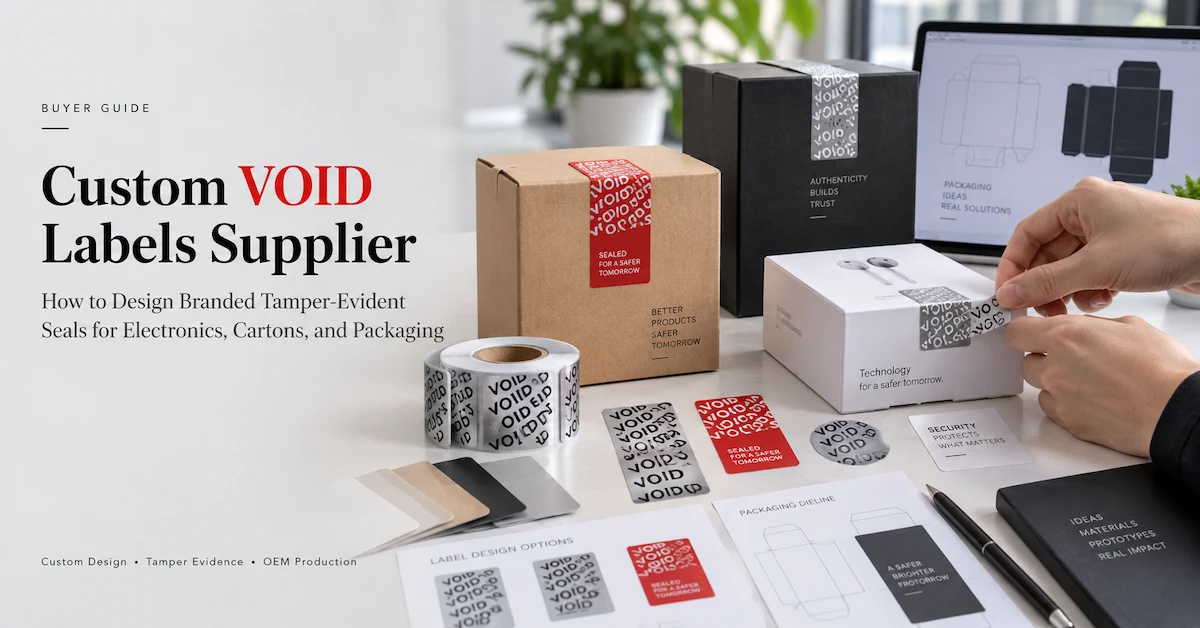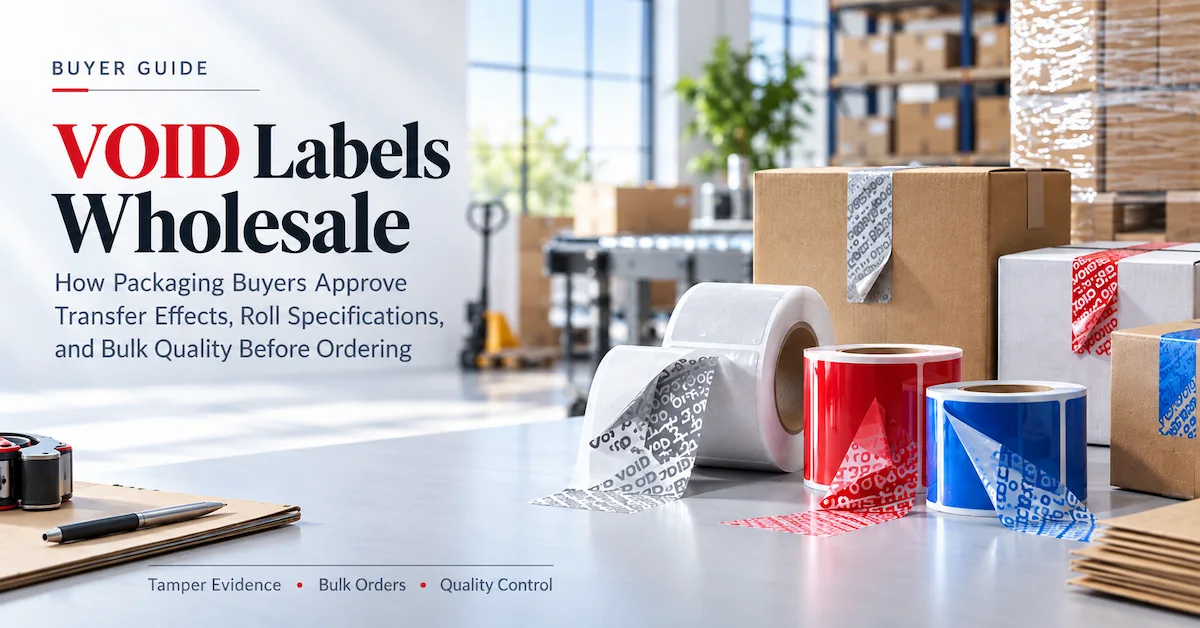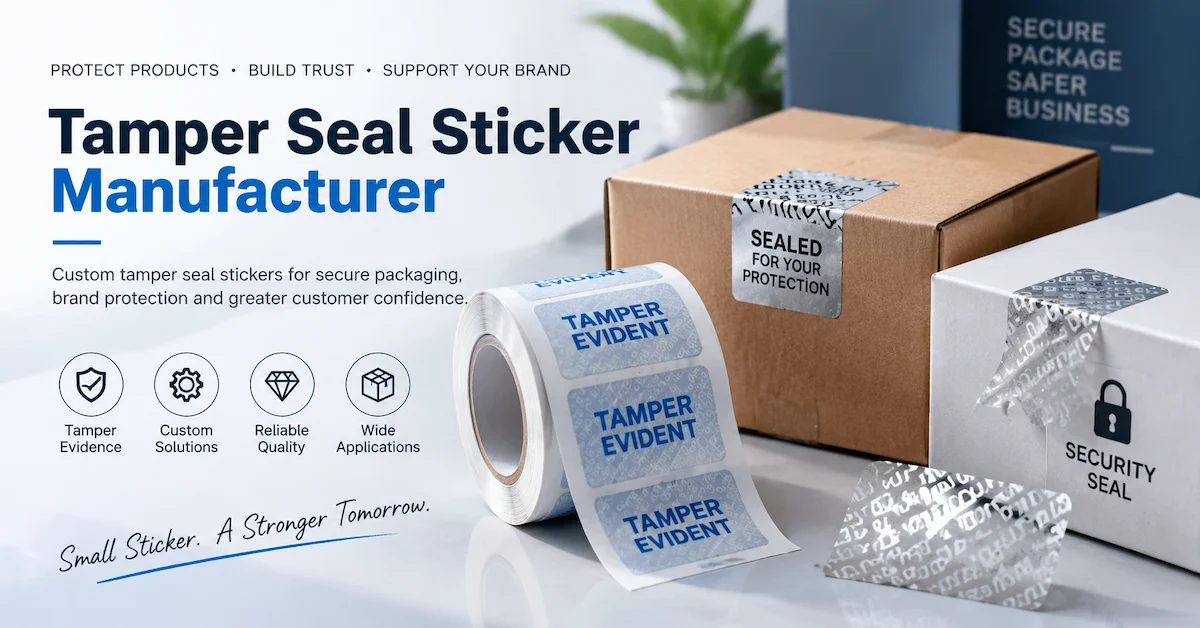

A full transfer VOID label is a tamper-evident label designed to leave a visible security pattern, message, or other intended evidence on the original application surface when the label is removed. For manufacturers, brand owners, packaging companies, and international buyers, this transfer behavior can make unauthorized opening easier to identify during inspection.
However, choosing a full transfer VOID label is not simply a matter of selecting a sticker that leaves a mark. The transfer effect must be compatible with the packaging surface, the label's intended function, the normal handling environment, and the way inspectors will recognize tampering.
A construction that works well on a disposable carton may not be suitable for a finished electronics housing or premium consumer product. Buyers must also distinguish between full transfer, partial transfer, non-transfer, and destructible security constructions before requesting quotations.
This guide explains the technical and commercial considerations involved in sourcing full transfer VOID labels. It is intended for B2B procurement teams, packaging engineers, electronics manufacturers, brand protection managers, distributors, and businesses developing custom security-label programs.
For an overview of available security products, visit the HX Security Label product catalog.
What Is a Full Transfer VOID Label?
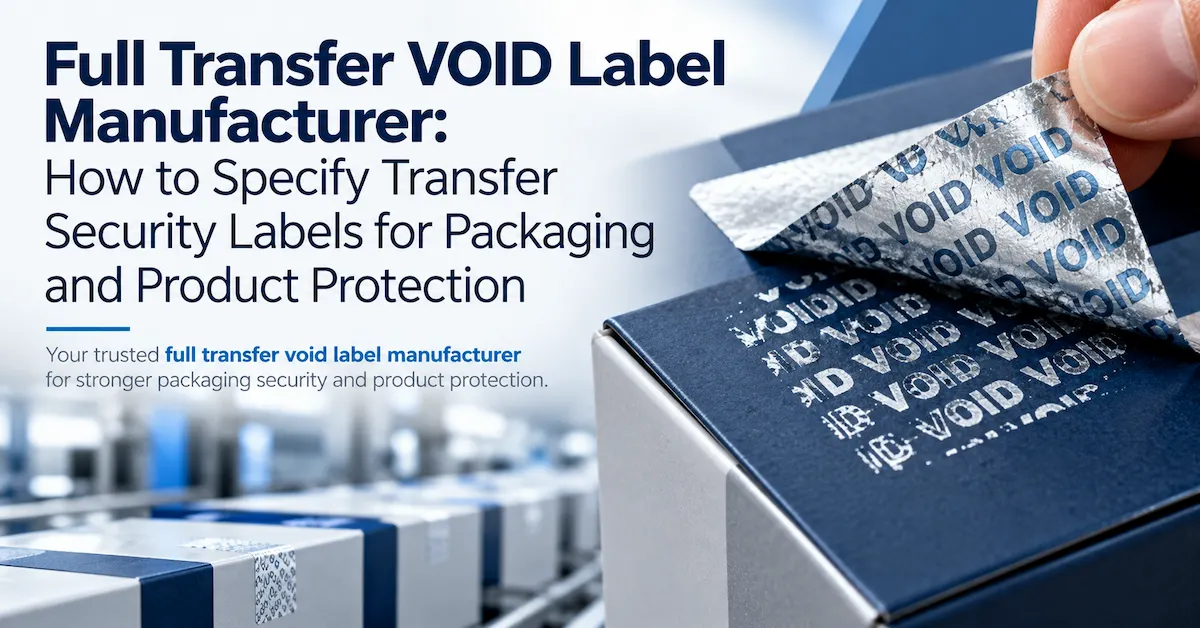
A full transfer VOID label is a tamper-evident security label designed to transfer its specified security pattern or message to the application surface during removal.
Depending on the construction, the transferred evidence may include a repeated VOID message, a custom word, a logo, or another recognizable pattern. The removed label may also show a corresponding change.
The defining feature is the intended transfer behavior: visible evidence remains on the original surface rather than the security response being limited to the removed label.
This characteristic can be valuable when a package or product must be inspected after the original seal has been lifted, removed, or disturbed.
For example, a warehouse employee receiving a sealed carton may be able to identify an attempted opening by examining the transferred pattern. An electronics service team may use a security label to identify possible interference around an enclosure opening.
The actual effect depends on the selected construction and must be verified using representative samples.
How Does the Full Transfer Mechanism Work?
A full transfer VOID label typically uses a pressure-sensitive adhesive system and an engineered security layer that produces a visible change during removal.
The process can be understood in three stages.
1. Application and bonding
The label is applied to the intended surface. The adhesive must make sufficient contact with the substrate under the specified application conditions.
2. Normal use
The label remains in place during the agreed handling, storage, and transportation conditions. The security feature should not activate prematurely during normal use.
3. Removal and transfer
When removal occurs, the construction separates or changes according to its design, leaving the intended security evidence on the original surface.
The transferred pattern helps distinguish an untouched label from one that has been disturbed.
However, a visible transfer pattern does not prove who removed the label, when removal occurred, or whether the enclosed product is genuine. It provides physical evidence of interference consistent with the construction's intended function.
Why Does Transfer Evidence Matter?
Some security labels reveal a message primarily on the removed label. That result can still be useful, but the original package may be harder to assess if the label is missing.
A full transfer design is intended to leave evidence on the protected surface itself.
This may support:
-
Visual inspection of opened cartons and packages.
-
Identification of possible unauthorized access to equipment.
-
Recognition of removed or disturbed warranty seals.
-
Inspection of security labels after transportation.
-
Review of returned products and packaging.
-
Identification of attempted label transfer or reuse.
These benefits depend on the transferred pattern being visible, interpretable, and appropriate for the application surface.
Full Transfer vs. Partial Transfer vs. Non-Transfer VOID Labels
One of the most important purchasing decisions is selecting the correct transfer behavior.
The terms describe different intended outcomes, not universal performance rankings. The best construction depends on what the buyer needs an inspector to see and what condition the package should be in after removal.
| Construction | Intended removal response | Potential advantage | Main consideration |
|---|---|---|---|
| Full transfer VOID label | Security evidence transfers to the original surface | Evidence remains on the protected package | Transferred marks may affect appearance |
| Partial transfer VOID label | Evidence is divided between the surface and removed label | Can create a recognizable change on both parts | Both results must be easy to interpret |
| Non-transfer VOID label | Security evidence appears mainly within or on the removed label | Can reduce visible residue on the original surface | Evidence may be less apparent if the label is missing |
| Destructible security label | Material breaks or fragments during removal | Can discourage intact removal and reuse | Normal handling must not damage the label |
When Is Full Transfer the Better Choice?
Full transfer is worth evaluating when the original application surface must retain visible evidence after removal.
Examples include shipping cartons, selected product boxes, security closures, and equipment surfaces where a transferred mark is acceptable.
It may be less appropriate when the original surface must remain visually pristine, such as a premium finished housing or a reusable component.
When Should Buyers Consider Non-Transfer Designs?
A non-transfer construction may be preferable when adhesive residue or a visible mark on the product would be undesirable.
However, the buyer must still determine whether the security response is obvious enough for the intended inspection process.
For applications that require both a clean surface and a clear indication of opening, compare samples rather than relying on product terminology alone.
HX lists VOID Open Labels as a relevant product category for buyers evaluating VOID-style security labels.
Which Businesses Need Full Transfer VOID Labels?
Full transfer VOID labels are most relevant to businesses that need visible evidence of label removal on a protected surface.
The exact requirements vary by industry, product value, distribution process, and consequences of unauthorized access.
1. Electronics Manufacturers
Electronics manufacturers may use tamper-evident labels around enclosure seams, service access points, or selected product packaging.
The label can help technicians and inspection teams identify possible interference with a protected area.
Important considerations include:
-
The exact housing material and surface finish.
-
Whether the label crosses a joint or movable component.
-
Whether the transferred message remains visible.
-
Whether normal servicing could activate the security feature.
-
Whether residue or surface damage is acceptable.
A full transfer construction should be tested on the actual enclosure or representative production material before approval.
2. Packaging and Carton Manufacturers
Packaging companies may source security labels for customers that require visible evidence of opening.
A transferred message on a disposable carton can be useful because the package itself retains the evidence after the label is removed.
However, carton coatings, printing varnishes, paper fibers, and surface texture can influence adhesion and transfer behavior.
Buyers should supply representative cartons rather than approving a label solely on an unrelated demonstration board.
3. Brand Owners and Consumer Product Companies
Brands may use security labels to support packaging integrity and reduce opportunities for unauthorized opening or label reuse.
A full transfer pattern can provide a visible warning when the original seal is removed.
The visual design should match the product's presentation requirements. A highly visible transfer mark may be appropriate for a shipping carton but unsuitable for a premium retail box that must remain attractive after inspection.
4. Industrial Equipment Manufacturers
Equipment manufacturers may need evidence that an enclosure, access panel, or protected component has been opened.
A full transfer label can support visual inspection, but the chosen material must be compatible with the surface and normal operating environment.
Buyers should consider temperature exposure, surface texture, maintenance procedures, and the consequences of accidental activation.
5. Importers, Distributors, and Packaging Converters
Importers and distributors may source custom security labels for multiple customers or product lines.
Their priorities often include repeat-order consistency, manageable SKU variations, accurate artwork, appropriate roll or sheet formats, and predictable approval procedures.
Packaging converters may also need the label to work with existing application equipment.
For these buyers, technical approval and supply documentation are as important as the initial sample's appearance.
How to Choose the Right Application Surface
A full transfer VOID label must be evaluated as part of the complete label-and-substrate system.
The same construction can behave differently on different surfaces because of variations in surface energy, texture, coating chemistry, cleanliness, and geometry.
| Surface type | Key consideration | Recommended evaluation |
|---|---|---|
| Uncoated paperboard | Fiber strength and roughness | Transfer visibility and substrate damage |
| Coated carton | Varnish and coating compatibility | Adhesion and transfer consistency |
| Corrugated packaging | Uneven surface and fiber variation | Contact quality and pattern visibility |
| PP or PE plastic | Low surface energy | Adhesive compatibility |
| PET plastic | Surface treatment and curvature | Bonding and removal response |
| Glass | Cleaning residues and condensation | Surface preparation and environmental exposure |
| Painted metal | Paint adhesion and finish | Transfer response and coating damage |
| Textured plastic housing | Uneven contact area | Adhesion and local transfer consistency |
Paperboard and Coated Cartons
Paperboard packaging is widely used for consumer products, electronics, and retail goods.
Yet not all cartons have the same surface properties. Printing varnishes, laminates, recycled fibers, and coatings can change the way a label bonds or transfers its security pattern.
A full transfer label may leave a clear mark on one carton but produce a different result on another carton with a different finish.
Before bulk purchasing, test the actual packaging material, including its printed or coated surface.
Plastic Housings
Plastic surfaces require particular attention because polymer type and surface treatment can influence adhesion.
Untreated polypropylene and polyethylene, for example, can be more challenging for some pressure-sensitive adhesives than certain other surfaces.
Mold-release residues, textured finishes, curved housings, and cleaning processes may also affect performance.
Buyers should identify the specific material and test the label on the actual application area.
Metal and Painted Surfaces
A label intended for metal equipment may be applied to bare metal, painted metal, powder-coated surfaces, or a protective coating.
These surfaces should not be treated as interchangeable.
If the coating itself separates during removal, the resulting damage may differ from the intended security effect.
Define whether the transferred message should appear without damaging the finish, or whether some surface disruption is acceptable for the application.
Customization Options for Full Transfer VOID Labels
A custom full transfer VOID label may require more than a standard security message.
The label's dimensions, artwork, transfer pattern, application format, and inspection requirements should be established before production.
Possible customization requirements include the following, subject to confirmation for the selected construction.
Custom VOID Messages and Patterns
Some projects require a recognizable VOID or OPEN message, while others may need a company name, logo, or customized security pattern.
The key requirement is that the resulting evidence remains clear enough for the intended inspection process.
The message should be evaluated on the actual packaging surface because color, printing, texture, and lighting can affect visibility.
Label Dimensions and Shape
The label must cover the intended area without interfering with the package's normal operation.
A label applied across an enclosure seam may require different dimensions from one used on a flat carton closure.
Oversized labels can affect product appearance, while undersized labels may not cover the required access point.
Confirm the available bonding area and final placement before approving the artwork.
Printing and Branding
Custom branding can help identify the label as part of an authorized packaging program.
However, decorative elements should not obscure the security message or make the transferred evidence difficult to recognize.
Buyers should approve the complete artwork and the actual removal result, not just a flat design proof.
Roll or Sheet Format
Production format should match the application process.
Roll labels may be suitable for compatible dispensing equipment, while sheet formats may be appropriate for certain manual applications.
For automatic application, buyers should clarify the required roll direction, core dimensions, label spacing, liner characteristics, and equipment compatibility.
These details should be confirmed with the supplier before the production order is finalized.
How to Test a Full Transfer VOID Label Before Bulk Production
A label should not be approved simply because its security message looks clear on a sample.
The purpose of testing is to confirm that the label performs as intended on the actual substrate and under the relevant operating conditions.
Step 1: Define the Required Transfer Result
Specify what should remain on the application surface after removal.
The requirement may include the appearance of a repeated VOID message, a customized pattern, or another agreed visual change.
Photograph the approved intact label and the expected removal result.
Step 2: Apply Samples to the Actual Substrate
Use the real carton, plastic housing, glass surface, or other intended packaging material whenever possible.
Record surface preparation, application method, and the time between application and testing.
If several substrates will be used, test each relevant material separately.
Step 3: Inspect Initial Appearance
Check label positioning, wrinkles, edge contact, bubbles, and premature activation.
The label should remain visually acceptable during the agreed normal-use conditions.
Step 4: Perform a Controlled Removal Test
Remove samples using a documented procedure.
Inspect the original surface and the removed label.
Confirm whether the transferred pattern matches the approved reference and whether the result can be interpreted without ambiguity.
Step 5: Evaluate Relevant Environmental Conditions
Where appropriate, assess samples after exposure to realistic storage, handling, or transportation conditions.
The test conditions should reflect the intended application rather than arbitrary extremes.
For products exposed to humidity, condensation, temperature changes, or repeated handling, determine whether those conditions may affect the transfer response.
Step 6: Approve and Record the Construction
Record the approved material, dimensions, artwork, substrate, application process, and test outcome.
If the supplier or packaging manufacturer later changes a critical material or process, determine whether the revised construction requires renewed validation.
A documented approval reference helps procurement teams compare repeat orders against the originally accepted result.
Quality-Control Requirements for Full Transfer VOID Labels
Quality control should focus on the security function as well as the label's visual and dimensional characteristics.
A label may look correct before application but fail to provide the expected transfer pattern after removal.
For that reason, buyers should establish acceptance criteria before approving production.
| Quality item | What to verify |
|---|---|
| Artwork | Matches the approved design |
| Dimensions | Meets the specified size and shape |
| Initial adhesion | Remains attached during agreed normal use |
| Transfer effect | Produces the specified evidence on removal |
| Pattern visibility | Remains recognizable under inspection conditions |
| Surface compatibility | Does not create unacceptable damage |
| Application format | Works with the intended manual or automatic process |
| Batch consistency | Matches the approved reference construction |
These are recommended inspection categories, not universal pass/fail limits. Actual acceptance criteria should be agreed for the project.
Distinguish Security Defects From Cosmetic Defects
A minor printing variation may be acceptable if it does not affect readability or security performance.
A label that removes without leaving the specified evidence may represent a critical functional defect.
Similarly, a label that activates prematurely during normal handling may create false tampering alerts.
Buyers should define which defects are critical, major, or minor and establish an appropriate sampling and inspection process.
Common Mistakes When Purchasing Full Transfer VOID Labels
Mistake 1: Selecting a Label Based Only on Price
Unit price is important, but a low-cost label that fails on the actual packaging may generate greater expenses through waste, rework, returns, and inspection.
Compare quotations against the same technical specification and approved test conditions.
Mistake 2: Assuming All VOID Labels Have the Same Transfer Effect
Full transfer, partial transfer, and non-transfer labels are not interchangeable.
The buyer should specify where the security evidence must appear and how it should look after removal.
Mistake 3: Testing on the Wrong Material
A successful test on smooth glass does not establish suitability for a coated carton or textured plastic housing.
Always prioritize representative production substrates.
Mistake 4: Ignoring Application Equipment
Automatic labeling can introduce stresses that are absent during hand application.
If the label will be applied by machine, validate the liner, dispensing process, label orientation, and placement requirements.
Mistake 5: Failing to Control Repeat Orders
A previously approved label may perform differently if its material, construction, artwork, or application surface changes.
Keep an approved reference and require review of relevant changes before repeat production.
What Determines the Cost of a Full Transfer VOID Label?
The price of a custom full transfer VOID label depends on the construction and commercial requirements of the project.
Relevant factors may include:
-
Label material and security structure.
-
Adhesive requirements.
-
Label dimensions and shape.
-
Custom message, pattern, or artwork.
-
Printing and variable-data requirements.
-
Roll or sheet format.
-
Order quantity.
-
Sampling and validation requirements.
-
Packaging and delivery arrangements.
No single cost model applies to every application.
A buyer requesting a standard transfer pattern for a carton may have different requirements from a manufacturer needing a custom security message for a curved equipment housing.
For an accurate quotation, provide the application surface, label dimensions, desired transfer result, artwork, quantity, and intended application method.
The supplier should confirm any project-specific MOQ, lead time, and technical limitations rather than relying on assumptions.
How to Prepare an RFQ for a Full Transfer VOID Label Manufacturer
A detailed Request for Quotation helps suppliers assess the project more accurately and reduces avoidable sample revisions.
| RFQ requirement | Information to provide |
|---|---|
| Product application | Carton, electronics, equipment, bottle, or other product |
| Label type | Full transfer VOID construction |
| Desired effect | Message or pattern expected after removal |
| Label dimensions | Length, width, shape, and placement |
| Substrate | Exact material, coating, and surface finish |
| Artwork | Logo, text, colors, and security graphics |
| Application method | Manual or automatic |
| Environmental conditions | Relevant storage and transportation conditions |
| Supply format | Roll or sheet, with equipment requirements if applicable |
| Quantity | Sample, pilot, initial, and estimated repeat quantities |
| Quality requirements | Reference samples and acceptance criteria |
| Additional features | Holographic elements, serial numbers, or QR codes if needed |
If the project is intended to replace an existing label, include photographs of the current construction and its performance.
Where possible, provide representative packaging samples. This allows the supplier to assess the actual surface and the required transfer effect.
A precise RFQ makes quotations easier to compare because each supplier can respond to the same application requirements.
Can Full Transfer VOID Labels Be Combined With Other Security Features?
Full transfer VOID labels primarily address tamper evidence. They do not automatically provide every type of authentication or traceability.
Some businesses may need a broader security solution that combines physical evidence with other features.
| Feature | Main purpose | What buyers should confirm |
|---|---|---|
| Full transfer VOID | Leaves visible evidence on the surface | Transfer clarity and surface compatibility |
| Holographic security feature | Provides optical authentication cues | Visibility and intended verification method |
| Serial number | Identifies an individual label or product | Sequence control and data management |
| QR code | Supports scanning and information access | Code uniqueness and verification process |
| Barcode | Supports identification and operational scanning | Readability and system compatibility |
The appropriate combination depends on the actual risk.
For example, a brand concerned primarily about unauthorized opening may need a suitable transfer construction. A brand facing both tampering and counterfeiting risks may need additional authentication features.
A QR code alone does not prevent copying, and a holographic feature alone does not necessarily show whether a package has been opened.
Buyers can review the HX Holographic Label category when considering optical security features alongside tamper evidence.
Working With HX Security Label on a Custom Project
HX Security Label's published product portfolio includes VOID Open Labels and other security-label categories.
For a full transfer project, buyers should begin by defining the intended security result, application surface, label dimensions, and production requirements.
A useful development brief should explain:
-
Where the label will be applied.
-
What should happen when the label is removed.
-
Whether transferred marks are acceptable on the product.
-
Which normal-use conditions the label must withstand.
-
Whether the label will be applied manually or automatically.
-
How the buyer will inspect and approve samples.
These details help establish the scope of the project before bulk production.
Specific transfer performance, material options, customization availability, MOQ, pricing, and lead time must be confirmed with HX for the proposed application. General product-category information should not be interpreted as a guarantee that every construction will suit every surface.
To discuss a project, review the HX company information and submit the application details through the HX Contact Us page.
Frequently Asked Questions About Full Transfer VOID Labels
1. What is a full transfer VOID label?
A full transfer VOID label is designed to leave its specified security message or pattern on the original application surface when removed. The visible evidence can help inspectors identify possible label removal or interference. The exact result depends on the selected construction and must be confirmed through testing.
2. What is the difference between full transfer and non-transfer VOID labels?
A full transfer label is designed to leave evidence on the original surface. A non-transfer construction is designed to reveal the main security response within or on the removed label while reducing transfer to the surface. The appropriate choice depends on whether visible residue is desirable or acceptable.
3. Which packaging materials can use full transfer VOID labels?
Potential applications include paperboard, coated cartons, selected plastics, glass, and metal surfaces. However, compatibility is not universal. Buyers should identify the exact substrate, coating, and surface finish, then test samples on representative packaging before bulk ordering.
4. Do full transfer VOID labels prevent all tampering?
No. They are designed to reveal a specified removal event, not make physical interference impossible. Their purpose is to provide visible evidence that supports inspection. The effectiveness of the security response depends on the construction, application surface, and conditions of use.
5. Can full transfer VOID labels include a custom company logo?
Custom artwork may be possible depending on the construction and project requirements. Buyers should provide the logo, message, color requirements, dimensions, and intended application. The final security effect and printed design should both be approved before production.
6. Are full transfer VOID labels suitable for electronics warranty seals?
They may be suitable for selected electronics applications where visible evidence of opening is required. The label must be tested on the actual housing material and positioned to monitor the intended access point. Buyers should also consider normal servicing, surface damage, and false activation risks.
7. How should a buyer test full transfer VOID labels?
Apply samples to the intended packaging, record the application conditions, and inspect the label during normal handling. Then perform a controlled removal test and verify that the required evidence appears on the surface. Document the result and retain an approved reference sample.
8. What information should be included in a quotation request?
Provide the application, substrate, label dimensions, desired transfer effect, artwork, quantity, application method, environmental conditions, and inspection requirements. If replacing an existing label, include photographs and representative packaging samples where possible.
9. Can full transfer VOID labels be combined with QR codes or holographic features?
Depending on the selected construction, a project may combine tamper evidence with identification or optical security features. The availability and suitability of each feature must be confirmed. Digital verification also requires appropriate data management; a QR code alone does not establish authenticity.
10. How can I request a custom full transfer VOID label from HX?
Prepare your application details, actual substrate information, desired transfer result, label dimensions, artwork, and estimated quantity. Then contact HX through the official contact page to discuss the project, sample requirements, and quotation.
Conclusion
Choosing the right full transfer VOID label manufacturer requires more than finding a label that leaves a visible mark. Buyers should evaluate the transfer mechanism, substrate compatibility, security-message visibility, application method, quality-control requirements, and repeat-order consistency.
A well-defined specification and successful sample validation help reduce procurement risks and ensure that the selected label produces the intended evidence on the actual package or product.
For customized transfer security labels, contact HX Security Label with your application details to discuss suitable options, sample evaluation, and quotation requirements.