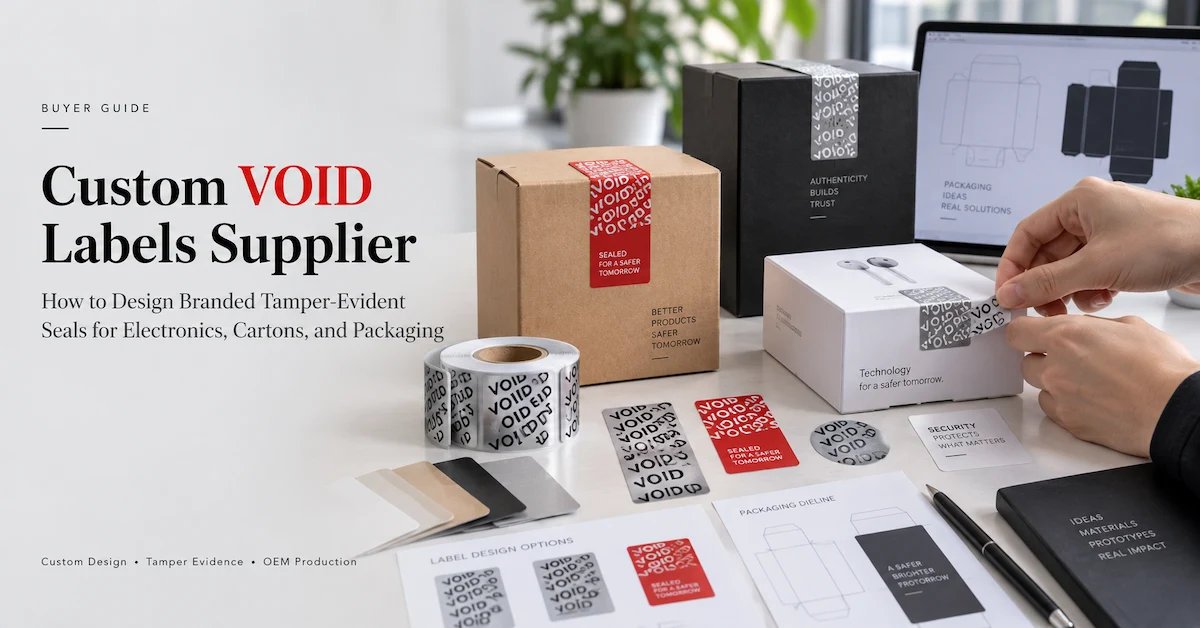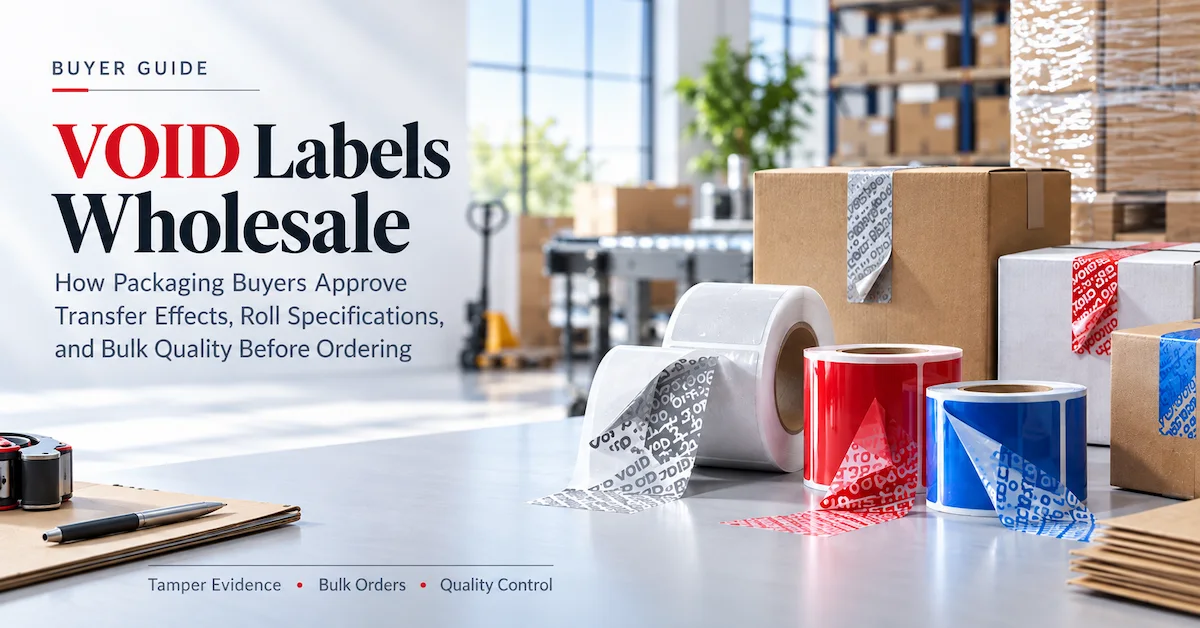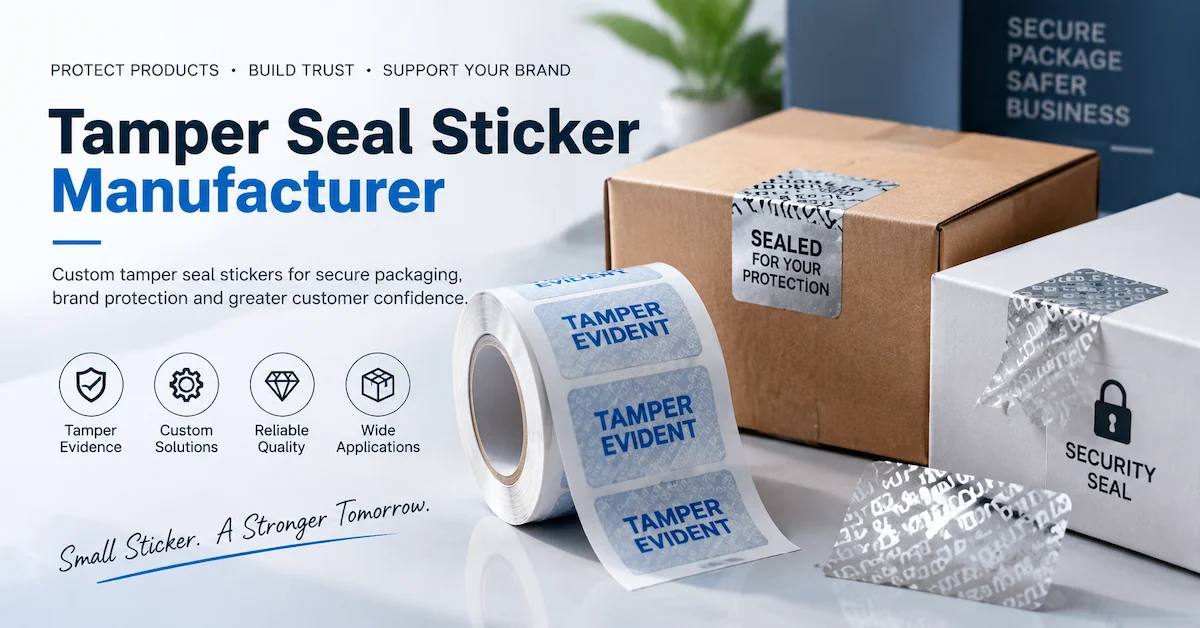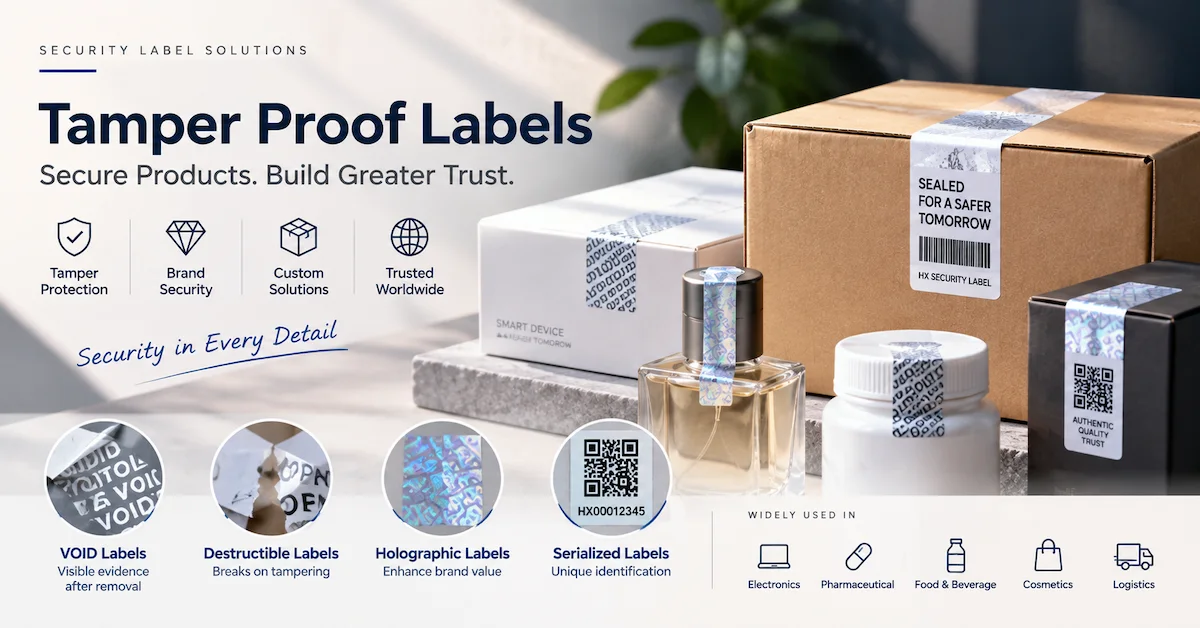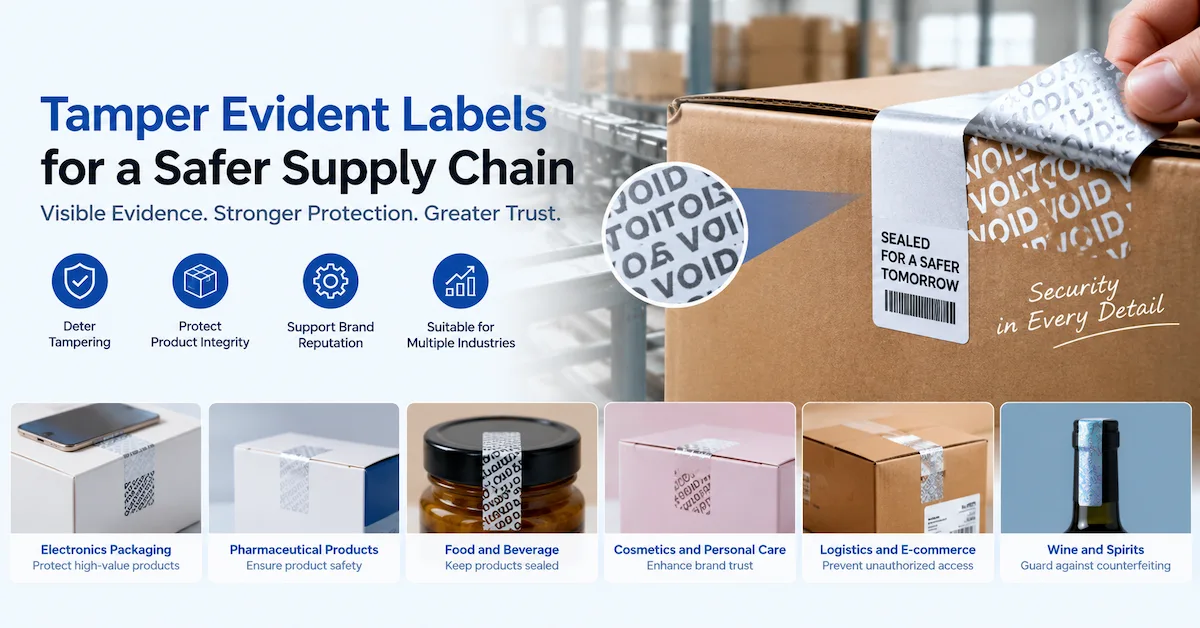

Tamper evident VOID labels are designed to reveal visible evidence when someone attempts to remove a label or open protected packaging. However, their performance depends on the relationship between the adhesive, packaging surface, security layers, and application conditions.
A label that peels away without the intended warning may fail to reveal interference. A label that activates during normal transportation can create false tampering alerts. Both outcomes may result in product returns, packaging rejection, and additional quality-control costs.
For brand owners, packaging engineers, electronics manufacturers, and international buyers, the solution is to understand the failure mechanism before selecting a replacement label.
This guide explains common VOID label failures, practical testing methods, material compatibility, and the information needed to purchase reliable custom security labels.
Buyers exploring available security constructions can begin with the HX VOID Open Label product category.
What Are Tamper Evident VOID Labels and How Do They Work?
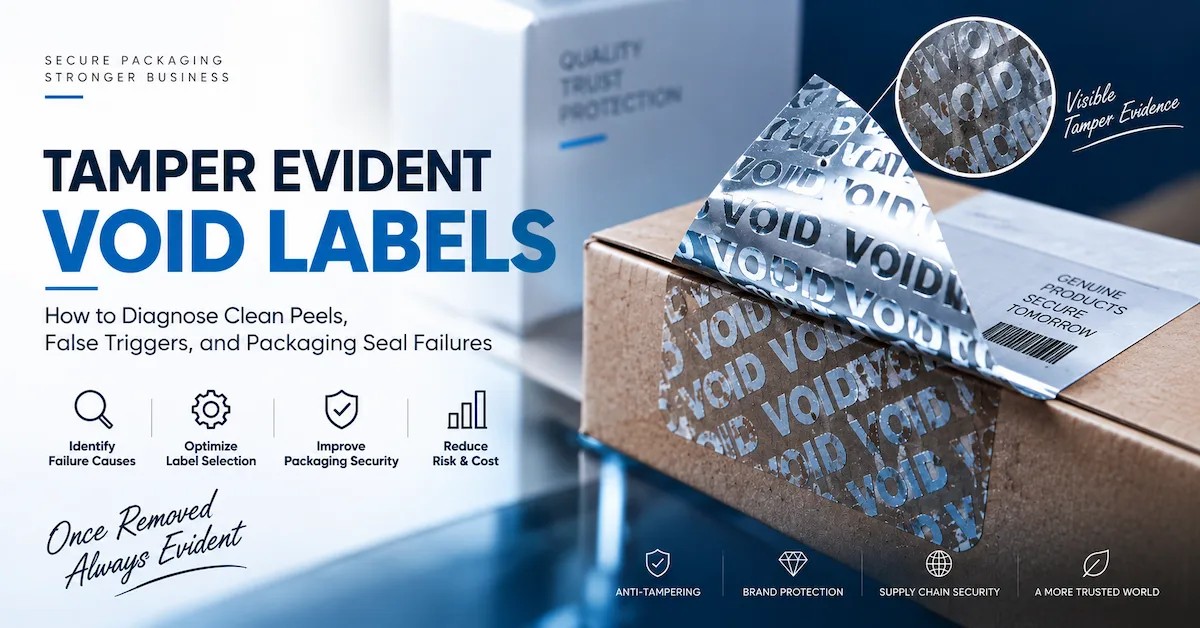
Tamper evident VOID labels are pressure-sensitive security labels engineered to produce a visible or irreversible change when removal occurs.
Depending on the construction, a hidden word such as "VOID" or "OPEN" may appear on the packaging surface, remain visible within the removed label, or become exposed through separation of the label's layers.
Common construction types include:
-
Full-transfer VOID labels: Designed to leave the specified security pattern primarily on the application surface.
-
Partial-transfer VOID labels: Designed to divide the visible security pattern between the surface and removed material.
-
Non-transfer VOID labels: Designed to reveal evidence within the label while minimizing transfer to the underlying surface.
-
Destructible security labels: Designed to break or fragment during removal.
These are industry construction types; actual availability and performance must be confirmed with the manufacturer.
A reliable VOID label must satisfy two conditions: remain intact during authorized handling and produce the expected security evidence during deliberate removal.
Importantly, VOID evidence does not independently prove that the enclosed product is genuine. Authentication may require additional security features.
Common Tamper Evident VOID Label Failures
Understanding the visible symptom is the first step toward identifying the root cause.
| Failure | Possible causes | Main risk |
|---|---|---|
| Clean peeling | Weak bonding, surface incompatibility, incorrect construction | Undetected removal |
| Premature VOID activation | Mechanical stress, bending, sensitive security layers | False tamper alerts |
| Edge lifting | Curvature, contamination, adhesive mismatch | Reduced seal integrity |
| Incomplete VOID pattern | Uneven application, coating variation, poor contact | Unclear tamper evidence |
| Surface damage | Excessive adhesion, weak surface coating | Packaging damage |
| Inconsistent batch results | Material variation, process changes | Quality rejection |
These symptoms do not establish a diagnosis by themselves. Proper troubleshooting requires inspection of the actual label, packaging material, and application process.
Failure 1: VOID Labels Peel Off Without Leaving the Expected Evidence
Clean peeling is a serious concern when a security construction is intended to transfer a visible warning to the packaging.
Possible causes include insufficient adhesion, surface contamination, inadequate application pressure, or separation at an unintended interface.
Low-surface-energy plastics such as untreated polypropylene and polyethylene can be particularly challenging for some pressure-sensitive adhesives.
A label that works on glass may not produce the same response on plastic packaging.
Recommended solution: Confirm the intended transfer mechanism, identify the exact substrate, and compare adhesive performance under controlled application conditions.
Increasing adhesive strength is not always the answer. Excessively strong bonding may damage the packaging or alter the security response.
Failure 2: The VOID Message Appears Before Opening
Premature activation occurs when a label reveals its security pattern during normal handling.
Possible causes include:
-
Excessive bending during application
-
Pressure or friction during transportation
-
Incorrect label placement across carton folds
-
Security-layer sensitivity
-
Stress created by automatic labeling equipment
For example, a label placed across a flexible carton joint may experience repeated movement before the package is deliberately opened.
Recommended solution: Examine where activation begins, evaluate the packaging movement, and test alternative placement or construction options.
The selected label should distinguish normal handling from the intended tampering event.
Failure 3: Label Edges Lift During Storage
Edge lifting can reduce the effectiveness of packaging seals and create an accessible starting point for removal.
Common contributors include curved surfaces, inadequate adhesive contact, contamination, film stiffness, and environmental exposure.
On a bottle, a relatively stiff label may resist conforming to the curved surface. On textured cardboard, the adhesive may not contact the entire application area.
Recommended solution: Evaluate the adhesive, film flexibility, surface geometry, and application pressure together.
A different label shape or placement may solve the problem without requiring a stronger adhesive.
Failure 4: The VOID Pattern Is Incomplete
An incomplete security message makes visual inspection more difficult.
The problem may result from uneven bonding, inconsistent security-layer separation, surface texture, or variations in application pressure.
Pattern visibility also depends on background color and surface finish.
Recommended solution: Use an approved reference sample showing the expected removal result. Define acceptable pattern visibility under specified lighting and inspection conditions.
Avoid vague inspection requirements such as "good VOID effect" without a clear visual reference.
Failure 5: Labels Damage the Packaging Surface
Some tamper-evident labels can remove surface coatings, carton fibers, or paint when peeled away.
This may be acceptable for certain single-use security closures but unsuitable for premium packaging or reusable equipment.
The cause can involve the adhesive, substrate strength, surface coating, or security construction.
Recommended solution: Test the label on actual production materials and determine the acceptable balance between removal evidence and packaging damage.
For applications requiring limited residue, an appropriate non-transfer construction may be worth evaluating.
Why Packaging Surface Compatibility Matters
There is no universal VOID label construction that guarantees identical performance on every material.
A packaging surface affects adhesive contact, bonding development, removal behavior, and the visibility of security evidence.
| Packaging material | Main challenge | Testing priority |
|---|---|---|
| Uncoated cardboard | Roughness and fiber strength | Contact and surface damage |
| Coated paperboard | Varnish and coating compatibility | Adhesion and VOID transfer |
| PP and PE plastics | Low surface energy | Adhesive compatibility |
| Glass bottles | Curvature and condensation | Bonding and moisture exposure |
| Painted metal | Coating adhesion | Residue and surface damage |
| Textured electronics housings | Uneven contact | Bonding and removal response |
Coated Cartons
Two cartons can appear identical but use different varnishes, laminates, or surface treatments.
These differences may change adhesive performance.
Buyers should therefore test representative samples from their actual packaging supplier.
Plastic Housings
Electronics manufacturers frequently use security seals around access points or enclosure joints.
Material grades, molded textures, cleaning residues, and surface treatments can affect bonding.
A label approved for one plastic housing should not automatically be accepted for another.
Glass Bottles
Glass packaging introduces different concerns, particularly curved surfaces, cleaning residues, and condensation.
For closures, the test should reproduce the actual bottle-opening movement rather than only removing a label from a flat glass panel.
Projects involving beverage security can also explore HX's Wine Tax Stamp category.
How Temperature, Humidity, and Application Conditions Affect VOID Labels
VOID label performance depends not only on materials but also on when and how the label is applied.
Application Temperature
Application temperature influences initial adhesive contact.
A label suitable for storage at a particular temperature is not necessarily suitable for application at that temperature.
Both conditions should be evaluated separately.
Humidity and Condensation
Moisture may interfere with bonding and affect some paperboard coatings.
This is important for refrigerated products, humid warehouses, and packaging exposed to temperature changes.
Testing should reflect realistic storage and transportation conditions.
Adhesive Dwell Time
Some pressure-sensitive adhesives develop their bonding characteristics over time.
A label removed immediately after application may behave differently after extended contact.
For meaningful comparisons, record the time between application and removal.
Different test periods may be required depending on the adhesive and intended use.
How to Test Tamper Evident VOID Labels Before Bulk Production
Testing should determine whether the label remains stable during normal handling and provides the specified evidence during removal.
A practical validation procedure includes the following stages.
Step 1: Define the Required Security Response
Document whether the label should transfer a VOID message, reveal evidence inside the label, or become irreversibly damaged.
Photograph approved intact and removed samples.
Step 2: Use Actual Packaging Materials
Test the real carton, bottle, plastic housing, or coated component whenever possible.
Generic demonstration samples may not represent production packaging.
Include relevant variations in coatings, surface finishes, and substrate materials.
Step 3: Control Application Conditions
Record the application method, surface preparation, relevant equipment settings, and adhesive dwell time.
For machine-applied labels, testing should reflect the intended production process.
Step 4: Evaluate Adhesion and VOID Function Separately
Peel adhesion testing can help characterize adhesive performance under defined conditions.
For example, ASTM D3330/D3330M describes test methods for peel adhesion of pressure-sensitive tape.
However, a peel-force result does not establish whether a VOID message activates correctly.
Functional removal tests must separately examine the security response.
Step 5: Evaluate Environmental Exposure
Select tests based on realistic conditions such as transportation handling, humidity, storage temperatures, or package bending.
After conditioning, inspect both the intact seal and its removal response.
Step 6: Document Approval and Changes
Record the approved construction, dimensions, materials, application conditions, and inspection results.
If a critical material or packaging process changes, determine whether renewed testing is necessary.
This is particularly important for repeat orders involving multiple factories or packaging suppliers.
VOID Label Quality-Control Checklist for B2B Buyers
A clear purchasing specification allows suppliers and buyers to evaluate samples consistently.
| Inspection item | Suggested acceptance requirement |
|---|---|
| Label appearance | Matches approved artwork and sample |
| Adhesion | Remains attached under agreed normal-use conditions |
| VOID activation | Shows the specified evidence during removal |
| Pattern readability | Security message is identifiable |
| Surface compatibility | No unacceptable lifting or damage |
| Environmental performance | Meets agreed conditioning tests |
| Application compatibility | Dispenses and applies without defined critical defects |
| Batch consistency | Matches the approved reference construction |
The acceptance criteria should be developed for the intended application. These are recommended inspection categories, not universal performance limits or confirmed specifications for all HX products.
A label that does not provide the agreed security evidence should be treated differently from one with a minor cosmetic variation.
Quality teams should classify critical defects before approving production.
VOID Labels vs. Holographic Security Labels: Which Is Better?
VOID labels and holographic labels address different security objectives.
| Feature | VOID Labels | Holographic Labels |
|---|---|---|
| Primary purpose | Reveal removal or opening | Provide optical authentication cues |
| Typical mechanism | Layer separation or irreversible change | Optical diffraction and security imagery |
| Tamper indication | Depends on security construction | Requires a tamper-evident feature if needed |
| Visual branding | Custom patterns possible | Distinctive optical appearance |
| Main applications | Warranty seals, packaging closures | Brand protection, premium packaging |
For applications requiring both tamper evidence and visual authentication, a combined construction may be considered.
A serialized code can provide another identification layer when supported by an appropriately managed database or verification process.
However, a static QR code alone is not a reliable guarantee against copying.
Brand owners interested in optical security can review HX's Holographic Label product category.
Applications That Require Different VOID Label Designs
Electronics and Warranty Seals
Electronics manufacturers may require labels for enclosure openings, access screws, or outer packaging.
Important considerations include plastic compatibility, visible removal evidence, label placement, and unacceptable damage.
Cosmetics and Premium Packaging
Premium packaging requires security without unnecessary visual defects.
Carton coatings, metallic finishes, box-opening movements, and label appearance should be considered during design.
Beverage Packaging
Wine and spirits packaging may require seals that reveal opening attempts around caps, closures, or bottle necks.
Curvature, moisture, and opening movement are important testing conditions.
Pharmaceutical Outer Packaging
Pharmaceutical packaging may require tamper-verification features that meet market-specific regulatory requirements.
ISO 21976:2018 provides relevant guidance for tamper verification features used in medicinal product packaging.
Buyers must verify the suitability and compliance of the complete packaging solution rather than assuming a general-purpose VOID label is automatically approved.
How to Reduce VOID Label Failure Risks in Repeat Orders
A successful initial sample does not eliminate future quality risks.
Material substitutions, packaging changes, application settings, and environmental conditions may change performance.
For repeat purchasing, establish a documented specification covering:
-
Approved label construction and security response
-
Packaging materials and surface conditions
-
Artwork, dimensions, and converting requirements
-
Agreed inspection and functional testing methods
-
Critical defects and acceptance criteria
-
Procedures for approving material or process changes
Retain representative approved samples and compare future orders with the reference construction.
If a failure occurs, preserve affected samples and record the relevant label batch, packaging supplier, and application conditions.
This information makes corrective-action investigations more effective and supports consistent long-term purchasing.
What Determines the Cost of Custom Tamper Evident VOID Labels?
The cost of custom VOID labels depends on the required construction and project scope.
Relevant factors may include adhesive selection, film materials, label size, security pattern, artwork, die-cutting, roll format, order quantity, and additional printing or identification features.
Testing or development requirements may also influence the quotation.
For professional buyers, unit price should not be the only consideration.
A lower-cost label may create greater total expense if it causes production waste, false tamper alarms, or insufficient security evidence.
The goal is to select a construction that satisfies the defined application requirements at an acceptable total cost.
What Should Buyers Include in a VOID Label RFQ?
A detailed Request for Quotation helps manufacturers evaluate the application and recommend suitable construction options.
| RFQ information | What to provide |
|---|---|
| Product application | Electronics, cartons, bottles, or other packaging |
| Current problem | Clean peeling, false activation, lifting, or incomplete VOID pattern |
| Label dimensions | Length, width, shape, and placement |
| Packaging material | Exact substrate and surface finish |
| Security response | Transfer, non-transfer, or other required tamper evidence |
| Environment | Application, storage, and transportation conditions |
| Application method | Manual or automatic labeling |
| Artwork | Logo, security message, and graphics |
| Quantity | Sample, trial, initial, and estimated repeat quantities |
| Quality requirements | Testing methods and acceptance criteria |
When replacing an unsuccessful label, include photographs of the failure and samples of the actual packaging.
The more precisely a buyer describes the application, the easier it becomes to evaluate suitable materials and avoid unnecessary sampling cycles.
Custom VOID Label Solutions from HX Security Label
HX Security Label, operated by Shenzhen Huaxin Anti-Counterfeiting Technology Co., Ltd., offers anti-counterfeiting label products and customization-related services.
Its publicly described development process includes requirements confirmation, design, proofing, material selection, sample approval, and logistics.
Buyers can explore the company's security label product range and review HX company information.
For projects involving VOID label failures, a useful starting point is to provide the existing label, actual packaging substrate, observed failure, and intended security response.
Specific materials, production specifications, MOQ, lead time, and performance requirements should be confirmed for each project.
To discuss a custom packaging security application, submit your technical requirements through the HX Security Label contact page.
Frequently Asked Questions About Tamper Evident VOID Labels
1. Why do VOID labels peel off without leaving a warning?
Clean peeling may involve inadequate adhesion, surface contamination, insufficient dwell time, or an unsuitable security construction. First confirm whether the label is designed to transfer evidence to the surface or reveal it within the removed label. Testing on the actual packaging helps identify the cause.
2. Can VOID labels be applied to plastic surfaces?
Yes, suitable constructions may be used on certain plastics, but adhesive compatibility must be confirmed. Low-surface-energy materials such as untreated PP and PE can be challenging. Testing on the specific plastic grade and surface finish is recommended.
3. What causes premature VOID activation?
Possible causes include bending, excessive pressure, transportation stress, unsuitable placement, or problems during automatic application. Engineers should examine the activation location and reproduce normal handling conditions before changing the construction.
4. How should buyers test VOID label adhesion?
Use representative packaging materials and controlled application conditions. Evaluate initial bonding, relevant dwell periods, and environmental exposure. Peel adhesion testing can provide useful information, but the actual VOID removal response must also be checked separately.
5. Are VOID labels completely impossible to remove?
No. Their purpose is to provide evidence of specified removal or interference, not to guarantee that removal is physically impossible. Performance depends on the construction, substrate, environment, and tampering method.
6. Can VOID labels include holographic features or QR codes?
Suitable custom security designs may combine physical tamper evidence with optical or identification features. Buyers should confirm the available construction and the scope of any digital verification service. A QR code by itself does not prevent copying.
7. What information is needed to order custom VOID labels?
Provide the intended application, packaging substrate, label dimensions, required security effect, environmental conditions, artwork, application method, and estimated quantity. If replacing a failed label, include samples or photographs of the failure.
Conclusion
Reliable tamper evident VOID labels require more than strong adhesive. Their performance depends on the security construction, packaging surface, application method, and operating environment.
B2B buyers should identify failure causes, test actual packaging materials, define clear acceptance criteria, and approve samples before bulk production.
For customized tamper-evident packaging solutions, contact HX Security Label with your application requirements to discuss suitable options and quotation details.