
Choosing a partial transfer VOID labels supplier requires more than comparing security-film prices or checking whether a sticker displays the word "VOID" after removal. For packaging manufacturers, electronics brands, and procurement teams, the critical question is whether the label produces consistent, recognizable tamper evidence on both the protected surface and the removed label.
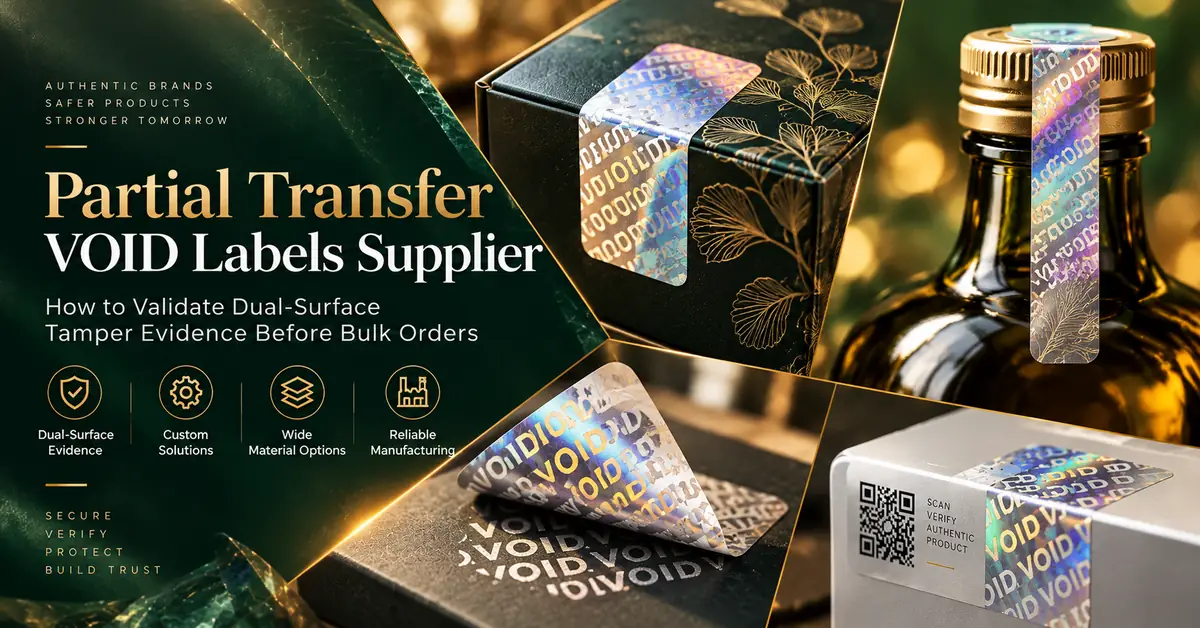
Partial transfer VOID labels use a controlled-release structure that divides the intended security evidence between the application surface and the lifted label. Depending on the material construction, a VOID message or corresponding positive-and-negative pattern becomes visible when the seal is removed.
Unlike a conventional printed warning sticker, this security response is built into the label's layered construction. Its effectiveness depends on the interaction between the security coating, adhesive, substrate, and application conditions.
For B2B buyers, the objective is to specify a security label that remains stable during normal use, reveals interference when removal occurs, and performs consistently across production batches.
This guide explains how to select partial transfer security labels, validate dual-surface evidence, evaluate manufacturers, and prepare a technical specification for bulk purchasing.
For available product categories, explore HX Security Label's tamper-evident label solutions.
What Are Partial Transfer VOID Labels, and How Do They Work?
A partial transfer VOID label is a tamper-evident adhesive label engineered to produce visible security evidence on both the original application surface and the removed label.
The security response is generally created through a patterned release layer, specially designed coating, or controlled adhesive-layer separation.
How the Transfer Mechanism Works
Stage 1: Application
The label is bonded to its intended substrate, such as a coated carton, plastic enclosure, or metal product housing. The security pattern remains concealed or visually unchanged during normal use.
Stage 2: Unauthorized Removal
When someone attempts to peel away the label, the engineered internal layers separate according to the security construction.
Stage 3: Dual-Surface Evidence
Part of the security pattern or coating remains on the original surface, while a corresponding message or visual change appears on the removed label.
The actual pattern distribution depends on the construction. Buyers should not assume that every partial-transfer label produces identical VOID lettering on both surfaces.
Why Is Dual-Surface Evidence Valuable?
Partial transfer designs can provide two inspection points.
The first is the protected product or packaging surface, where transferred residue or a security message indicates possible removal.
The second is the lifted label, where the corresponding pattern provides additional evidence that the original seal has been disturbed.
This can support inspection during warehouse receiving, product returns, after-sales servicing, and distribution.
However, the presence of a VOID pattern does not independently prove product authenticity or identify who removed the label. Its primary function is to provide visible tamper evidence.
Who Should Use Partial Transfer VOID Labels?
Partial-transfer constructions are particularly relevant when buyers want a recognizable security response on both the label and the protected surface.
| Buyer or industry | Security concern | Potential application |
|---|---|---|
| Electronics manufacturers | Unauthorized enclosure opening | Equipment access seals and selected warranty labels |
| Packaging manufacturers | Carton opening or seal removal | Folding cartons and retail packaging |
| Consumer product brands | Packaging interference and label reuse | Branded product security seals |
| Industrial equipment suppliers | Access to protected components | Service panels and equipment housings |
| Logistics and distribution companies | Possible package interference | Selected shipping cartons and security closures |
| Packaging converters | Repeatable custom security constructions | OEM security-label projects |
When Are Partial Transfer Labels Not the Best Choice?
Partial transfer is not automatically preferable for every application.
A non-transfer design may be more suitable when the original product surface must remain comparatively clean after label removal.
A full-transfer construction may be preferable when inspectors require particularly prominent evidence on the original packaging, even if the removed label is unavailable.
Destructible labels may be considered when fragmentation during removal is the primary security objective.
The appropriate design depends on the intended evidence, appearance requirements, and acceptable surface effects.
Partial Transfer vs. Full Transfer vs. Non-Transfer VOID Labels
Buyers should compare removal behavior rather than treating all VOID materials as interchangeable.
| Feature | Partial transfer | Full transfer | Non-transfer |
|---|---|---|---|
| Main security response | Evidence on both label and substrate | Substantial evidence on substrate | Evidence mainly within removed label |
| Surface marking | Controlled partial transfer | More extensive intended transfer | Comparatively limited transfer |
| Removed-label evidence | Corresponding visible change | Construction-dependent | Primary security indication |
| Main advantage | Two inspection points | Evidence retained on package | Reduced visible surface marking |
| Typical consideration | Pattern balance and clarity | Surface residue acceptance | Visibility after label removal |
| Critical test | Paired evidence inspection | Surface transfer inspection | Irreversible label-change inspection |
The main advantage of partial transfer is not necessarily stronger adhesion. It is the specified distribution of tamper evidence.
The buyer must confirm that both intended visual results are identifiable under normal inspection conditions.
For a broader overview of security constructions, read HX's anti-counterfeit security label selection guide.
What Specifications Should You Confirm With a Partial Transfer VOID Labels Supplier?
A successful quotation begins with a clear technical specification.
Instead of requesting only "custom silver VOID stickers," buyers should define the removal behavior, application surface, visual appearance, and manufacturing format.
Technical Specification Checklist
| Specification | What buyers should confirm |
|---|---|
| Security construction | Partial-transfer design with defined evidence on both surfaces |
| Face material | Suitable film or alternative substrate for the intended application |
| Adhesive system | Compatibility with the actual packaging or product surface |
| Security pattern | VOID, OPEN, custom text, or approved graphic |
| Transfer behavior | Appearance of both substrate residue and lifted-label pattern |
| Label dimensions | Width, length, shape, and bonding area |
| Printing | Brand logo, colors, text, or additional security graphics |
| Application format | Roll, sheet, or other agreed supply format |
| Application method | Manual or automatic labeling |
| Environmental requirements | Relevant temperature, humidity, handling, and storage conditions |
| Inspection requirements | Agreed intact-label and post-removal appearance |
| Production approval | Reference samples, artwork version, and documented specifications |
These are RFQ fields, not published specifications for a particular HX product. Material choices, dimensions, custom patterns, and performance limits require project confirmation.
Why Does Pattern Definition Matter?
A partially transferred VOID message must be sufficiently recognizable.
If the residue pattern is too faint, inspectors may not immediately identify a disturbed seal.
If the security layers separate incorrectly, the expected complementary pattern may fail to appear.
The goal is not to maximize the amount of residue. It is to obtain the agreed security response consistently.
For critical applications, buyers should approve photographs showing the untouched seal, the original surface after removal, and the lifted label.
How Does Packaging Material Affect Partial Transfer Performance?
Even a well-designed security film may behave differently across packaging materials.
Surface energy, coatings, texture, cleanliness, and curvature influence adhesive bonding and security-layer separation.
| Application surface | Potential challenge | Important validation |
|---|---|---|
| Coated paperboard | Varnish and coating compatibility | Residue visibility and coating integrity |
| Uncoated paper carton | Fibers and uneven surface | Pattern definition and surface damage |
| Corrugated cardboard | Roughness and incomplete contact | Bonding consistency and transfer clarity |
| ABS plastic housing | Surface finish and texture | Adhesion and dual-surface evidence |
| PP or PE plastic | Relatively low surface energy | Adhesive compatibility |
| Glass packaging | Condensation and cleaning residue | Bond stability and removal response |
| Painted metal | Coating adhesion and surface finish | Evidence visibility without unacceptable finish damage |
| Curved packaging | Conformability and edge stress | Premature lifting and transfer uniformity |
Coated Cartons and Retail Packaging
For printed retail cartons, partial transfer labels may provide useful opening evidence without requiring a conventional full-transfer construction.
However, glossy coatings, matte varnishes, laminates, and printed inks can change adhesion behavior.
A successful sample test on plain paperboard does not prove that the same label will work on the final coated package.
Electronics and Plastic Enclosures
For electronics manufacturers, label position and plastic formulation can be especially important.
Textured housings may reduce effective adhesive contact. Mold-release residues and surface treatments may further influence performance.
A buyer should confirm whether the seal must cross an enclosure joint, remain on a flat panel, or cover a protected fastener.
If transferred markings are unacceptable on the housing, a non-transfer construction may be a better option.
Glass and Metal Products
Smooth glass and metal can provide suitable bonding surfaces for selected adhesive systems, but they are not universally compatible.
Condensation, coatings, curvature, contamination, and storage conditions can all affect label performance.
Supplier selection should always include testing on the actual production substrate whenever practical.
How to Validate Dual-Surface Tamper Evidence Before Bulk Production
A partial transfer VOID label should be evaluated as a complete security system rather than as a printed sticker.
The following six-stage process provides a practical approach for sample approval.
Step 1: Define the Expected Security Response
Specify what must appear on the protected surface and what must remain visible on the lifted label.
The intended pattern might be a positive-and-negative VOID message, complementary security image, or another approved design.
Create an inspection reference before testing.
Step 2: Prepare Representative Application Samples
Use the actual carton, plastic enclosure, glass container, or product component.
Record the material, surface treatment, cleaning procedure, application conditions, and sample identification.
Where a product uses different coatings or multiple material suppliers, include those variations in the test plan.
Step 3: Apply Labels Under Controlled Conditions
Apply samples using the intended manual or automated process.
Maintain consistent application pressure and record the time between application and removal testing.
Inspect for bubbles, wrinkles, edge lifting, unintended security activation, or other installation defects.
Step 4: Perform Documented Removal Tests
Remove the samples using a defined procedure.
Inspect both the protected surface and the lifted label.
Record whether the security pattern is recognizable, whether the intended transfer occurs, and whether the label can be repositioned without an obvious visual change.
Removal behavior may vary with peel direction and speed, so use a repeatable test procedure.
Step 5: Evaluate Realistic Environmental Exposure
Where relevant, repeat tests after representative storage and handling conditions.
For example, packaging intended for international transportation may require evaluation after temperature changes, humidity exposure, and handling.
The objective is to establish whether the label remains stable during normal use while still producing the intended response during removal.
Step 6: Approve and Preserve a Reference Sample
Retain photographs and physical samples representing the accepted result.
Document the approved material, design revision, application surface, testing conditions, and manufacturing format.
This reference becomes important when inspecting future production batches or reviewing repeat orders.
A dual-evidence label should pass both parts of the inspection: the substrate evidence and the removed-label evidence.
What Quality-Control Requirements Should a Supplier Meet?
Quality control must cover the security function, not merely printing appearance.
A label may look correct before application while failing to create the expected pattern after removal.
Recommended Quality Acceptance Matrix
| Inspection item | Suggested acceptance objective |
|---|---|
| Initial appearance | Correct artwork, dimensions, and no premature activation |
| Adhesive contact | Stable attachment during agreed normal conditions |
| Substrate evidence | Specified transfer pattern is visible |
| Removed-label evidence | Corresponding security change is recognizable |
| Pattern consistency | Matches the approved reference |
| Reapplication behavior | Removal remains identifiable after an attempted reapplication |
| Surface compatibility | No unacceptable substrate damage |
| Batch consistency | Functional samples match approved production criteria |
| Roll quality | Correct orientation, spacing, liner, and dispensing performance |
These are recommended inspection categories. Specific acceptance limits and sampling plans should be agreed between buyer and supplier.
Relevant Industry References
The European Union Intellectual Property Office's Anti-Counterfeiting and Anti-Piracy Technology Guide identifies VOID labels as a physical tamper-evidence technology for products and packaging.
For pressure-sensitive adhesive evaluation, ASTM D3330/D3330M-04(2025), Standard Test Method for Peel Adhesion of Pressure-Sensitive Tape, provides recognized peel-adhesion measurement methods.
However, a peel-adhesion result does not by itself establish whether a partial-transfer VOID pattern performs correctly.
Buyers should supplement appropriate adhesive testing with application-specific removal and visual-inspection procedures.
These references do not imply that a specific HX label has been tested or certified under a particular standard.
How Does Manufacturing Affect Partial Transfer Consistency?
Partial-transfer performance depends on more than the face material and adhesive.
The construction must support controlled separation during removal.
Relevant production considerations can include patterned release coatings, coating registration, material lamination, printing, die-cutting, and converting.
Small changes to a critical layer or manufacturing process may influence the finished security effect.
What Should Manufacturers Control?
Security-layer consistency: The pattern must separate according to the intended design.
Artwork and registration: Printed graphics should remain aligned with security features where required.
Adhesive and material compatibility: The selected combination must suit the approved substrate.
Die-cutting quality: Labels should separate cleanly from the liner without unintended damage.
Roll converting: Winding direction, liner quality, and label spacing must match application equipment.
Production traceability: Approved specifications and relevant batch information should be maintained for repeat orders.
For automatic labeling lines, buyers should request representative production-format samples instead of relying only on hand-applied demonstration stickers.
How to Evaluate a Partial Transfer VOID Labels Supplier
When comparing suppliers, focus on their ability to demonstrate the required security response.
A manufacturer should be able to discuss more than material appearance and unit price.
1. Can the Supplier Explain the Transfer Structure?
Ask which parts of the construction produce the intended positive-and-negative evidence.
A useful technical discussion should identify what appears on the protected surface and what remains on the lifted label.
2. Can the Supplier Test Your Actual Packaging?
Representative substrate testing reduces the risk of choosing a construction that works only on a demonstration panel.
3. Can the Supplier Produce Consistent Custom Samples?
Evaluate artwork accuracy, transfer behavior, surface compatibility, and repeatability.
4. Can the Supplier Support Your Application Process?
A manual packaging operation may require different supply formats from a high-speed automated production line.
5. How Are Security Designs and Production Revisions Controlled?
For custom brand-protection projects, ask about artwork authorization, version control, production references, and handling of sensitive security designs.
6. What Happens if the Label Fails During Testing?
A useful supplier should be able to discuss possible causes and proposed adjustments rather than simply recommending stronger adhesive.
Buyers can also review HX Security Label's custom VOID label design and testing guide for broader considerations when developing branded tamper-evident seals.
What Affects Partial Transfer VOID Label Pricing, MOQ, and Lead Time?
The price of a partial transfer security label depends on the complete construction and commercial requirements.
Important cost factors include the selected film and adhesive system, security-pattern complexity, printing requirements, custom dimensions, tooling, roll format, order volume, and testing needs.
A standard design may have different development requirements from a project involving custom security graphics or additional identification features.
Order quantity also influences production planning and unit economics.
However, there is no reliable universal MOQ, unit price, or production lead time for every custom partial-transfer construction.
Buyers should request project-specific figures after confirming the material, artwork, application method, and required quantity.
Comparing supplier quotations is most meaningful when every supplier is evaluating the same approved technical brief.
Custom Partial Transfer VOID Labels: Branding and Additional Security Features
For OEM packaging and branded products, the security function can be considered alongside visual identity and product identification.
Depending on construction availability, customization may involve brand logos, custom VOID messages, label dimensions, printed colors, serial numbers, or other identification elements.
Some projects may also evaluate holographic features to add a visual authentication component.
However, tamper evidence and product authentication solve different problems.
A partial-transfer seal can indicate possible removal. A holographic feature can provide an additional optical inspection cue. A serialized code can support identification when accompanied by suitable data controls.
None of these features alone guarantees that a product is genuine.
For projects requiring optical security features, explore HX Holographic Labels.
Working With HX Security Label on Partial Transfer Security Label Projects
HX Security Label, operated by Shenzhen Huaxin Anti-Counterfeiting Technology Co., Ltd., focuses on anti-counterfeiting label design, manufacturing, and customized security solutions.
Established in 2008, the company describes a project workflow involving requirements confirmation, design drafting, product proofing, material selection, sample approval, and delivery.
Its published portfolio includes VOID Open Labels, holographic security labels, and other anti-counterfeiting products.
For partial-transfer projects, the most useful starting point is a description of the required result, rather than assuming that a standard stock label will meet every application.
Buyers should confirm the availability of the required partial-transfer construction, material options, functional performance, MOQ, and lead time before placing an order.
What Should You Include in Your RFQ?
| RFQ information | Example details |
|---|---|
| Application | Electronics enclosure, cosmetic carton, industrial packaging |
| Required construction | Partial transfer VOID |
| Protected surface | Coated paperboard, ABS, metal, glass, or other substrate |
| Security result | Visible evidence on label and application surface |
| Artwork | Company logo, custom text, printed design |
| Label dimensions | Actual size and shape |
| Application process | Manual or automatic |
| Supply format | Roll or sheet |
| Environmental conditions | Intended storage, shipping, and operating environment |
| Order quantity | Sampling, initial production, and repeat-order forecast |
| Inspection criteria | Approved appearance and post-removal reference |
| Delivery requirements | Destination and requested project schedule |
A complete RFQ helps clarify development needs, sample expectations, and quotation scope.
Request a Custom Security Label Consultation
Share your packaging material, required dual-surface evidence, dimensions, artwork, and estimated order quantity with the HX team to discuss appropriate options and sample evaluation.
Frequently Asked Questions About Partial Transfer VOID Labels
1. What is a partial transfer VOID label?
A partial transfer VOID label is a tamper-evident label designed to create a visible security change on both the original application surface and the removed label. The precise pattern depends on the layered construction. Buyers should verify both results using samples applied to the intended substrate.
2. How is partial transfer different from full transfer?
Partial transfer distributes the intended evidence between the substrate and the lifted label. Full transfer generally emphasizes visible evidence retained on the original surface. Neither design is universally superior; the correct choice depends on the inspection process and acceptable surface marking.
3. Can partial transfer VOID labels be used on electronics?
Yes, selected constructions may be suitable for electronics packaging or enclosure security. Compatibility depends on housing material, surface finish, label position, and adhesive behavior. The intended surface should be tested before production approval.
4. Do partial transfer labels leave adhesive residue?
They are designed to create a specified transfer effect, which may involve adhesive or coating material remaining on the protected surface. The appearance and quantity of transferred material vary by construction. Buyers should specify what residue or marking is acceptable.
5. Can a partial transfer VOID label be removed and reused?
These labels are intended to reveal evidence of removal, making undetected reuse more difficult. However, no label should be assumed impossible to defeat. Buyers should validate the intended tamper response, including whether an attempted reapplication remains visibly identifiable.
6. Can I customize the VOID message with my company logo?
Custom text or graphic patterns may be possible, depending on the security construction and supplier capability. Buyers should submit artwork and define how the message must appear after removal. Both the printed design and resulting transfer effect should be approved.
7. Are partial transfer VOID labels suitable for automatic labeling machines?
They may be suitable when converted into a compatible supply format. Buyers should confirm roll direction, core size, label spacing, liner characteristics, dispensing behavior, and equipment compatibility. A production-line trial is recommended for automated applications.
8. How do I test partial transfer VOID label quality?
Apply samples to the intended surface under documented conditions. Inspect the intact label, perform controlled removal, and examine both the substrate and removed label. Compare results against approved references and repeat relevant tests after realistic environmental exposure.
9. What is the MOQ for custom partial transfer VOID labels?
MOQ depends on the selected construction, dimensions, printing requirements, tooling, and production arrangements. A specific MOQ should be confirmed directly with the supplier. Providing estimated initial and repeat quantities can help establish an appropriate quotation.
10. How do I request samples from a partial transfer VOID labels supplier?
Provide the application surface, expected transfer pattern, dimensions, artwork, handling conditions, and intended application method. Representative packaging samples are particularly valuable. You can contact HX Security Label to discuss sample feasibility, customization, and quotation requirements.
Conclusion
Choosing the right partial transfer VOID labels supplier requires a clear understanding of how the label should respond to removal, how the security pattern interacts with the protected surface, and how consistently that result can be reproduced during bulk manufacturing.
For packaging engineers and procurement teams, the key advantage of partial transfer technology is its potential to provide recognizable tamper evidence on both the lifted label and the original application surface.
Successful implementation depends on defining the required dual-surface evidence, selecting compatible materials, validating samples, and establishing practical quality-control criteria before production.
HX Security Label provides a starting point for businesses evaluating customized tamper-evident security solutions. Project-specific partial-transfer availability and performance should be confirmed through technical consultation and sample approval.
Contact HX Security Label to Discuss Your Partial Transfer VOID Label Project and provide your packaging specifications, required security effect, and estimated order quantity to begin the evaluation and quotation process.