
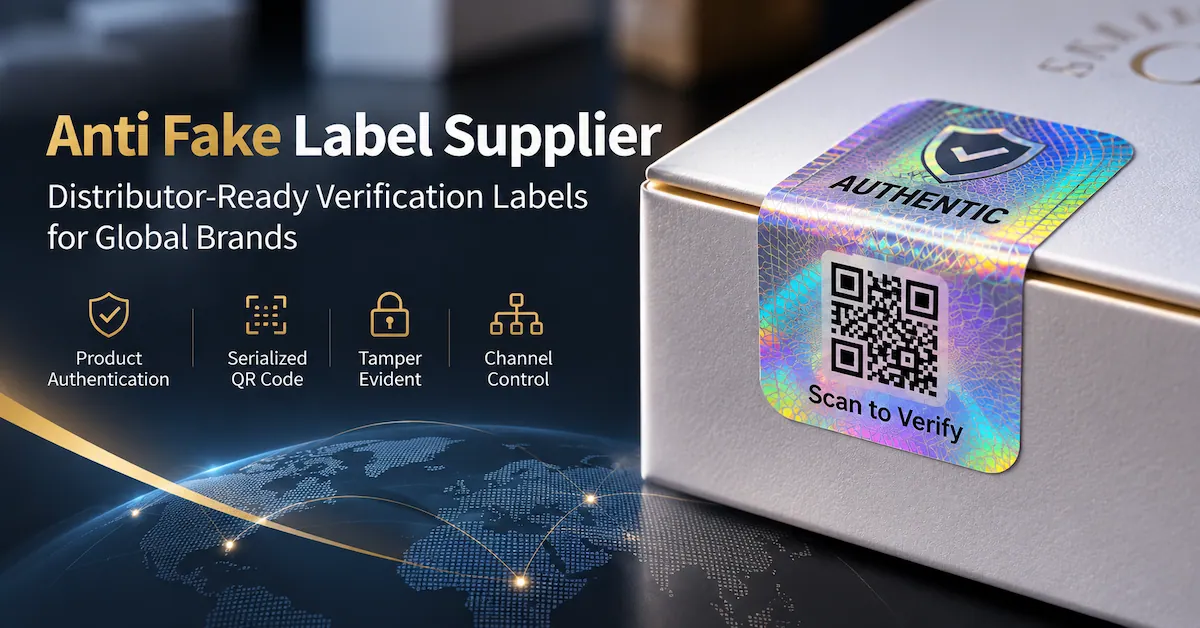
TL;DR: Choosing an anti fake label supplier for international distribution requires more than selecting a holographic sticker or adding a QR code. An effective anti-fake labeling program should combine appropriate physical security features, controlled product identification, and a clearly defined verification process. Brand owners should validate label performance, establish data responsibilities, and test dealer inspection procedures before approving bulk production.
For manufacturers selling through international distributors, product authenticity becomes increasingly difficult to manage as goods move through warehouses, importers, wholesalers, and retail channels.
A product may arrive in convincing packaging while containing counterfeit goods. A genuine security label may be removed and reused, or its visible code may be copied onto unauthorized packaging. Even authentic products may enter markets outside their intended distribution arrangements.
These situations create different risks and require different responses.
The purpose of anti-fake labeling is not simply to make products look secure. It is to provide recognizable evidence and support a practical verification process throughout the product's distribution journey.
This guide explains how procurement teams and brand protection managers can specify anti-fake labels for dealer verification, select suitable authentication technologies, establish inspection procedures, and manage bulk label orders.
For available product categories, explore the HX Security Label product collection.
Key Takeaways
-
Define the verification user: Consumers, distributors, warehouse teams, and brand inspectors may need different authentication methods.
-
Separate authentication from tracking: A QR code can identify or retrieve information about a product, but it does not automatically prove authenticity.
-
Combine physical and digital features selectively: Holographic elements, tamper-evident structures, and serialized codes address different risks.
-
Control every printed identity: Unique-code allocation, rejected-label handling, and production reconciliation are important for bulk orders.
-
Test the complete process: Verify actual packaging, code readability, dealer procedures, and handling of suspicious results before rollout.
Why Do Global Brands Need Distributor-Ready Anti-Fake Labels?
Brands operating through multiple sales channels face security challenges that may not be visible at the factory.
A security label can provide a consistent reference for identifying products, but its usefulness depends on the person checking it and the evidence available.
Four Common Distribution Risks
1. Counterfeit Product Substitution
A fake product may be placed inside packaging that resembles the genuine product.
A recognizable physical feature or controlled verification process can support inspection, although neither guarantees detection of every counterfeit.
2. Security Label Copying
A visible QR code or printed serial number can be copied.
Without additional verification controls, a duplicated code may appear legitimate during a simple scan.
3. Label Removal and Reuse
An original label may be removed from one package and transferred to another.
A suitable VOID or destructible construction can make intact removal or undetected reuse more difficult.
4. Unauthorized Channel Movement
Genuine products may appear in markets or distribution channels other than those originally intended.
This is a channel-management issue, not automatically proof of counterfeiting.
Distinguishing these situations helps brands avoid incorrectly classifying legitimate goods as fake.
Who Should Verify Products, and at What Stage?
A successful anti-fake label program should define its verification users before selecting the technology.
| Verification user | Primary question | Suitable information or feature |
|---|---|---|
| Factory quality team | Does the label match the approved specification? | Artwork, security features, code records |
| Distributor receiving team | Does this shipment match the expected product and batch? | Serial numbers, shipment records, physical security checks |
| Retailer | Does the package show suspicious interference? | Visible authentication features and tamper evidence |
| Consumer | How can I check the product? | Clear verification instructions and an appropriate digital process |
| Brand protection team | Are suspicious codes or distribution patterns being reported? | Authorized verification records and investigation procedures |
| After-sales team | Does the returned product match its registered identity? | Product identifiers, warranty records, physical inspection |
Why One Verification Method May Not Suit Every User
Consumers usually need a simple, understandable process.
A distributor may require access to additional information, such as product identification, expected batch details, or authorized shipment records.
Brand protection teams may need more detailed records for investigating unusual verification activity.
These differences can justify separate verification interfaces or permissions if a digital platform is part of the project.
The label supplier should confirm which physical and printing capabilities are available, while the buyer must separately define any required database, software, and access-control functions.
How Should an Anti Fake Label Supplier Combine Security Technologies?
Anti-fake labels can use several types of security features.
The objective is to select technologies that address specific risks, rather than adding features simply to make the label appear complicated.
Security Technology Comparison
| Security feature | Primary function | Suitable use | Main limitation |
|---|---|---|---|
| Custom holographic feature | Visual authentication | Brand packaging and distributor inspection | Does not automatically show package opening |
| VOID security structure | Tamper evidence | Carton closures and selected product surfaces | Does not independently prove product origin |
| Destructible material | Evidence of removal | Warranty and anti-transfer applications | Must be compatible with the substrate |
| Latent image | Secondary visual verification | Trained inspectors and brand protection teams | May require specific viewing conditions |
| Unique serial number | Individual product identification | Dealer verification and warranty records | Requires numbering controls |
| QR code | Machine-readable identification or information access | Consumer and distributor interaction | A visible code can be copied |
| Combined security label | Multiple defined security functions | Products exposed to several risks | More complex specification and quality control |
When Should Buyers Use Multi-Layer Security?
A cosmetics brand facing imitation packaging may evaluate a custom hologram with a defined verification method.
An electronics manufacturer concerned about unauthorized access may prioritize a tamper-evident seal.
A brand selling through several overseas distributors may need serialized identification and a controlled verification process.
For products exposed to multiple risks, combining optical features, tamper evidence, and individual identification may be appropriate.
HX offers a Holographic Label product category that buyers can review when considering optical authentication.
The availability of any specific combined construction should be confirmed during product development.
What Is the Difference Between Product Authentication and Channel Verification?
These terms describe related but separate functions.
Product authentication evaluates whether the available evidence supports the conclusion that a product is genuine.
Channel verification checks whether a product's identity or movement is consistent with an authorized distribution arrangement.
A product may be genuine but sold through an unauthorized channel.
Similarly, a product may carry a legitimate-looking identifier without being authentic.
Example: A Serialized Export Product
Consider a hypothetical electronics brand shipping products to three regional distributors.
Each product receives a unique serial number.
The brand maintains a controlled record linking product identities to approved shipments.
When a distributor receives the goods, its authorized staff can compare the physical shipment against the expected records.
If a code is associated with a different shipment or does not appear in the assigned record, the discrepancy can trigger further investigation.
An unexpected result is an investigation signal, not automatic proof that the product is counterfeit.
For this arrangement to work, the buyer needs more than printed labels. It also needs reliable shipment records, code management, and an appropriate verification system.
How Should Serialized QR Code Anti-Fake Labels Work?
A serialized QR code can connect an individual product with a defined digital identity.
The code may encode a unique URL or other structured identification information.
However, the QR image itself is only a data carrier.
The European Union Intellectual Property Office's Anti-Counterfeiting and Anti-Piracy Technology Guide explains that two-dimensional barcodes can support authentication applications when combined with appropriate identification and verification technologies.
It also makes an important distinction: QR codes alone do not prevent copying.
Five Essential Requirements for a Digital Verification Project
Unique Identity Allocation
The system should define which codes are assigned to which products or packaging units.
Duplicate Control
Printing and production processes should prevent unintended duplication of identifiers.
Defined Verification Responses
The buyer should establish what users will see when a code is recognized, unknown, deactivated, or requires further investigation.
Authorized Data Access
Different users may require different information. Commercially sensitive shipment data should not automatically be available to every consumer.
Record Management
Where verification events are recorded, the brand should establish suitable retention, access, privacy, and investigation procedures.
Should Every QR Code Use GS1 Digital Link?
Not necessarily.
GS1 Digital Link can connect standardized product identifiers with online information and is appropriate for certain supply-chain and consumer applications.
However, a proprietary security-verification project may have different technical requirements.
Buyers should select a code format according to the intended systems, market requirements, and verification objectives.
A standard QR code should not be described as GS1-compliant unless its actual encoding follows the relevant requirements.
How to Design an Anti-Fake Label for Distributor Inspection
A good label should be easy to inspect using the intended equipment and verification procedure.
Three design factors deserve particular attention.
1. Visible Authentication Features
A recognizable holographic element can provide a quick visual reference.
The design should remain clear at its final production size and under practical inspection conditions.
If specialized hidden features are included, the inspection method should be documented.
2. Tamper-Evident Placement
A security seal should be positioned where interference with a protected opening is likely to disturb it.
For cartons, this may involve a closure or opening flap.
For equipment, the intended position may be an enclosure joint or service-access point.
Buyers should test the actual label location rather than assuming that any placement provides equivalent protection.
3. Scannable Code Design
The QR code must remain readable after printing and application.
Important factors include symbol size, contrast, quiet zones, surface reflection, and package curvature.
A code printed over highly reflective holographic material may require additional design consideration to maintain reliable scanning.
For applications requiring individual product identification, buyers can also review HX's security label product range.
What Technical Specifications Should Buyers Confirm?
Before requesting bulk pricing, establish a written specification covering both the physical label and its intended verification function.
Anti-Fake Label Specification Table
| Specification | Buyer should define |
|---|---|
| Product application | Cosmetics, electronics, beverage, industrial goods, etc. |
| Main security objective | Authentication, tamper evidence, identification, or channel verification |
| Face material | Appropriate film or paper-based construction |
| Adhesive | Compatible with the actual packaging surface |
| Label dimensions | Finished size, shape, and placement |
| Visible security feature | Custom hologram or approved graphics |
| Hidden security feature | Inspection method, if required |
| Tamper response | Defined VOID, destructible, or other removal behavior |
| QR or serial data | Format, quantity, numbering rules, verification destination |
| Application process | Manual or automatic labeling |
| Supply format | Rolls or sheets |
| Inspection requirements | Physical reference samples and functional acceptance criteria |
| Commercial information | Initial volume, projected repeat orders, delivery market |
These are recommended RFQ fields. Actual materials, construction options, MOQ, and technical performance must be confirmed for the project.
How Do Packaging Materials Affect Anti-Fake Label Performance?
Security-label performance can vary significantly according to the application surface.
The same adhesive and security construction may produce different results on coated paperboard, plastic, glass, or metal.
| Packaging surface | Common challenge | Important test |
|---|---|---|
| Coated carton | Varnish and surface coating | Adhesion and removal response |
| Corrugated carton | Roughness and paper fibers | Contact area and pattern visibility |
| Plastic enclosure | Polymer type and surface treatment | Adhesive compatibility |
| Glass bottle | Curvature and condensation | Edge lifting and security response |
| Painted metal | Coating interaction | Adhesion and finish compatibility |
| Flexible packaging | Bending and distortion | Label stability and scan readability |
If a project requires tamper evidence, physical removal tests must be performed on the actual or representative packaging.
For selected applications, review the HX VOID Open Label category.
How to Launch a Distributor Verification Program Before Bulk Ordering
A distributor-ready label project should be tested as a complete process.
The following six stages provide a practical implementation framework.
Step 1: Identify the Main Risk
Decide whether the primary concern is counterfeit packaging, label reuse, code copying, unauthorized distribution, or several risks.
Define the expected inspection result.
Step 2: Choose the Label Construction
Select suitable physical and identification features according to the defined risk.
Do not assume every product needs holograms, VOID material, and serialized codes simultaneously.
Step 3: Approve Physical Samples
Test actual labels on representative product packaging.
Inspect graphics, security effects, adhesion, code readability, and removal behavior where applicable.
Step 4: Establish Code and Data Responsibilities
If unique codes are required, agree who generates them, prints them, manages rejected labels, maintains product records, and operates any verification service.
Step 5: Conduct a Pilot With Selected Distributors
Use a controlled group of products and authorized users.
Check whether staff can recognize the intended security features and correctly interpret verification responses.
Include realistic test situations, such as unreadable codes, packaging damage, incorrect batch information, and repeated code observations.
Step 6: Approve Bulk Production and Monitoring
After successful validation, document the final label specification, data responsibilities, quality acceptance criteria, and procedures for handling suspicious products.
This process supports a more reliable rollout than ordering a large quantity of labels before testing how the system will be used.
What Quality-Control Checks Should an Anti Fake Label Supplier Provide?
Security-label inspection should focus on whether the product performs its required function.
A visually attractive label may still be unacceptable if its serial data is incorrect or its tamper-evident structure does not respond as specified.
Recommended Quality-Control Matrix
| Inspection area | Acceptance objective |
|---|---|
| Approved artwork | Correct logo, text, and design revision |
| Holographic effect | Matches approved physical reference |
| Dimensions | Within agreed size and die-cut tolerances |
| Adhesion | Suitable under defined application conditions |
| Tamper response | Intended security evidence appears |
| QR readability | Meets agreed scanning requirements |
| Serial-number accuracy | Matches approved production data |
| Duplicate control | No unintended repeated identities within the production set |
| Roll configuration | Compatible with intended application equipment |
| Batch reconciliation | Printed, rejected, and released quantities are accounted for |
These are recommended quality-control categories, not guaranteed HX testing services or universal pass/fail standards.
How Should Defects Be Classified?
A missing required security feature, incorrect product identity, or failed tamper response may be treated as a critical functional concern.
Incorrect roll direction, substantial printing misalignment, or unreadable codes may require rejection or rework depending on their significance.
Minor cosmetic differences should be assessed against the approved reference and agreed acceptance criteria.
Defect classifications and sampling procedures should be defined before mass production.
How Should Distributors Respond to Suspicious Verification Results?
Verification technology becomes more useful when staff know what action to take.
A simple decision framework can help reduce confusion.
| Inspection result | Recommended action |
|---|---|
| Expected identity and intact physical features | Continue the normal authorized receiving process |
| Code unreadable | Check the physical condition and follow the documented exception procedure |
| Code not recognized | Hold for further review and verify the data source |
| Code previously observed | Investigate possible duplication, repeated legitimate scanning, or another explanation |
| Tamper feature visibly disturbed | Inspect package integrity and follow the incident procedure |
| Channel or shipment mismatch | Confirm shipment records before deciding whether a distribution problem exists |
Repeated scans are not necessarily evidence of counterfeiting.
The same product may legitimately be checked more than once by warehouse staff, retailers, or consumers.
Likewise, a product found outside its expected sales territory may be genuine.
The purpose of the verification process is to provide evidence for informed decisions, not to generate automatic accusations.
What Affects Anti-Fake Label Cost, MOQ, and Lead Time?
Pricing depends on the physical construction and the additional project requirements.
Relevant cost factors include:
-
Security materials and adhesives.
-
Original holographic artwork or tooling.
-
Custom dimensions and die-cut shapes.
-
Tamper-evident structures.
-
Variable-data printing and inspection.
-
Code generation and reconciliation.
-
Sampling and application testing.
-
Roll or sheet formatting.
-
Order quantity and repeat-order requirements.
Digital verification services, software integration, database operation, and ongoing support may represent separate costs if required.
A buyer should confirm whether a supplier's quotation covers only printed labels or also includes any supporting verification functions.
What Is the Right Purchasing Approach?
Compare quotations based on the same security and production specifications.
Ask for sample approval procedures, current MOQ, tooling requirements, production scheduling, and repeat-order controls.
There is no universal MOQ or lead time that applies to every customized anti-fake label.
Working With HX Security Label on Custom Anti-Fake Projects
HX Security Label, operated by Shenzhen Huaxin Anti-Counterfeiting Technology Co., Ltd., focuses on anti-counterfeiting label development, manufacturing, and customized security solutions.
Established in Shenzhen in 2008, the company presents a product portfolio including holographic labels, VOID-related labels, latent image labels, and other security-label applications.
According to its published company information, HX uses a development process involving requirements confirmation, design drafting, product proofing, material selection, sample confirmation, and delivery coordination.
These stages provide a useful foundation for custom physical-label projects.
For distributor verification applications, buyers should identify which label features are required and which digital verification responsibilities must be handled by the brand, its technology provider, or another agreed party.
The availability of any specific authentication platform, database integration, or distributor-management function should be confirmed separately with HX.
Review the HX company profile to learn more about its published manufacturing background.
What Should You Include in an RFQ?
A useful request should describe the product category, target markets, packaging material, security risks, intended verification users, label dimensions, preferred physical features, code requirements, expected quantity, and application process.
For serialized projects, also explain the expected code format, record ownership, and whether an existing verification system will be used.
Request a Custom Anti-Fake Label Quotation
Share your packaging specifications, product-protection requirements, and estimated purchasing volume to discuss suitable physical security-label options and sample development.
Frequently Asked Questions About Anti-Fake Label Suppliers
1. What does an anti fake label supplier provide?
An anti fake label supplier provides security labels intended to support authentication, tamper evidence, identification, or related product-protection functions. Depending on the selected construction, labels may incorporate holographic features, VOID structures, hidden images, serial numbers, or QR codes. Specific capabilities must be confirmed for each project.
2. Can anti-fake labels help distributors identify counterfeit products?
They can support inspection by providing recognizable security features or controlled product identifiers. Their effectiveness depends on the verification process, product records, and whether the security features have been selected for the relevant counterfeit risks.
3. Are QR code anti-fake labels enough to guarantee authenticity?
No. A QR code can be copied and printed on another label. Effective digital authentication requires appropriate data management, verification logic, and supporting security measures. A successful scan alone does not prove that the physical product is genuine.
4. What is the difference between anti-counterfeit labels and tamper-evident labels?
Anti-counterfeit labels are broadly intended to support product authentication or brand protection. Tamper-evident labels specifically reveal defined forms of removal or interference. A product may require one or both functions depending on its risks.
5. Can anti-fake labels include custom holographic logos?
Custom holographic graphics may be available depending on the design and production technology. Buyers should provide approved artwork, final dimensions, and intended optical effects. Physical samples should be reviewed before bulk production.
6. How can brands reduce the risk of genuine security labels being reused?
A suitable VOID or destructible construction may provide visible evidence of removal. Buyers should test the label on the actual packaging and confirm the intended response. No construction should be described as impossible to defeat.
7. What information should dealers verify when receiving products?
The required checks depend on the program. They may include package integrity, visible security features, product identifiers, expected shipment details, and any authorized digital verification response. Dealers should follow documented procedures for suspicious or inconclusive results.
8. Can one anti-fake label work on cartons, glass, plastic, and metal?
Not necessarily. Adhesion and tamper-evident behavior depend on substrate material, surface finish, curvature, cleanliness, and environmental conditions. Buyers should qualify representative packaging before approving one construction for several surfaces.
9. What determines the MOQ for wholesale anti-fake labels?
MOQ can depend on materials, custom security features, artwork, tooling, variable printing, converting formats, and production quantity. Buyers should request specific commercial terms based on their actual specifications and expected order volume.
10. How do I request custom anti-fake labels from HX Security Label?
Prepare product and packaging information, label dimensions, artwork, required security features, intended inspection methods, and estimated quantity. Then contact HX Security Label to discuss available construction options, sample requirements, and quotation details.
Conclusion
Selecting a reliable anti fake label supplier is not simply a matter of finding a factory that prints holographic stickers or QR codes. For brands operating through international distribution networks, effective product protection requires clearly defined authentication objectives, suitable physical security features, controlled identification data, and practical verification procedures.
Holographic labels can support visual authentication, VOID and destructible constructions can provide evidence of removal, and serialized QR codes can support individual identification when connected to appropriate data-management processes.
However, no single feature guarantees that counterfeit products will be detected or that unauthorized distribution will be prevented.
For procurement managers, packaging engineers, and brand protection teams, the most effective approach is to qualify the physical label, clarify digital-system responsibilities, test dealer workflows, and establish production quality controls before ordering in volume.
HX Security Label provides customized anti-counterfeiting label solutions that can be evaluated as part of a broader product-protection strategy.
Contact HX Security Label with your packaging details, verification objectives, security-feature requirements, and estimated order quantity to discuss suitable anti-fake label options and request a quotation.