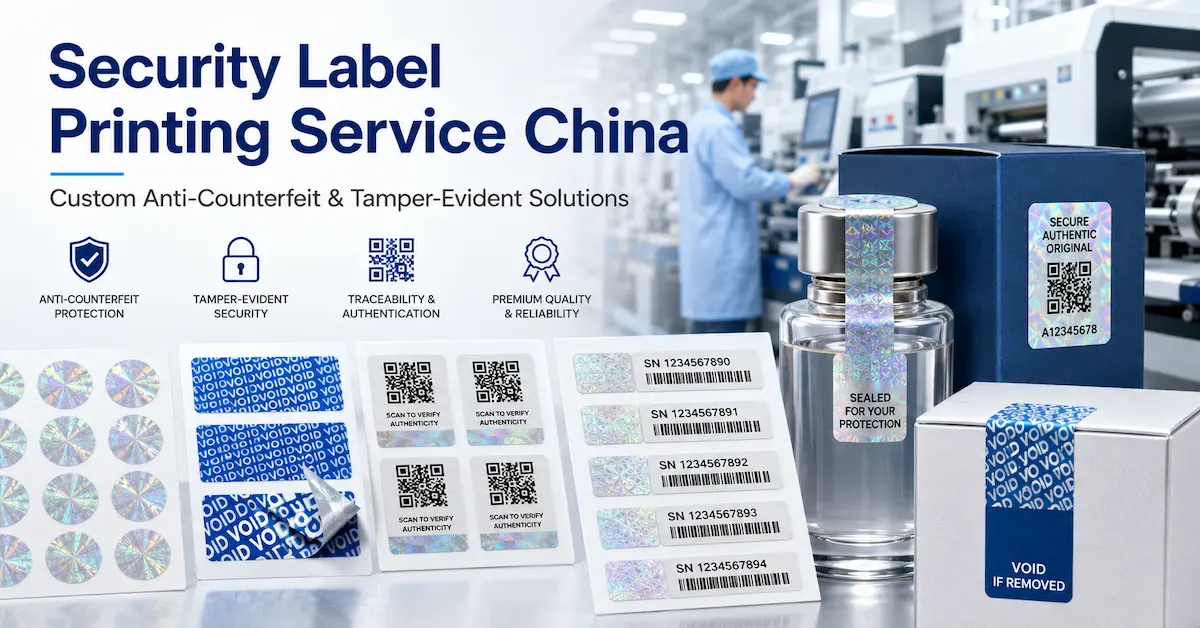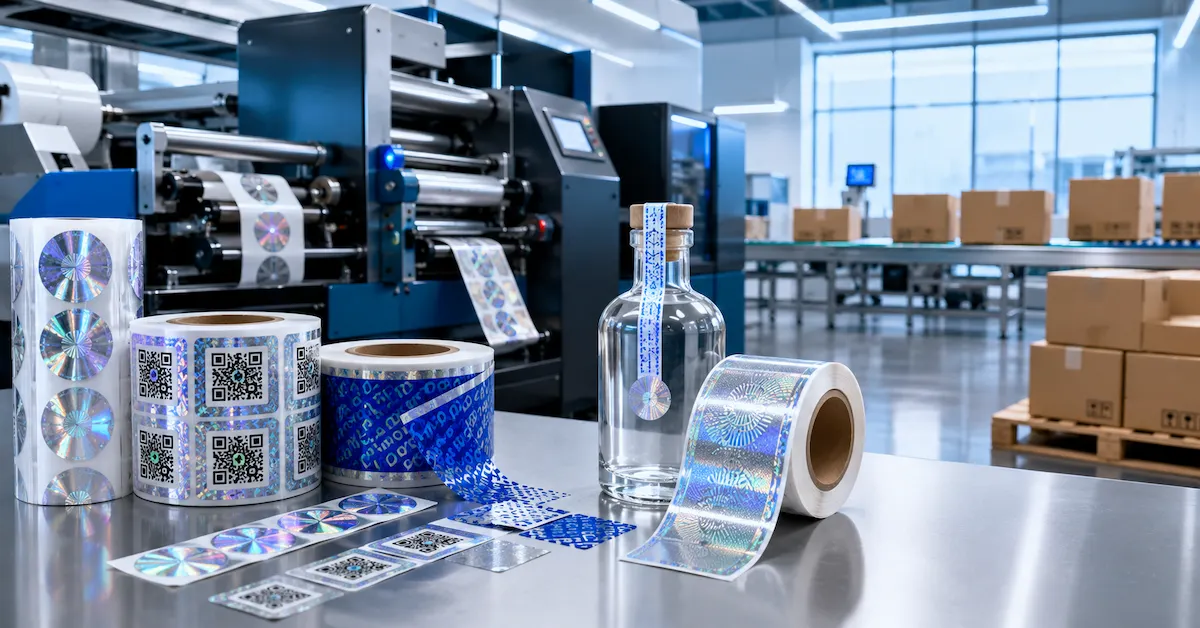

Choosing an OEM security label manufacturer is not the same as buying ordinary printed stickers. Security labels need to protect products, prove authenticity, prevent tampering, and support brand trust across real supply chains.
For brands in liquor, pharmaceuticals, electronics, cosmetics, tea, food, agricultural products, and logistics packaging, the label must match the product surface, packaging material, verification method, and tamper risk.
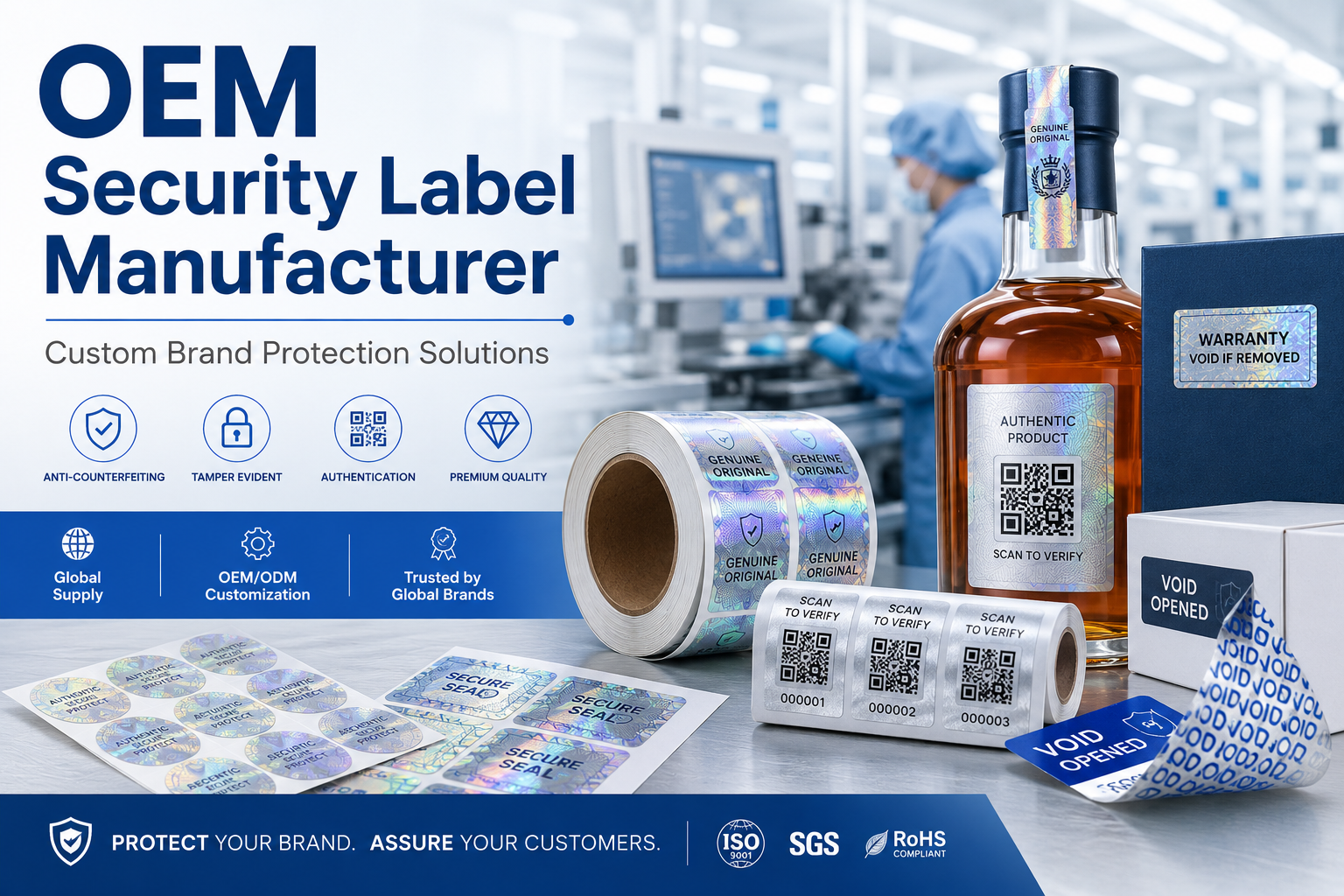
A professional OEM manufacturer should help you answer practical questions:
- Will the label stay stable during transport?
- Will it show clear evidence if removed?
- Can it include holographic effects, QR codes, serial numbers, or hidden features?
- Can it be customized for glass, plastic, cartons, metal, or film packaging?
- Can the supplier keep quality consistent during bulk production?
If you are looking for different anti-counterfeiting label options, you can first explore HX’s security label product categories to understand common structures and applications.
What Is an OEM Security Label Manufacturer?
An OEM security label manufacturer produces customized labels according to a brand’s design, packaging requirement, anti-counterfeiting need, and production standard.
Unlike general sticker suppliers, an OEM security label factory usually provides more than printing. It may support:
- Custom label size, shape, color, and logo
- Holographic security design
- VOID or tamper-evident structure
- QR code or barcode authentication
- Serial number printing
- Hidden image or latent image features
- Wine tax stamp and bottle seal labels
- Material and adhesive selection
- Sample proofing before mass production
- Bulk packaging and export delivery
For international buyers, this matters because different products face different risks. A liquor bottle needs anti-refill protection. An electronic device may need warranty seal protection. A pharmaceutical package may need product authentication and traceability. A logistics carton may need tamper evidence during transport.
A good OEM security label manufacturer should design the label around the product’s actual use, not just around appearance.
Why OEM Security Labels Matter for Brand Protection
Counterfeiting, product replacement, unauthorized refilling, and package tampering often happen after production. A product may leave the factory safely but face risk during storage, distribution, retail handling, or cross-border shipment.
OEM security labels help brands reduce these risks by adding visible and hidden protection layers.
Common protection goals include:
| Brand Risk | Suitable Security Label Solution |
|---|---|
| Product counterfeiting | Holographic label, QR code label, serial number label |
| Package tampering | VOID label, fragile label, tamper evident seal |
| Bottle refilling | Wine tax stamp, bottle neck seal, destructible label |
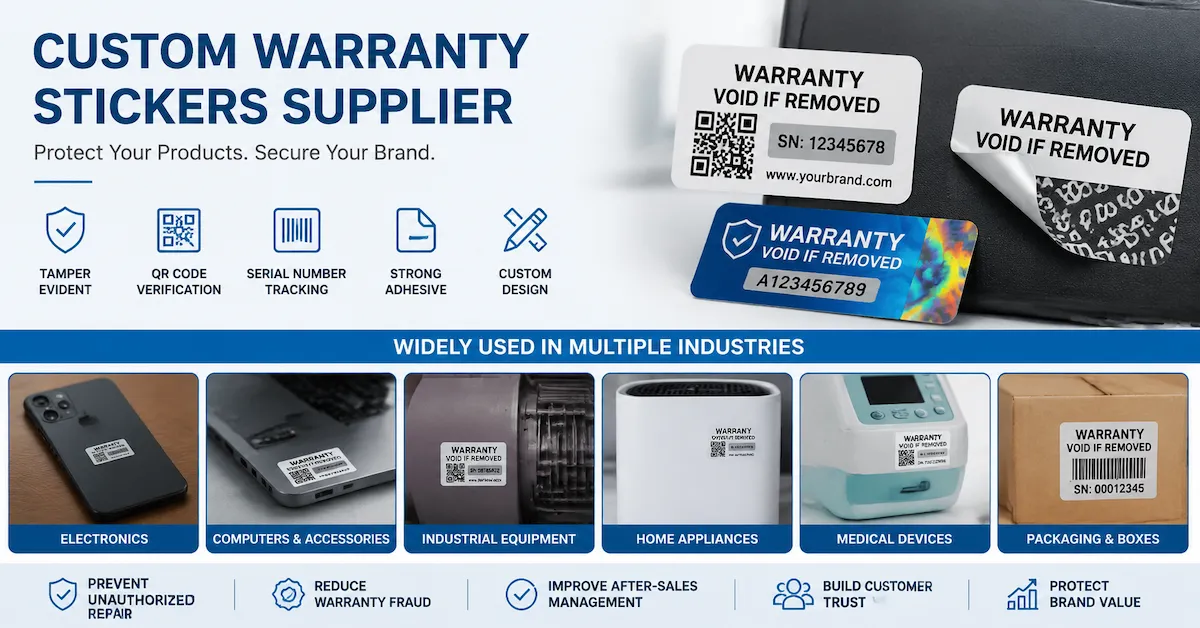
| Warranty fraud | VOID warranty seal, serialized electronics label |
| Logistics replacement | Carton security seal, barcode security label |
| Fake retail products | Custom anti counterfeit label with brand logo |
For B2B buyers, the purpose is not only to make packaging look secure. The real goal is to make unauthorized copying, removal, or reuse harder and easier to detect.
Key Features to Check Before Choosing a Manufacturer
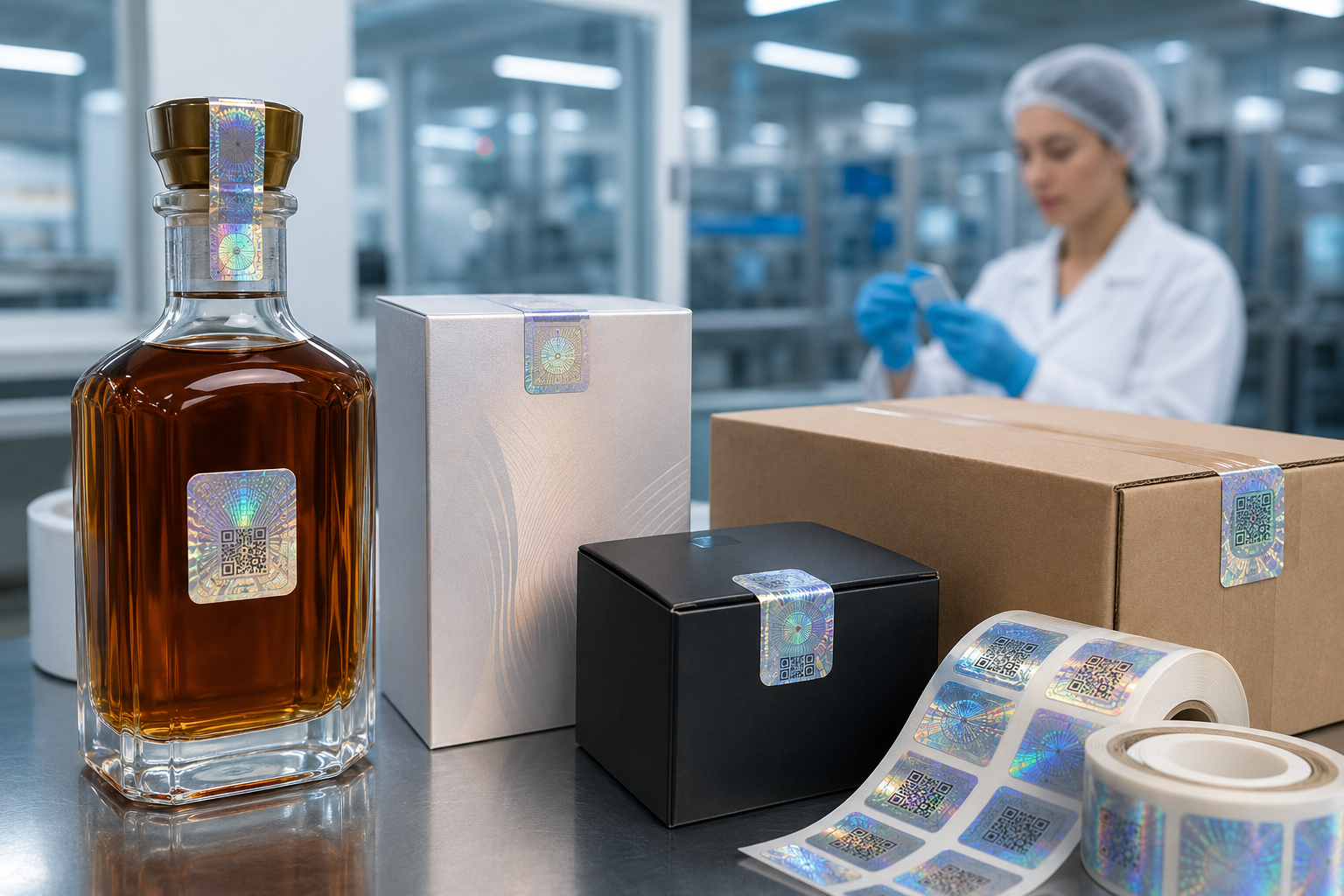
When comparing security label suppliers, buyers should not only ask for price. A lower unit price may become expensive if labels fail during transport, peel off from the package, or show unclear tamper evidence.
Here are the key points to check.
1. Custom Security Design Capability
OEM projects usually require brand-specific design. The manufacturer should be able to combine visual branding with anti-counterfeit features.
For example, a custom security label may include:
- Brand logo
- Holographic background
- Microtext
- QR code
- Barcode
- Serial number
- Hidden image
- Color-shifting effect
- Scratch-off verification area
- VOID or destructible layer
The best design is not always the most complicated one. It should match the product value, market risk, inspection method, and buyer budget.
For projects that need stronger visual authentication, holographic labels are often used because they combine brand presentation with optical anti-counterfeiting effects.
2. Material Selection
Security labels can be made from different materials, such as PET film, holographic film, destructible paper, VOID film, adhesive paper, or composite materials.
The right material depends on the application surface:
| Application Surface | Common Label Requirement |
| Glass bottle | Strong adhesion, curved surface fit, anti-refill protection |
| Carton box | Clear tamper evidence, stable adhesion on paper surface |
| Plastic packaging | Adhesive compatibility, moisture resistance |
| Metal device | Warranty protection, clean tamper mark |
| Film packaging | Flexible label structure, lightweight material |
| Pharmaceutical box | Clean printing, traceability, product authentication |
A professional OEM security label manufacturer should ask where the label will be applied before recommending the material.
3. Adhesive Performance
Adhesive is one of the most important parts of a security label. If the adhesive is too weak, the label may lift during transport. If it is too aggressive, it may damage the packaging before use or create application problems.
For tamper evident labels, the adhesive must be controlled carefully. It should stay stable during normal use but react clearly when someone tries to remove the label.
Important adhesive questions include:
- Will the label be used indoors or outdoors?
- Will the product face moisture, cold storage, or heat?
- Is the surface glass, plastic, metal, paper, or coated carton?
- Does the label need to leave VOID residue?
- Should the label break into pieces after removal?
- Does the packaging need a clean appearance before tampering?
These details directly affect the final label performance. If your project needs clear opening evidence, VOID open labels can be a practical choice for cartons, electronics, logistics packaging, and warranty protection.
4. Anti-Counterfeiting Technology
A reliable OEM security label manufacturer should offer multiple security technologies, not only basic printing.
Common options include:
- Holographic imaging
- Laser engraving
- Rainbow gradient microtext
- QR code authentication
- Barcode tracking
- Digital anti-counterfeiting codes
- Fluorescent features
- Latent image design
- VOID tamper evidence
- Destructible material
- Serial number printing
For high-risk products, combining physical and digital protection is often more effective. For example, a liquor bottle label can use holographic effects for visual inspection, a destructible seal for anti-refilling, and a QR code for consumer verification.
OEM Security Label Types for Different Products
Different industries need different label structures. Buyers should choose label types according to real usage instead of using one design for all products.
Holographic Security Labels
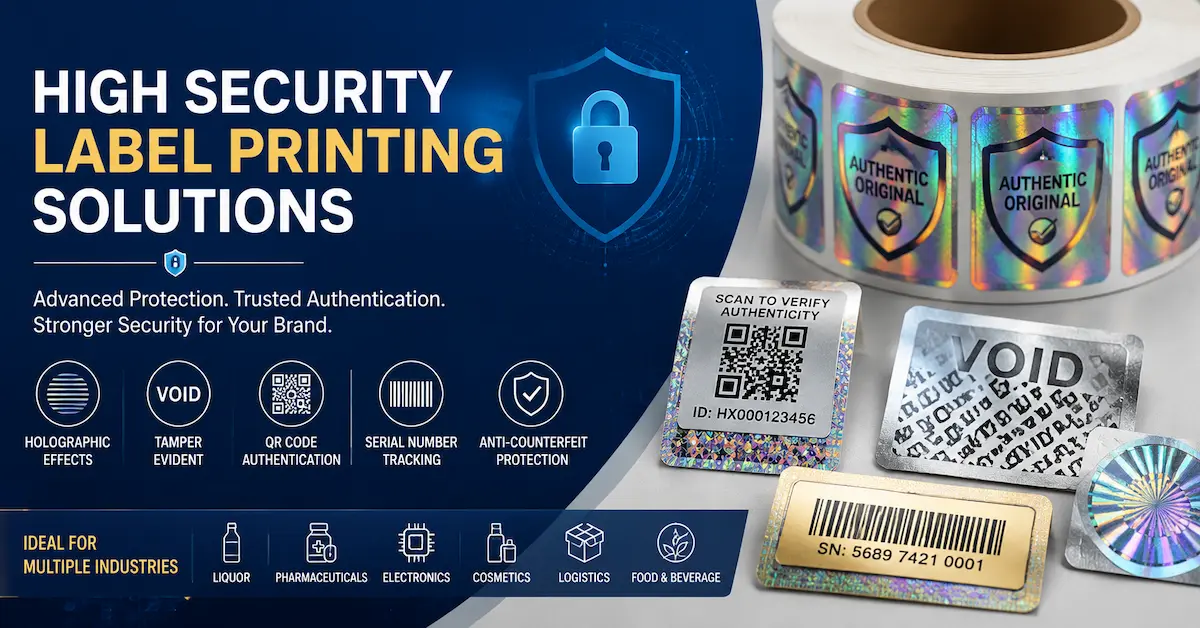
Holographic security labels are suitable for premium packaging, alcohol, cosmetics, certificates, electronics, and retail products.
They provide strong visual recognition and are difficult to reproduce with ordinary printing. They can also improve packaging appearance while supporting brand protection.
Best for:
- Liquor and spirits
- Cosmetics
- Electronics
- Gift boxes
- Certificates
- Premium consumer goods
VOID Security Labels
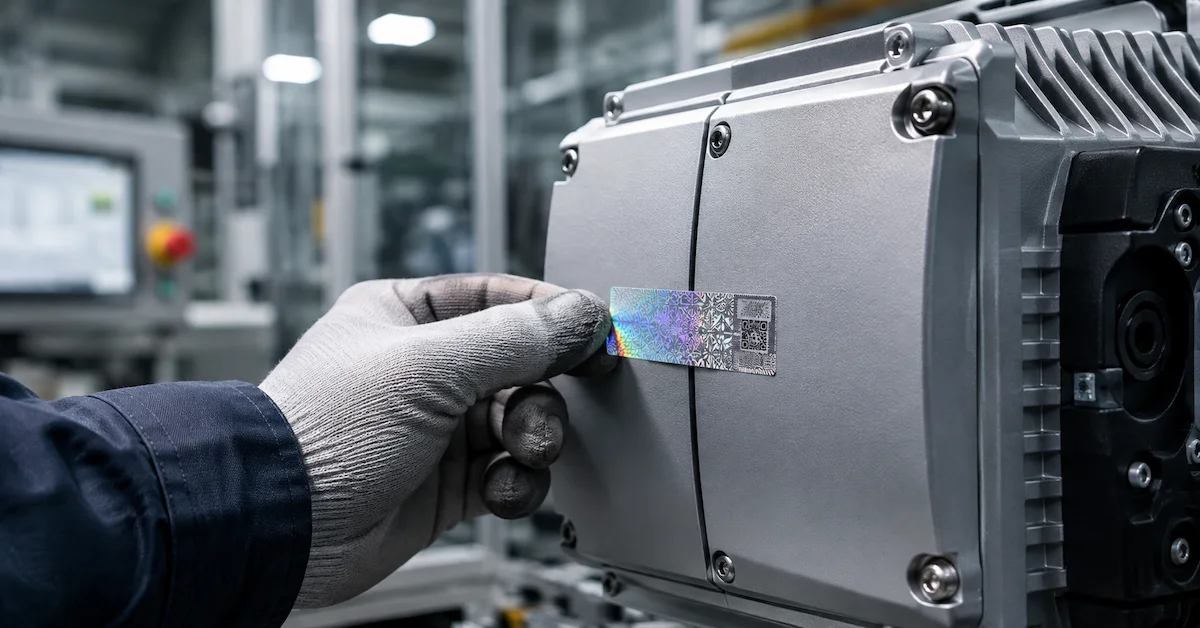
VOID labels leave visible text or residue after removal. They are widely used for packaging seals, warranty seals, electronics, logistics cartons, and equipment protection.
Best for:
- Electronic devices
- Warranty seals
- Shipping cartons
- Asset protection
- Warehouse packaging
- Sealed packages
Wine Tax Stamp Labels
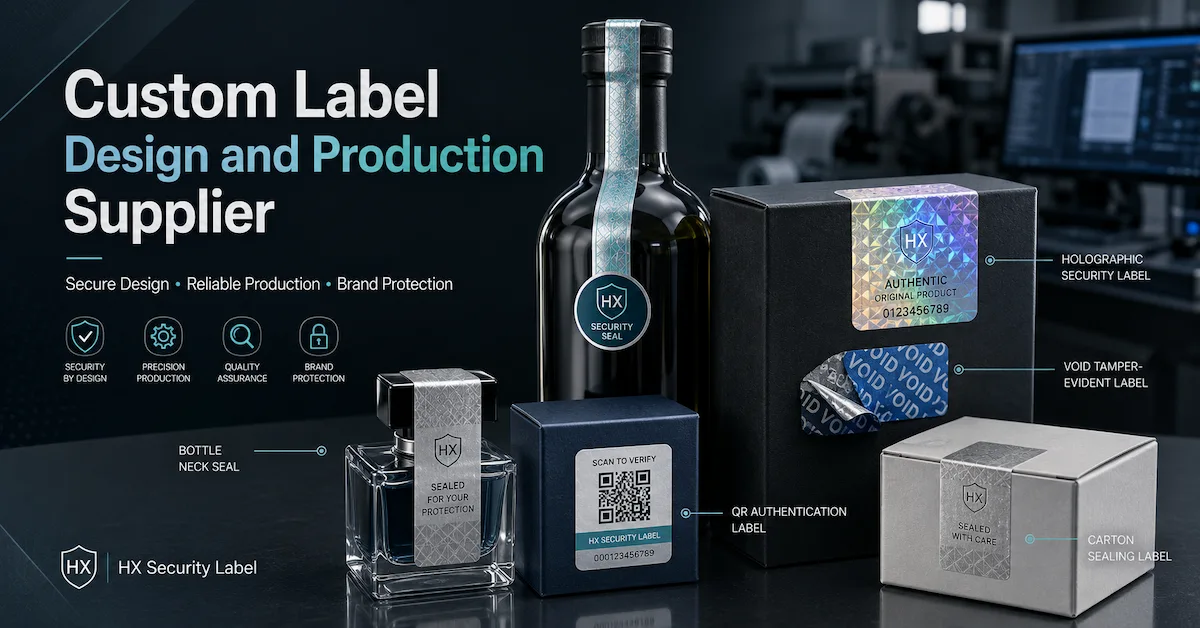
Wine tax stamp labels are used on bottle necks, caps, and alcohol packaging. They need to resist reuse, support inspection, and protect products against refilling or counterfeiting.
For liquor, wine, and spirits packaging, wine tax stamp labels are commonly used on bottle necks, caps, and sealing positions to support anti-refill and product authentication needs.
Best for:
- Wine bottles
- Spirits
- Liquor brands
- Imported alcohol
- Tax control labels
- Bottle seal applications
Latent Image Labels
Latent image labels contain hidden visual information that becomes visible under certain viewing angles or tools. They are useful when brands need a covert verification layer.
If your brand needs hidden verification beyond visible holographic effects, latent image labels can add another layer of inspection security.
Best for:
- High-value products
- Certificates
- Anti-counterfeit documents
- Electronics
- Branded packaging
- Controlled inspection systems
QR Code and Barcode Security Labels
QR code and barcode security labels support product verification, traceability, batch management, and consumer authentication.
Best for:
- Pharmaceuticals
- Food and tea products
- Cosmetics
- Logistics packaging
- Electronics
- Supply chain tracking
For customized applications beyond standard categories, buyers can also review HX’s other uses label solutions for more packaging and product protection scenarios.
How to Evaluate an OEM Security Label Manufacturer
Before placing an order, buyers should evaluate the supplier from technical, production, and communication perspectives.
1. Does the Manufacturer Understand Your Industry?
A supplier that only asks for artwork and size may not be enough. A professional manufacturer should ask about:
- Product category
- Packaging surface
- Label position
- Anti-counterfeit level
- Verification method
- Use environment
- Order quantity
- Export market
- Packaging process
For example, a label for a wine bottle neck is very different from a label for an electronic warranty seal. The shape, adhesive, tamper response, and material all need different planning.
You can also learn more about HX’s background, production process, patents, and anti-counterfeiting experience on the About Us page.
2. Can the Supplier Provide Proofing Before Mass Production?
For OEM security labels, sample proofing is important. It allows buyers to check color, material, adhesion, QR code readability, tamper evidence, and packaging fit before bulk production.
A proper proofing process helps reduce risk and prevents costly production mistakes.
3. Can the Factory Maintain Consistency in Bulk Orders?
Security labels often require accurate printing, stable color, clear codes, and consistent adhesive behavior. During large production runs, small inconsistencies may create problems in packaging lines or inspections.
Buyers should check whether the supplier can manage:
- Batch color consistency
- Serial number accuracy
- QR code readability
- Die-cutting precision
- Adhesive stability
- Packaging and roll/sheet format
- Quality inspection before shipment
4. Can the Label Be Customized for Your Packaging Line?
OEM security labels should not only look correct. They also need to work with the buyer’s packaging process.
Before production, confirm:
- Roll or sheet format
- Label direction
- Core size
- Gap between labels
- Automatic labeling compatibility
- Manual application requirements
- Packaging storage conditions
This is especially important for brands using automated labeling machines or high-volume packaging lines.
Common Mistakes Buyers Should Avoid
Many buyers make the same mistakes when sourcing security labels.
Mistake 1: Choosing Only by Price
Low-cost labels may look acceptable at first, but they may fail in adhesion, tamper response, code readability, or long-term durability.
For security labels, performance matters more than unit price alone.
Mistake 2: Using One Label for Every Surface
A label that works on a paper box may not work on a glass bottle, plastic bag, metal shell, or curved cap. Always match the label material and adhesive to the application surface.
Mistake 3: Ignoring Transport Conditions
Labels may face humidity, temperature changes, stacking pressure, abrasion, or cold storage. If the label is not tested for real conditions, it may fail before the product reaches the market.
Mistake 4: Adding Too Many Features Without a Clear Purpose
More security features do not always mean better protection. Each feature should serve a clear purpose: visual authentication, tamper evidence, digital verification, traceability, or inspection support.
Mistake 5: Not Confirming Data Management
If the label includes QR codes, barcodes, or serial numbers, the buyer should confirm how codes are generated, printed, checked, and delivered. Duplicate codes or unreadable codes can damage trust.
How HX Supports OEM Security Label Projects
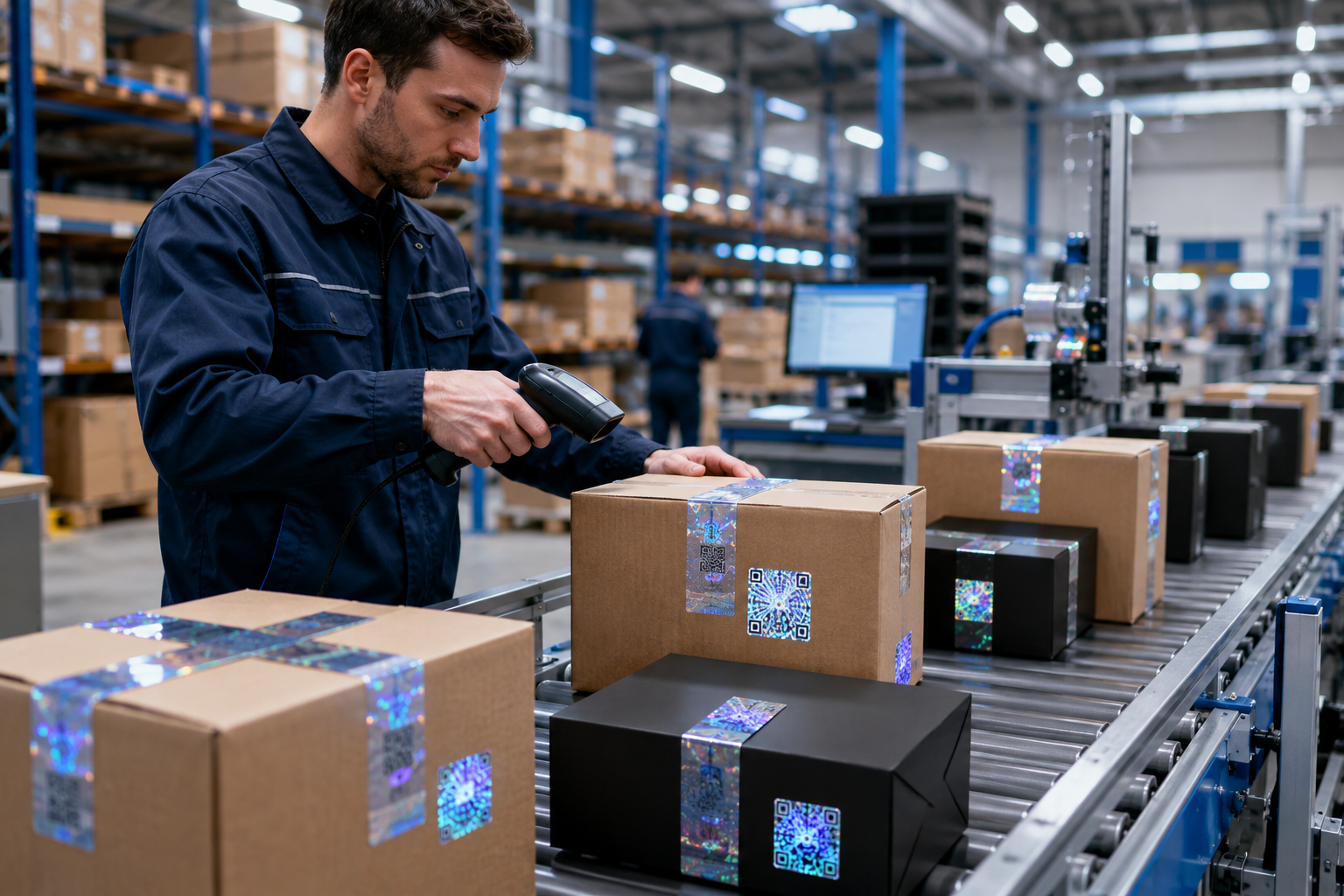
HX Security Label provides customized anti-counterfeiting label solutions for industries such as liquor, pharmaceuticals, electronics, tea, food, agricultural products, tobacco, alcohol, and other brand protection markets.
For OEM projects, HX can support different product needs, including:
- Holographic security labels
- VOID open labels
- Wine tax stamp labels
- Latent image labels
- Barcode and QR code security labels
- Custom anti counterfeit labels
- Tamper evident packaging seals
- Serialized product authentication labels
HX’s OEM process focuses on practical project steps: requirement confirmation, design draft, product proof, material selection, sample confirmation, logistics, and packaging.
This process helps buyers move from concept to mass production with less uncertainty.
For brands that need long-term protection, HX can combine visible security, hidden features, tamper-evident materials, and digital verification into one customized label solution.
OEM Security Label Specification Checklist
Before requesting a quote, buyers should prepare the following information:
| Item | What to Prepare |
| Product type | Liquor, electronics, medicine, cosmetics, food, logistics, etc. |
| Application surface | Glass, plastic, paper box, carton, metal, film, cap, bottle neck |
| Label size | Width, height, shape, roll or sheet format |
| Design file | Logo, color requirement, artwork, brand elements |
| Security feature | Holographic, VOID, QR code, barcode, serial number, latent image |
| Tamper requirement | VOID residue, destructible material, one-time use, anti-refill |
| Environment | Moisture, heat, cold storage, transport abrasion, outdoor exposure |
| Quantity | Sample quantity and bulk order quantity |
| Packaging method | Manual labeling or automatic labeling |
| Target market | Domestic, export, regulated industry, retail, supply chain use |
Providing this information helps the manufacturer recommend a more accurate solution and quote.
Why Work with an OEM Manufacturer Instead of a General Sticker Supplier?
A general sticker supplier may be enough for simple branding labels. But for product authentication and anti-counterfeit packaging, brands need stronger technical support.
| Comparison Point | General Sticker Supplier | OEM Security Label Manufacturer |
| Main focus | Printing appearance | Security performance and brand protection |
| Material selection | Basic sticker materials | Application-specific security materials |
| Tamper response | Limited or none | VOID, destructible, anti-removal options |
| Verification | Usually none | QR code, barcode, serial number options |
| Customization | Logo and size | Structure, adhesive, security layer, data |
| Bulk consistency | Basic quality check | Security-focused quality control |
| Best for | Promotional stickers | Anti-counterfeit and tamper-evident packaging |
For brands facing counterfeiting risk, an OEM security label manufacturer is a safer long-term partner.
FAQ
1. What is an OEM security label manufacturer?
An OEM security label manufacturer produces customized anti-counterfeit and tamper-evident labels based on a brand’s packaging, design, surface, verification method, and security requirements.
2. Can security labels be customized with our logo?
Yes. OEM security labels can be customized with logo, brand colors, shape, size, holographic design, QR code, barcode, serial number, hidden image, or VOID effect.
3. What products need OEM security labels?
OEM security labels are commonly used for liquor, wine, pharmaceuticals, electronics, cosmetics, food, tea, agricultural products, logistics packaging, and premium retail products.
4. What is the difference between holographic labels and VOID labels?
Holographic labels focus on visual anti-counterfeiting and brand authentication. VOID labels focus on tamper evidence and leave a visible mark after removal. Some products may use both together.
5. Can OEM security labels support QR code verification?
Yes. QR codes, barcodes, serial numbers, and digital anti-counterfeiting codes can be integrated into custom security labels for authentication and traceability.
6. Are security labels suitable for glass bottles?
Yes, but the label must use suitable material and adhesive. Wine tax stamps and bottle seal labels are often designed for glass bottles, caps, and curved bottle necks.
7. Do I need a sample before mass production?
Yes. Sample proofing is recommended for OEM projects because it allows you to check appearance, adhesion, tamper effect, code readability, and packaging compatibility before bulk production.
8. How do I choose the right security label material?
The right material depends on the surface, use environment, tamper requirement, and packaging process. PET film, holographic film, VOID film, destructible paper, and composite materials are common options.
9. Can security labels be used for logistics packaging?
Yes. Security labels can be used on cartons, shipping boxes, pallets, and warehouse packaging to show tamper evidence and support product tracking.
10. What information should I send for a quotation?
You can send product type, label size, application surface, design file, quantity, security feature requirements, packaging method, and whether you need QR codes, serial numbers, VOID effect, or holographic design.
Conclusion
Choosing an OEM security label manufacturer is a brand protection decision, not just a printing purchase.
The right partner should understand your product, packaging surface, supply chain risk, tamper requirement, verification method, and bulk production needs. Whether you need holographic labels, VOID labels, wine tax stamps, QR code labels, latent image labels, or serialized anti-counterfeit labels, the solution should be designed around real product use.
HX Security Label supports custom OEM security label projects with anti-counterfeiting technology, material selection, proofing, and mass production service.
If you are planning a custom security label project, prepare your product details, label size, application surface, security requirements, and order quantity. You can contact HX Security Label to discuss a practical label solution for brand protection, product authentication, and tamper-evident packaging.