
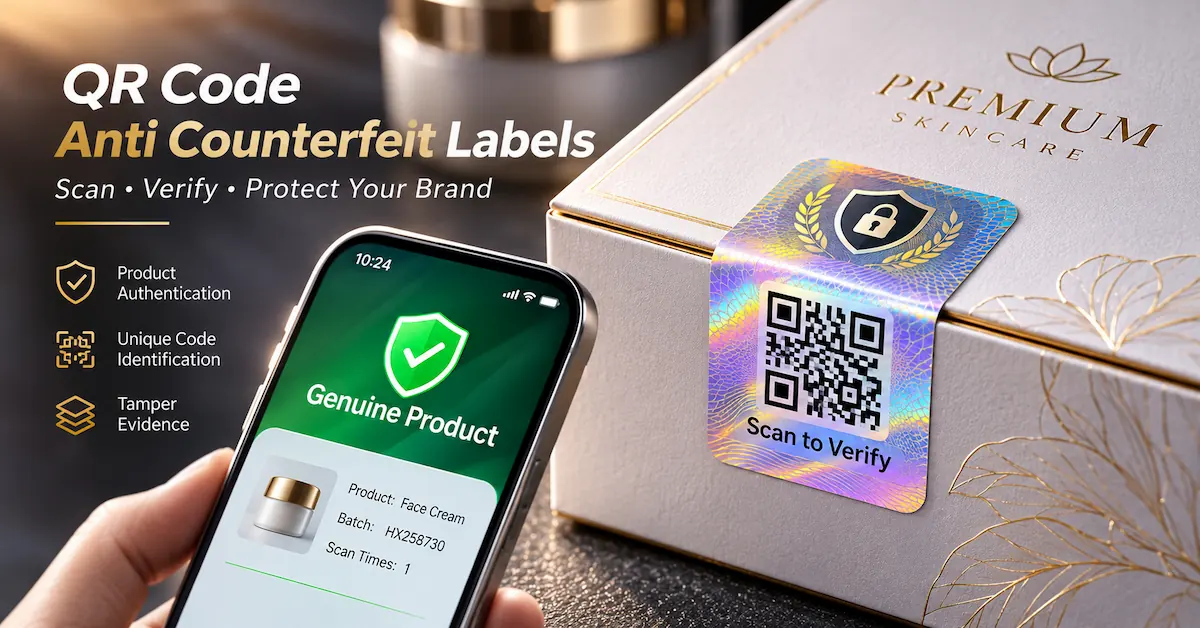
TL;DR: QR code anti counterfeit labels can connect individual products to digital verification records, but printing a unique QR code does not automatically prevent copying. A practical authentication program requires controlled code generation, a trustworthy verification page, appropriate handling of repeated scans, and physical label protection. Before bulk production, brands should validate scanning performance, data accuracy, packaging compatibility, and the complete consumer experience.
For cosmetics brands, electronics manufacturers, and international packaging buyers, product authentication is no longer limited to visual inspection.
Customers increasingly expect to access product information through their smartphones. A QR-enabled security label offers a convenient interaction point between physical packaging and digital product records.
However, there is a critical distinction between a label that opens a website and one that participates in a meaningful authentication system.
A counterfeiter may photograph a legitimate QR code and reproduce it on multiple packages. If the verification service simply displays the same confirmation page whenever that code is scanned, customers may receive misleading reassurance.
Effective QR authentication therefore depends on the complete verification workflow, not the printed symbol alone.
This guide explains how to specify QR security labels, design consumer-facing verification processes, assess suspicious scans, and prepare a reliable project specification for custom manufacturing.
Explore HX Security Label's product collection to review relevant security-label categories.
Key Takeaways
-
Unique codes need verification logic: Printing a different QR code on every product supports identification, but the backend must determine how that identity is validated.
-
Copied codes require careful investigation: Repeated scans can indicate duplication, but legitimate customers may scan authentic products multiple times.
-
Consumer experience matters: Verification pages should clearly explain scan outcomes without making unsupported authenticity claims.
-
Physical security adds value: Holographic and tamper-evident features can help address risks that digital codes alone cannot resolve.
-
Production testing is essential: Code readability, data accuracy, packaging compatibility, and system responses should be validated before bulk orders.
What Are QR Code Anti Counterfeit Labels?
QR code anti counterfeit labels are printed labels incorporating machine-readable QR symbols intended to support product identification, authentication, or related brand-protection processes.
Depending on the construction, these labels may also include serial numbers, brand logos, holographic features, or tamper-evident materials.
A QR code stores information that a compatible scanner can decode. In consumer applications, it commonly directs users to a website or digital service.
However, the QR symbol itself does not verify whether the physical product is genuine.
The Three Components of a QR Authentication Solution
A complete solution can be divided into three functional layers.
1. Physical Security Label
The printed label carries the QR symbol and any selected security features.
Its materials, dimensions, adhesive, and printing quality determine whether consumers can access the encoded information reliably.
2. Product Identity Record
A controlled data record associates the label's identifier with an intended product, batch, or other authorized information.
Unique identities must be created, assigned, and managed according to defined procedures.
3. Verification Service
A digital service interprets the identifier and provides an appropriate result.
Depending on the system design, it may check identity status, recorded events, or other conditions.
A printed QR label without an appropriate verification service is not equivalent to a complete digital authentication system.
Static vs. Serialized vs. Tamper-Evident QR Labels
B2B buyers should distinguish between different QR label configurations before discussing pricing or production volume.
| Label configuration | Main function | Security limitation | Suitable use |
|---|---|---|---|
| Static QR label | Directs users to shared information | The same code can be copied freely | Product instructions and marketing |
| Serialized QR label | Provides an individual product identifier | Unique printing alone does not prevent cloning | Product registration and identification |
| Serialized QR with verification service | Connects an identifier to a controlled record | Copied codes may still reference genuine records | Consumer authentication workflows |
| QR label with holographic security | Combines digital interaction with an optical feature | Optical inspection must be defined separately | Branded retail products |
| QR label with tamper evidence | Combines identification with removal evidence | Tamper evidence does not independently authenticate the product | Packaging closures and protected access points |
Which Configuration Is Best?
The choice depends on what the brand needs to verify.
A static QR code is generally sufficient when the objective is to open a public instruction page.
A serialized code becomes relevant when individual products need separate identities.
For counterfeit-related risks, the brand should assess how those identities will be validated, whether copies could be detected, and whether physical security features are necessary.
For related purchasing considerations, see HX's Unique QR Code Labels Supplier Guide.
Who Uses QR Code Authentication During the Product Lifecycle?
Different users expect different information from the same product label.
| User | Main question | Recommended verification focus |
|---|---|---|
| Consumer | Is this product consistent with a genuine product? | Clear verification result and next steps |
| Retailer | Does the package appear legitimate? | Visual features and authorized product information |
| Distributor | Does the product match expected records? | Product identity and shipment information |
| Quality inspector | Was the correct code printed? | Data accuracy and code readability |
| Brand protection manager | Are suspicious verification patterns emerging? | Exception review and investigation |
| After-sales team | Does the product identity match service records? | Product and warranty identification |
A consumer-facing system should be easy to understand.
An internal distributor or brand-protection system may require more detailed records and controlled access.
These differences should be established during project planning.
How Should a Consumer QR Verification Journey Work?
A successful verification process should minimize confusion while providing useful information.
The following six stages illustrate a possible consumer workflow.
Step 1: Locate the Security Label
The consumer finds the QR security label on the product packaging.
The label should be clearly positioned and include suitable instructions, such as "Scan to Verify."
Placement should allow convenient scanning without forcing the customer to damage the packaging unnecessarily.
Step 2: Scan the QR Code
The smartphone decodes the printed symbol.
A successful scan confirms that the code is readable and contains decodable information. It does not establish authenticity.
The printed code should direct the consumer to an appropriate destination, ideally a clearly recognizable domain controlled by the brand or its authorized verification provider.
Step 3: Establish a Secure Connection
The destination should use HTTPS and provide a recognizable brand identity.
Consumers should be able to distinguish the intended verification website from a suspicious imitation.
Avoid requiring unnecessary software downloads or personal information simply to view a basic verification result.
Step 4: Retrieve the Product Record
Where a backend verification system is implemented, the service checks the presented identifier against authorized records.
Possible checks include:
-
Whether the identifier exists.
-
Whether the identity has been activated or released.
-
Whether it is associated with the intended product.
-
Whether relevant status restrictions apply.
-
Whether previous verification events require investigation.
The available checks depend on the system's actual architecture.
Step 5: Display an Appropriate Result
The consumer receives an understandable response.
An existing code should not automatically produce an unconditional "100% Genuine" message.
The system should distinguish what has actually been checked from what remains uncertain.
Step 6: Provide Next Steps
When a result is suspicious or inconclusive, the page should explain what the customer can do.
For example, the consumer may be directed to check a physical security feature, retain the packaging, or contact the brand through an authorized support channel.
A practical consumer journey ends with clear guidance rather than an unexplained error message.
How Should Verification Pages Handle Different Scan Results?
One of the most valuable design decisions is determining how to communicate uncertainty.
A verification page should not automatically classify every unusual scan as a counterfeit.
Recommended Verification Response Matrix
| Scan result | Possible explanation | Appropriate consumer response |
|---|---|---|
| Recognized identifier | Code matches an authorized record | Explain which checks were completed |
| Unknown identifier | Unrecognized code, entry error, or data problem | Recommend further verification |
| Repeated scan | Legitimate rescan or possible copying | Avoid automatic accusations |
| Unusual scan pattern | Multiple locations or unexpected activity | Trigger further review where appropriate |
| Deactivated identifier | Product or code status has changed | Provide a clear status explanation |
| Network failure | Temporary connectivity problem | Offer a retry option without labeling the product fake |
| Damaged QR code | Printing, abrasion, or packaging damage | Offer an alternative support process |
Why Should Brands Avoid Automatic "Fake Product" Warnings?
An authentic product may be scanned by a distributor, retailer, and final customer.
The same customer may also scan it multiple times.
A verification system that treats every repeated scan as proof of counterfeiting can produce false alarms.
Suspicious activity should trigger an appropriate review process, not an unsupported conclusion about the product.
This distinction protects legitimate customers while still supporting brand-protection investigations.
How Can Brands Reduce the Risk of QR Code Cloning?
A visible QR code can be photographed, printed, and reused.
That limitation remains even when the underlying identifier is unique.
Therefore, anti-counterfeiting measures should focus on making copied codes less useful and improving the ability to identify suspicious use.
1. Use Controlled Product Identifiers
For projects requiring unique identities, identifiers should be generated and managed according to defined security procedures.
Predictable sequential identifiers may create additional risks if the verification service accepts easily guessed values.
A digital system designer may evaluate appropriately generated, difficult-to-guess tokens rather than exposing simple predictable identifiers as the sole authentication credential.
2. Protect the Physical Label
Selected security constructions may incorporate holographic features, VOID materials, or destructible structures.
These features address physical copying, removal, or transfer risks that an ordinary printed code cannot address alone.
However, their effectiveness must be validated separately.
3. Monitor Verification Exceptions
Where the verification service records relevant events, unusual activity may justify investigation.
Examples include unexpected code patterns, inconsistent product information, or repeated observations that conflict with the intended distribution process.
Scan frequency or location alone should not be treated as definitive proof of cloning.
4. Control Code Issuance and Reprints
Manufacturing processes should document which identifiers were printed, rejected, replaced, or released.
Rejected labels containing security identifiers should be handled according to agreed procedures.
5. Establish a Clear Investigation Process
The brand should define how suspicious cases are reviewed, who receives reports, and what supporting information may be needed.
A digital alert is useful only when the organization has a practical way to evaluate it.
Should QR Code Labels Include Holographic or VOID Features?
QR-enabled packaging can benefit from physical security features when the product risk justifies them.
Holographic QR Labels
A holographic feature can provide recognizable optical characteristics.
Consumers or trained inspectors may compare the label against an approved visual reference.
However, the holographic feature does not automatically prove that the QR data is correct.
The optical effect and the digital verification function require separate quality checks.
Explore the HX Holographic Label collection for relevant product directions.
VOID and Tamper-Evident QR Labels
A tamper-evident construction may reveal signs of removal when applied to a suitable surface.
This can be useful when the label also protects a package closure.
Different constructions produce different removal responses, and some may leave visible marks on the original surface.
Review HX VOID Open Labels when evaluating this application.
Is a Combined Label Always Better?
No.
More features can increase development complexity and manufacturing cost.
The selected combination should address identifiable security risks while remaining compatible with the product, packaging, and verification process.
How Should QR Codes Be Printed for Reliable Scanning?
A well-designed verification system is ineffective if customers cannot scan the label.
Printing quality should therefore be part of the technical specification.
GS1's 2D Barcode Colour & Quality Guide (2025) highlights several factors influencing barcode performance, including contrast, symbol dimensions, quiet zones, reflectance, and printing defects.
Technical Printing Requirements
| Design factor | Potential problem | Recommended approach |
|---|---|---|
| Symbol contrast | Camera cannot distinguish modules | Use suitable dark-light contrast |
| Quiet zone | Nearby graphics interfere with detection | Preserve the required clear margin |
| Module size | Symbols become too small | Validate dimensions for the intended application |
| Holographic reflection | Glare reduces readability | Consider a controlled nonreflective code area |
| Surface curvature | Symbol becomes distorted | Test the final packaging geometry |
| Protective coating | Reflection or damage affects scanning | Evaluate finished production samples |
| Printing defects | Missing or distorted modules | Use appropriate print verification |
For standard QR code symbology, the quiet zone is four modules wide on each side.
However, the appropriate overall symbol size depends on the data density, printing process, and intended scanning conditions.
Is Smartphone Scanning Enough for Quality Approval?
No.
Smartphone trials are useful for evaluating consumer experience, but they are not equivalent to standardized print-quality verification.
ISO/IEC 15415:2024 provides methods for assessing the print quality of two-dimensional barcode symbols.
Where applicable, buyers should agree on the required verification method and acceptance criteria.
The barcode's printed quality and the authenticity of its linked product record are separate matters.
How Do Packaging Surfaces Affect QR Security Labels?
The packaging surface influences scanning, adhesion, and appearance.
| Packaging material | Potential challenge | Recommended test |
|---|---|---|
| Coated paperboard | Gloss and reflective finishes | Scan readability and adhesion |
| Glass bottle | Curvature and condensation | Scan angle and bond stability |
| Plastic housing | Surface energy and texture | Adhesive compatibility |
| Metallic packaging | Strong background reflection | Contrast and scanner performance |
| Flexible packaging | Wrinkling and deformation | Symbol distortion after application |
| Corrugated carton | Roughness and abrasion | Print protection and durability |
For example, a QR code that scans reliably on a flat laboratory sample may become harder to read when applied to a curved bottle.
Physical samples should be approved on representative production packaging, not solely as digital artwork.
How to Test QR Code Anti Counterfeit Labels Before Launch
A practical validation program should cover the printed label, verification system, and consumer experience.
Test 1: Code Identity and Data Accuracy
Confirm that each intended product identifier matches its approved record.
For serialized projects, reconcile printed, rejected, and released identifiers.
Test 2: Printing and Readability
Inspect finished codes for adequate contrast, correct dimensions, and printing defects.
Use suitable verification equipment where the project requires formal print-quality assessment.
Test 3: Consumer Device Testing
Test representative smartphones and normal scanning environments.
Check indoor lighting, reflective surfaces, and final packaging positions.
Test 4: Verification Page Behavior
Confirm that the destination loads correctly and presents understandable product information.
Test recognized, unknown, deactivated, and unavailable-service conditions where supported.
Test 5: Repeated-Scan Handling
Conduct authorized repeated scans to evaluate how the system identifies unusual activity without wrongly classifying legitimate products.
Test 6: Physical Security Performance
If the label includes VOID or other tamper evidence, test the required removal response on the intended substrate.
Test 7: Pilot Distribution
Use a controlled pilot to assess the complete workflow before wider deployment.
Record scanning problems, unclear consumer messages, data mismatches, and packaging issues.
How Do QR Security Labels Work in Different Industries?
Example 1: Premium Cosmetics Packaging
Consider a skincare brand planning QR-enabled anti-counterfeit packaging for several overseas markets.
This is an illustrative scenario, not a documented HX customer case.
The brand wants consumers to scan a security label and receive information associated with the purchased product.
Its project requirements may include:
-
A distinct product identifier.
-
A recognizable brand verification page.
-
Suitable label placement on coated cartons.
-
Optional holographic authentication features.
-
Support for the languages used in target markets.
-
Clear guidance when verification is inconclusive.
The brand should test both the printed label and the customer-facing experience before release.
Example 2: Electronics Product Authentication
An electronics manufacturer may want individual product identification connected to after-sales records.
A serialized QR code can provide a convenient starting point.
However, the manufacturer should separately determine whether the label must also reveal enclosure opening or unauthorized removal.
For this application, physical tamper evidence, serial-data accuracy, and after-sales verification procedures may be more important than decorative appearance.
What Should Buyers Ask a QR Code Security Label Manufacturer?
A supplier evaluation should distinguish between physical label production and digital-system delivery.
| Supplier question | Why it matters |
|---|---|
| Can the required QR code format be printed? | Establishes production feasibility |
| Who generates the individual codes? | Defines data responsibilities |
| How are duplicate or rejected codes managed? | Supports identity control |
| Can labels include suitable physical security features? | Addresses additional risks |
| Which materials suit the packaging surface? | Reduces application failures |
| How is print quality verified? | Supports reliable scanning |
| Can production rolls match automatic labeling equipment? | Reduces manufacturing disruption |
| Who operates the verification page and database? | Clarifies software responsibility |
| Who owns the codes and associated records? | Protects the buyer's project continuity |
| What evidence is supplied with a production batch? | Supports quality acceptance |
A label manufacturer should not be assumed to provide a complete hosted authentication platform unless that service has been explicitly confirmed.
What Affects Custom QR Security Label Cost and MOQ?
The total cost depends on both the physical label and any associated digital services.
Physical-label cost factors may include materials, adhesive construction, dimensions, custom holographic effects, variable-data printing, die cutting, quality inspection, and order quantity.
Digital-system costs may involve code generation, website development, database hosting, monitoring, integration, maintenance, and customer support.
These services may be supplied by different organizations.
Physical Label vs. Verification Platform
| Project component | Common cost drivers |
|---|---|
| Basic printed QR labels | Materials, printing, quantity, converting |
| Unique serialized labels | Variable-data preparation and inspection |
| Holographic QR labels | Optical design, materials, printing alignment |
| Tamper-evident QR labels | Security construction, adhesive, functional testing |
| Verification platform | Development, hosting, access control, maintenance |
| Ongoing support | Monitoring, system updates, exception handling |
Buyers should request itemized quotations where several components are involved.
MOQ and lead time depend on the approved product specification and production requirements rather than one universal figure.
Working With HX Security Label on QR Anti-Counterfeit Packaging
HX Security Label, operated by Shenzhen Huaxin Anti-Counterfeiting Technology Co., Ltd., specializes in anti-counterfeiting label development, manufacturing, and customized product-security solutions.
Established in 2008, the Shenzhen-based company presents a product portfolio that includes holographic labels, VOID-related labels, latent-image products, and labels associated with QR codes and individual identification.
Its published development process includes requirements confirmation, design, product proofing, material selection, sample approval, and delivery coordination.
These capabilities provide a starting point for discussing custom physical security labels.
For QR authentication projects, buyers should confirm which code-generation, serialization, data-management, or verification-platform functions are available and who is responsible for delivering each component.
What Should Your RFQ Include?
| Requirement | Information to provide |
|---|---|
| Product category | Cosmetics, electronics, consumer goods, etc. |
| Packaging material | Coated carton, plastic, glass, or other substrate |
| Label dimensions | Width, height, shape, placement |
| QR code requirements | Static, serialized, or other defined format |
| Verification objective | Product identity, consumer authentication, registration |
| Security features | Holographic, VOID, or other approved options |
| Verification platform | Existing system or separately required development |
| Application process | Manual or automated labeling |
| Order quantity | Initial production and repeat-order estimates |
| Inspection criteria | Print quality, data accuracy, adhesion |
| Target markets | Countries, languages, and relevant requirements |
Buyers can review the HX company profile and security label product range before submitting a project brief.
Request Custom QR Code Security Label Samples and a Quotation
Share your packaging details, required QR configuration, security objectives, and estimated quantity to discuss available label constructions and sample evaluation.
Frequently Asked Questions About QR Code Anti Counterfeit Labels
1. How do QR code anti counterfeit labels work?
They connect a printed QR symbol with product-related information or a defined verification process. In serialized applications, each label may reference an individual product record. The effectiveness of authentication depends on the verification system, data controls, and any additional physical security features.
2. Can QR codes prevent product counterfeiting?
QR codes alone cannot prevent counterfeiting because visible symbols can be copied. They can support an anti-counterfeiting program when combined with appropriate identity management, verification procedures, and physical security measures.
3. What happens if someone copies a genuine QR code?
A copied code may lead to the same verification destination as the original. Depending on the backend design, repeated or conflicting observations may trigger investigation. However, the system cannot automatically identify every copy or determine which physical product is genuine.
4. Are unique QR codes better than static QR codes?
Unique codes allow individual products to be distinguished in a controlled system, while static codes usually lead to shared information. Unique identification can support authentication workflows, but it must be combined with appropriate data management to provide meaningful protection.
5. Can QR code security labels include holograms?
Yes, suitable label constructions may combine QR codes and holographic optical features. Buyers should ensure that reflective effects do not reduce code readability and that the physical and digital functions are evaluated separately.
6. Can QR labels show evidence of package opening?
Yes, if the selected label includes an appropriate tamper-evident structure. VOID or destructible constructions may provide evidence of removal, but the response depends on the material and application surface.
7. What should a consumer do when verification fails?
The verification page should provide clear instructions for further checks or contacting the brand. An inconclusive result may arise from data, network, printing, or other problems and should not automatically be interpreted as proof of counterfeiting.
8. How are QR code labels tested for printing quality?
Important checks include symbol dimensions, contrast, quiet zones, printed-data accuracy, damage, and readability. ISO/IEC 15415:2024 provides relevant methods for assessing two-dimensional barcode print quality.
9. What affects the MOQ of customized QR anti-counterfeit labels?
MOQ depends on label materials, dimensions, variable printing, security features, production format, tooling, and order quantity. Buyers should confirm commercial terms after defining the required construction.
10. How can I request custom QR anti-counterfeit labels from HX?
Prepare your packaging specifications, QR code requirements, intended verification process, artwork, security features, application method, and estimated quantity. Then contact HX Security Label to discuss suitable physical-label options, sampling, and quotation requirements.
Technical References
The following references support the technical principles discussed in this guide:
GS1 — 2D Barcode Colour & Quality Guide (2025). Guidance on 2D barcode print quality, contrast, reflectance, and scanning considerations.
ISO/IEC 15415:2024 — Information Technology — Automatic Identification and Data Capture Techniques — Bar Code Symbol Print Quality Test Specification — Two-Dimensional Symbols. Methods for evaluating two-dimensional barcode print quality.
ISO 22383:2020 — Security and Resilience — Authenticity, Integrity and Trust for Products and Documents. Guidance on selecting and evaluating authentication solutions for material goods.
ISO 22384:2020 — Guidelines to Establish and Monitor a Protection Plan and Its Implementation. Guidance for developing and monitoring product-protection measures.
These references support technical evaluation and system planning. They do not establish that any specific HX product or service has been certified under these standards.
Conclusion
QR code anti counterfeit labels can provide a valuable connection between physical products and digital identity records, but meaningful protection depends on far more than printing a scannable symbol.
For brand owners, packaging engineers, and procurement teams, the most important decisions involve selecting the right code architecture, controlling product identities, designing understandable verification responses, and managing the risks associated with copied codes.
Physical security features, appropriate printing quality, reliable data management, and realistic consumer testing can strengthen a broader product-protection strategy.
Before placing bulk orders, buyers should clearly define the responsibilities of the label manufacturer, digital verification provider, and brand owner. This helps avoid gaps between the physical label and the intended authentication process.
HX Security Label offers customized anti-counterfeiting label products that can be evaluated for QR-enabled packaging and brand-protection projects.
Contact HX Security Label with your product application, QR specifications, intended security features, and estimated order quantity to discuss appropriate custom label options and request a quotation.