
When Security Features Exist but Cannot Be Verified
In many anti-counterfeit systems, the problem is not the absence of security features—but the failure to verify them reliably.
A UV mark is printed, but under inspection it appears too faint. In some cases, it fades after storage. In others, the pattern becomes inconsistent across batches. What was intended to be a hidden layer of protection turns into an unreliable element that inspectors can no longer trust.
These issues are more common than expected, especially when UV ink is treated as just another printing option rather than a precision-controlled security feature.
At HX, we’ve seen how inconsistent UV ink performance can weaken entire authentication systems. That’s why working with a professional UV ink security labels supplier is critical when invisible verification needs to remain stable over time.
UV Ink Technology: More Than Just Invisible Printing
UV ink security labels rely on specialized ink formulations that react under ultraviolet light. However, achieving consistent performance requires more than simply applying UV-reactive ink.
Key technical elements include:
- Fluorescent or phosphorescent UV inks with controlled emission wavelengths
- Ink layer precision to ensure consistent visibility under UV light
- Substrate compatibility to prevent ink absorption or distortion
- Protective coatings to maintain long-term stability
Printing methods also matter:
- Screen printing for thicker, more stable ink layers
- Digital printing for variable data and fine detail
- Hybrid techniques for combining visible and invisible features
According to Smithers, the durability of UV security features depends heavily on ink formulation stability and environmental resistance, especially when exposed to light, heat, and handling.
Why UV Security Labels Require Manufacturing Experience
UV ink behaves differently from standard inks, and small variations in production can significantly affect performance.
At HX, UV security label production involves:
- Calibration of UV ink density for consistent brightness
- Control of curing processes to stabilize ink structure
- Alignment of UV features with visible design elements
- Testing under different UV light sources
We also evaluate how labels perform after:
- Long-term storage
- Exposure to sunlight
- Repeated handling
This ensures that UV features remain detectable—not just immediately after printing, but throughout the product lifecycle.
Why Some UV Labels Fail in Real Applications
A common assumption is that once UV ink is printed, it will remain stable. In practice, performance varies widely.
| Factor | Low-Quality UV Labels | Engineered UV Security Labels |
|---|---|---|
| Visibility under UV light | Weak / inconsistent | Clear and stable |
| Durability over time | Fades or degrades | Long-term stability |
| Print precision | Irregular patterns | High accuracy |
| Resistance to handling | Low | High |
When UV features degrade or become inconsistent, they lose their value as a verification tool.
Case Insight: When UV Marks Became Unreliable in Inspection
A client in branded consumer goods implemented UV ink labels as part of their anti-counterfeit strategy. Initially, everything worked as expected.
However, after several months:
- UV marks became less visible under inspection
- Some batches showed inconsistent brightness
- Inspectors reported difficulty verifying authenticity
The issue was traced to:
- Ink formulation not optimized for long-term stability
- Insufficient curing during production
- Lack of protective layering
HX redesigned the solution by:
- Selecting a more stable UV ink formulation
- Optimizing curing parameters
- Adding a protective coating layer
After implementation:
- UV visibility remained consistent across batches
- Inspection accuracy improved
- Brand protection measures became more reliable
What Buyers Should Evaluate Before Choosing a Supplier
When sourcing UV ink security labels, buyers should consider factors beyond basic printing capability.
Key evaluation points include:
- Ink stability under light and environmental exposure
- Consistency of UV visibility across batches
- Compatibility with inspection equipment
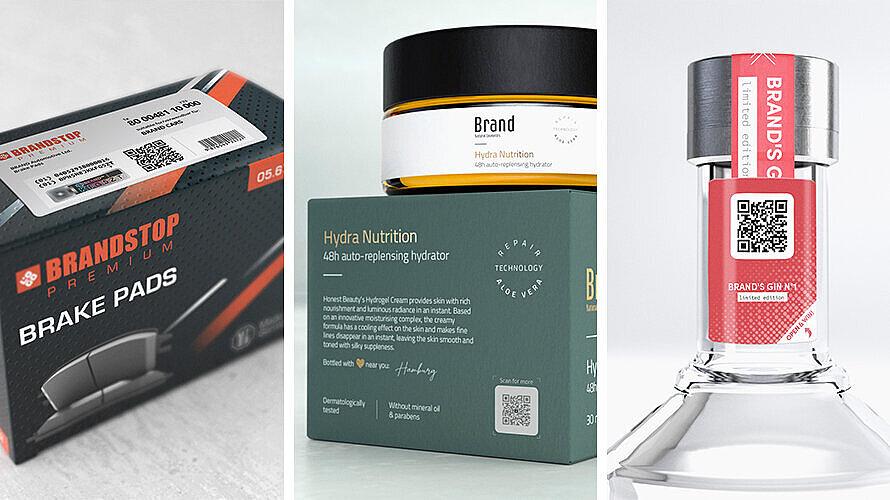
- Integration with other security features (QR, serial numbers)
- Production control and quality assurance processes
According to Packaging World, multi-layered security solutions—including invisible features like UV ink—are most effective when each layer is engineered for consistency and long-term reliability.
Frequently Asked Questions
Q: Are UV ink security labels visible without UV light?
A: No, they are designed to remain invisible under normal lighting and only appear under UV light.
Q: Can UV ink fade over time?
A: Yes, if the ink formulation or curing process is not properly controlled.
Q: Can UV features be combined with other security elements?
A: Yes, they are often integrated with QR codes, holograms, or tamper evident features.
A More Reliable Approach to UV-Based Security Labeling
UV ink security labels provide an additional layer of protection that is difficult to replicate. However, their effectiveness depends entirely on how well they are engineered and produced.
At HX, we focus on ensuring that UV features remain stable, detectable, and consistent—so they function as a reliable authentication tool throughout the product lifecycle.
Making Invisible Security Features Work in Real Conditions
UV ink security labels are designed to be invisible—but their performance must always be visible in inspection results. When properly engineered, they provide a powerful layer of protection that complements other security features.
Explore UV and Multi-Layer Security Label Solutions
If you want to understand how UV ink is combined with other security technologies such as tamper evident structures and variable data systems, you can explore our product range here: https://www.hxsecuritylabel.com/products, where different solutions are organized based on real application scenarios.
Discuss Your UV Security Requirements with HX
If you are evaluating a UV ink security labels supplier or facing inconsistencies in UV feature performance, it may be worth reviewing your current printing and material setup. You can reach out via https://www.hxsecuritylabel.com/contact-us to discuss your specific requirements, and we can help you develop a more stable and reliable UV-based security solution.