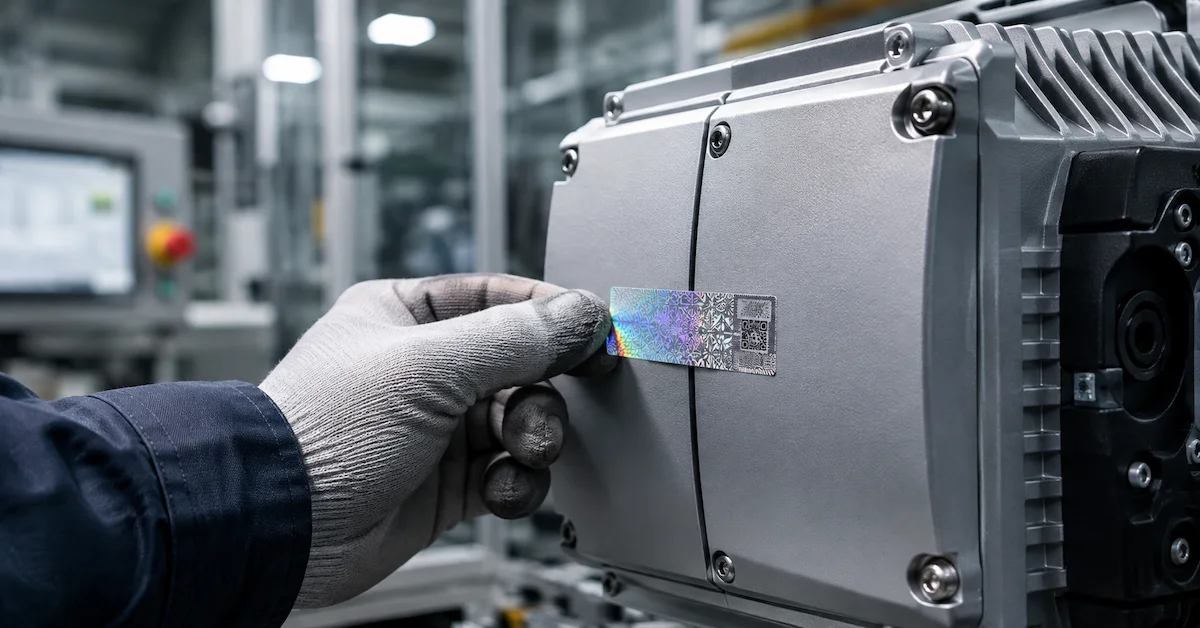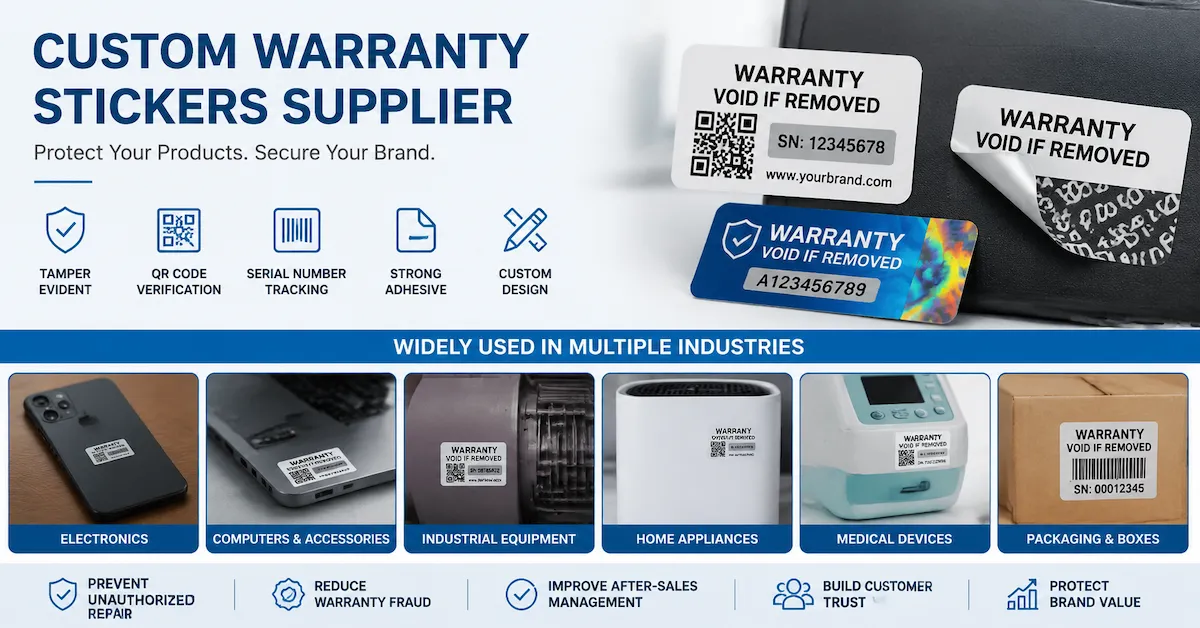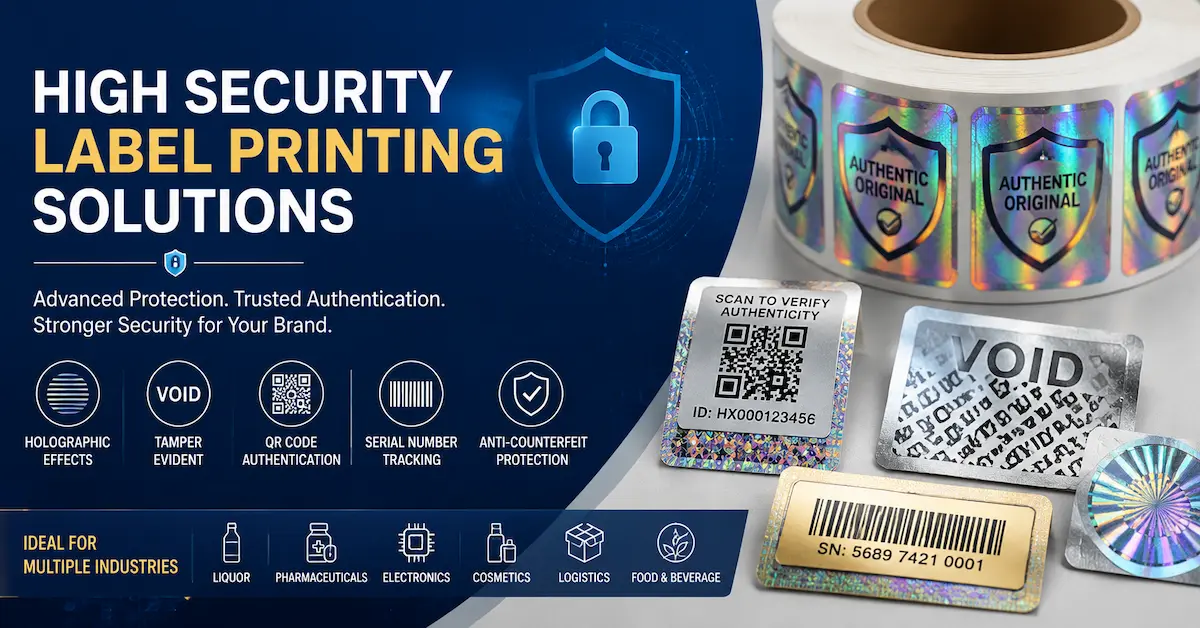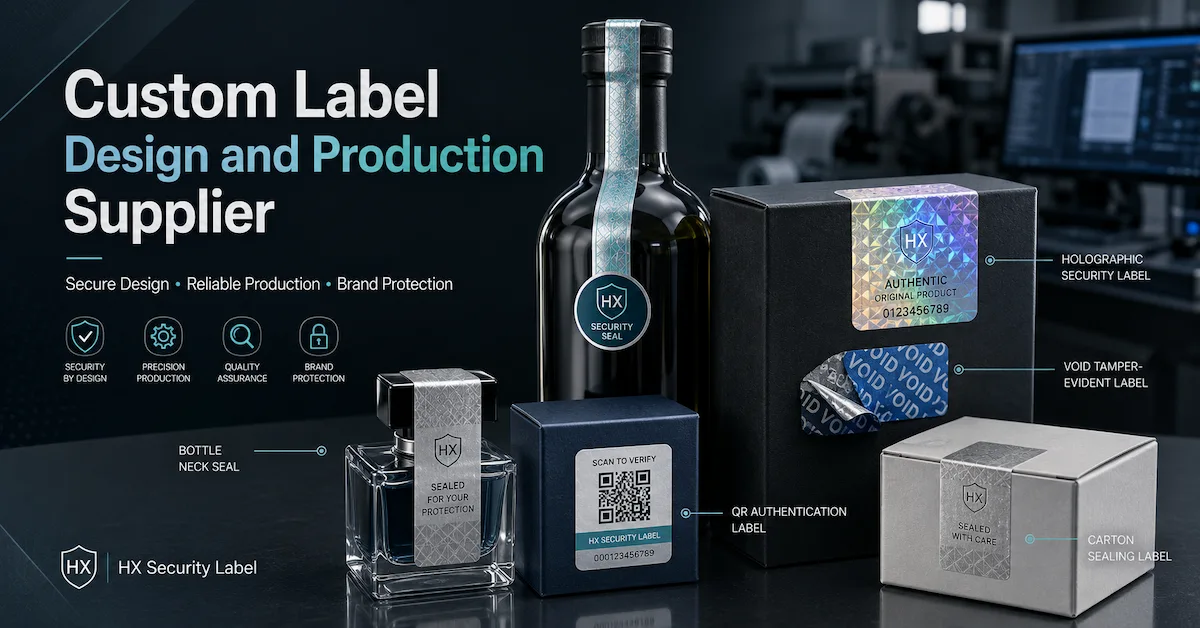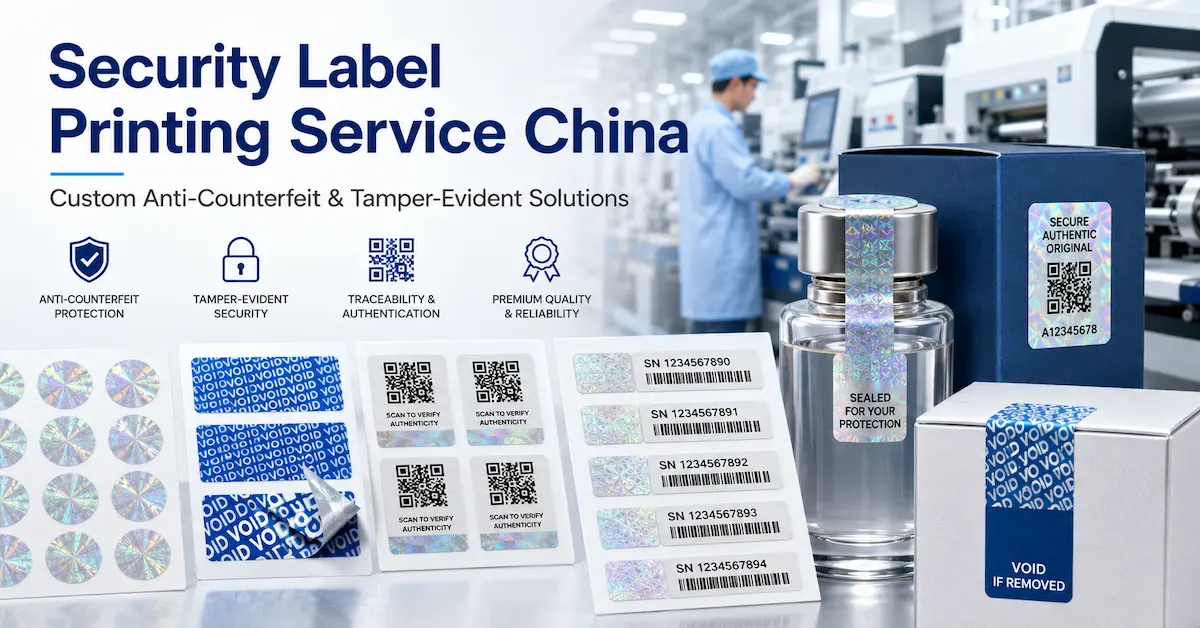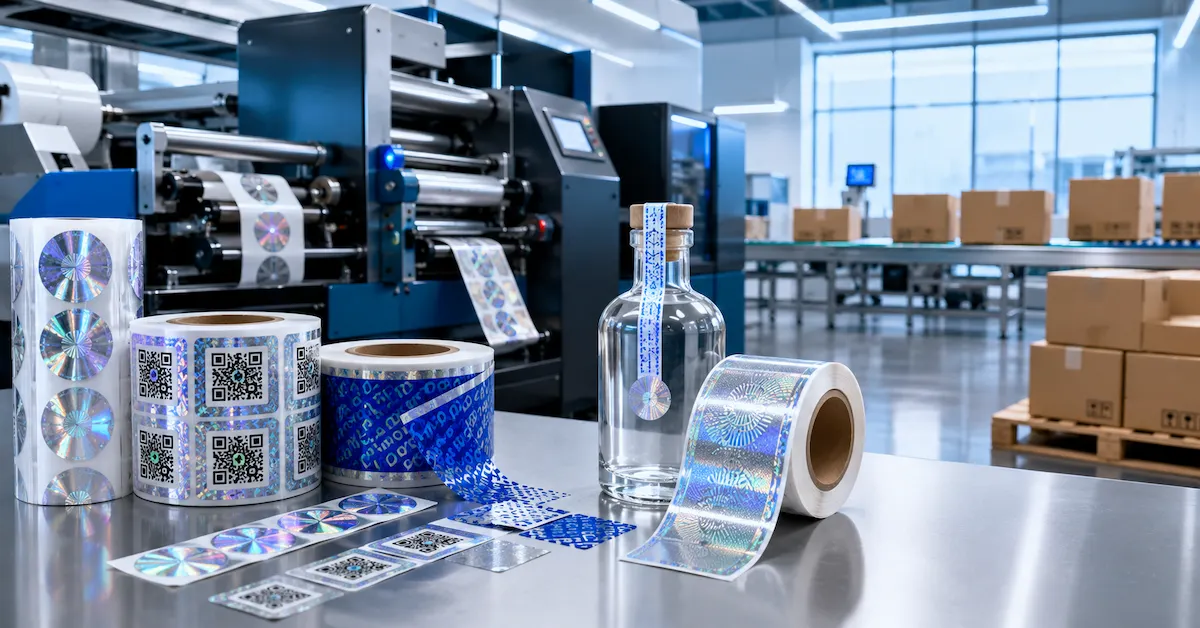

The cost of custom security labels is not based on size alone. For brands that need anti-counterfeiting, tamper evidence, QR code verification, holographic effects, serial numbers, or packaging security, the final price depends on the label structure, material, adhesive, security technology, printing process, order quantity, and delivery requirements.
A simple printed sticker and a custom anti-counterfeit security label are very different products. A security label may need to protect liquor bottles, electronics, cosmetics, pharmaceuticals, food packaging, tea products, shipping cartons, warranty seals, or premium retail boxes.
For buyers, the goal should not be to find the cheapest label. The goal is to find a label that works reliably on the actual product package and supports long-term brand protection.
If you are comparing different options, you can first review HX’s security label product categories, including holographic labels, VOID open labels, wine tax stamps, latent image labels, and other security label applications.
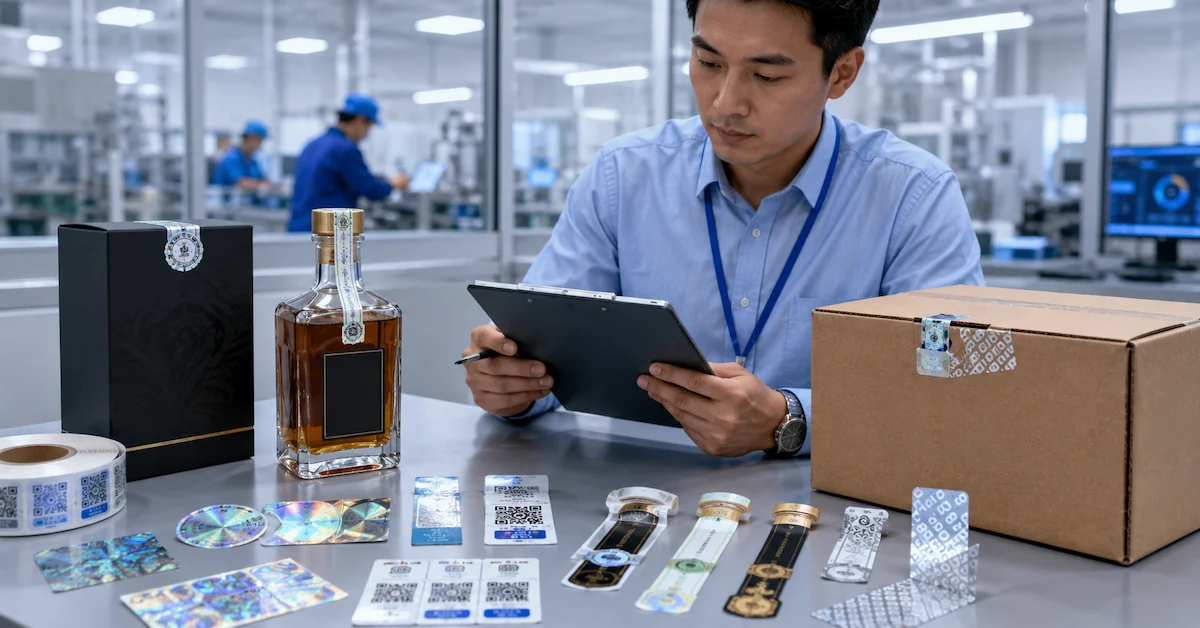
Why Custom Security Label Prices Vary
Custom security labels are priced differently because every project has different requirements.
The price may change depending on:
- Label material
- Label size and shape
- Adhesive type
- Printing color and finishing
- Holographic security effect
- VOID or tamper-evident structure
- QR code or barcode printing
- Serial number requirements
- Roll or sheet format
- Sample proofing
- Order quantity
- Packaging and delivery method
For example, a basic QR code label for a paper box usually costs less than a holographic VOID label with serial numbers for a premium liquor bottle. A simple carton security seal may also be priced differently from a wine tax stamp or a latent image label.
Main Factors That Affect the Cost of Custom Security Labels
1. Label Material
Material is one of the first factors that affects cost. Security labels may use PET film, holographic film, VOID film, destructible paper, synthetic paper, coated paper, or composite materials.
Each material has a different purpose.
| Material Type | Common Use |
|---|---|
| PET film | Durable security labels and product packaging |
| Holographic film | Visual anti-counterfeiting and premium packaging |
| VOID film | Tamper-evident seals and anti-opening labels |
| Destructible paper | Warranty seals and one-time-use labels |
| Coated paper | Lower-cost printed security labels |
| Composite material | Multi-layer security label structures |
The right material depends on the product surface, environment, and security goal. A reliable supplier should recommend material based on real application conditions, not only appearance.
2. Label Size and Shape
Larger labels usually require more material and may cost more. Custom shapes also affect die-cutting, tooling, and production setup.
Common custom options include:
- Rectangle labels
- Round stickers
- Bottle neck seals
- Long strip labels
- Carton sealing labels
- Custom die-cut shapes
- Small warranty labels
- Large packaging authentication labels
If your label needs to wrap over a bottle cap, box edge, or carton seam, the shape must be designed carefully. Poor shape design may affect application and tamper evidence.
3. Security Technology
Security features are a major pricing factor. The more advanced or layered the security structure is, the more the cost may increase.
Common security features include:
- Holographic effect
- Laser security pattern
- Microtext
- VOID residue
- Destructible structure
- QR code authentication
- Barcode tracking
- Serial number printing
- Latent image
- Fluorescent or hidden feature
- Scratch-off verification area
For premium packaging or visual authentication, holographic labels are often used because they improve both anti-counterfeiting and packaging appearance.
For packaging that needs visible opening evidence, VOID open labels can help show whether a label has been removed or tampered with.
4. Adhesive Type
Adhesive affects both performance and cost. Security labels may need different adhesives depending on the surface and use environment.
Important questions include:
- Will the label be applied to glass, plastic, carton, metal, paper box, or film?
- Is the surface smooth, rough, curved, or coated?
- Will the product face humidity, heat, cold, or transport abrasion?
- Should the label leave residue after removal?
- Should it break after peeling?
- Will it be applied manually or by machine?
A label for a glass liquor bottle may need a different adhesive than a carton seal or electronics warranty label. Choosing the wrong adhesive can cause peeling, poor tamper evidence, or packaging damage.
5. QR Codes, Barcodes, and Serial Numbers
If your custom security labels include QR codes, barcodes, or serial numbers, the price may increase because variable data printing and data checking are required.
Buyers should confirm:
- Whether every code is unique
- Whether codes need to match product batches
- Whether serial numbers need to be printed in order
- Whether QR codes need high scanning accuracy
- Whether data needs to be exported
- Whether duplicate codes must be avoided
For food, tea, cosmetics, pharmaceuticals, electronics, and logistics packaging, code accuracy is very important. A low-cost label with unreadable or duplicated codes can create serious verification problems.
6. Order Quantity
Order quantity has a strong effect on unit cost. In most cases, a larger order reduces the average cost per label because setup, design preparation, printing adjustment, and tooling costs are spread across more pieces.
However, buyers should not place a large order before testing samples.
A better process is:
- Confirm label design and material.
- Request samples.
- Test on real packaging.
- Adjust adhesive, size, or layout if needed.
- Move to bulk production after approval.
This reduces the risk of mass production problems.
7. Roll or Sheet Format
Security labels can be supplied in rolls or sheets. The format affects production, packaging, and application.
| Format | Best For |
| Roll labels | Automatic labeling machines and high-volume packaging |
| Sheet labels | Manual application and smaller batches |
| Individual pieces | Special packaging or inspection use |
| Custom rolls | Machine-specific production lines |
If you use automatic labeling equipment, you should provide roll direction, core size, label gap, liner requirement, and machine details before production.
Cost Comparison by Label Type
The following table helps buyers understand relative cost levels. Actual pricing depends on final specifications and quantity.
| Label Type | Relative Cost Level | Best For |
| Basic printed security label | Low to medium | Simple packaging authentication |
| QR code security label | Medium | Product verification and batch tracking |
| VOID label | Medium | Cartons, electronics, logistics packaging |
| Holographic label | Medium to high | Premium packaging and visual anti-counterfeiting |
| Wine tax stamp label | Medium to high | Liquor, wine, spirits, bottle sealing |
| Latent image label | Higher | Hidden verification and high-value products |
| Multi-layer custom label | Higher | Advanced brand protection projects |
For alcohol and bottle sealing applications, wine tax stamp labels can support anti-refill protection, bottle authentication, and premium packaging security.
For projects that need hidden inspection features, latent image labels can add another security layer.
How to Reduce Cost Without Reducing Security
Many buyers want to control cost while keeping effective protection. This is possible if the label is designed carefully.
1. Choose the Right Security Level
Not every product needs the highest-cost label. A carton seal may only need a VOID structure. A premium cosmetics package may need holographic authentication. A liquor bottle may need a bottle neck seal with QR code verification.
Choose the security level based on product risk.
2. Standardize Size Where Possible
Using standard label sizes can reduce tooling and production complexity. If your brand has multiple product lines, consider whether some products can share the same label size while changing QR codes or serial numbers.
3. Plan Repeat Orders
Repeat orders can be more efficient if the supplier keeps your artwork, material, specifications, and production records. This helps reduce communication time and improves consistency.
4. Avoid Unnecessary Features
More security features do not always mean better protection. Each feature should have a clear purpose: visual authentication, tamper evidence, digital verification, traceability, or hidden inspection.
5. Test Before Bulk Production
Sample testing prevents expensive mistakes. It is better to adjust a small sample order than to discover problems after mass production.
What Information Should You Provide for an Accurate Quote?
To receive a fast and accurate quotation, prepare these details before contacting a supplier.
| Item | Details to Provide |
| Product type | Liquor, electronics, cosmetics, food, medicine, logistics, etc. |
| Label purpose | Anti-counterfeit, tamper evidence, authentication, tracking |
| Application surface | Glass, plastic, carton, paper box, metal, film |
| Label size | Width, height, shape, roll or sheet format |
| Material preference | PET, holographic film, VOID film, destructible paper, etc. |
| Security feature | Hologram, VOID, QR code, barcode, serial number, latent image |
| Design file | Logo, artwork, color, layout |
| Quantity | Sample order, bulk order, repeat order plan |
| Packaging method | Manual application or automatic labeling machine |
| Use environment | Heat, cold, humidity, transport abrasion |
| Delivery plan | Urgent order, regular order, export shipment |
Clear information helps the supplier avoid guessing and recommend a more suitable solution.
Common Mistakes When Comparing Security Label Prices
Mistake 1: Comparing Prices Without Matching Specifications
Two labels may look similar in a photo but use different materials, adhesives, security structures, or printing methods. Always compare specifications, not just unit prices.
Mistake 2: Choosing the Cheapest Option
Low-cost labels may fail during actual use. If a label peels off, does not show tamper evidence, or scans poorly, the brand may face higher long-term costs.
Mistake 3: Ignoring the Application Surface
The same label may perform differently on glass, plastic, carton, coated paper, metal, or film packaging. Always test on the real surface.
Mistake 4: Not Checking QR Code Quality
Unreadable QR codes or duplicated serial numbers can damage product verification and customer trust.
Mistake 5: Skipping Sample Proofing
For custom security labels, samples are important. A sample helps check appearance, adhesion, tamper evidence, QR readability, and packaging fit before bulk production.
How HX Helps Buyers Control Security Label Cost
HX Security Label supports custom security label projects for brands that need anti-counterfeiting, tamper evidence, product authentication, and packaging protection.
HX can help buyers choose practical solutions based on budget, product risk, and packaging use.
HX supports:
- Holographic security labels
- VOID open labels
- QR code authentication labels
- Barcode and serial number labels
- Wine tax stamp labels
- Latent image labels
- Custom security stickers
- Packaging security labels
- Bulk security label production
Instead of recommending the most complicated option, HX can help match label material, adhesive, security feature, and production format to your actual application.
You can learn more about HX’s company background and anti-counterfeiting experience on the About Us page.
FAQ
1. What is the cost of custom security labels?
The cost of custom security labels depends on material, size, adhesive, printing method, security features, QR code or serial number requirements, order quantity, and packaging format.
2. Are holographic security labels more expensive?
Usually, holographic labels cost more than basic printed labels because they use optical security materials and special finishing. They are often used for premium packaging and anti-counterfeit protection.
3. Do VOID labels cost more than normal stickers?
Yes. VOID labels usually cost more than ordinary stickers because they use tamper-evident materials that leave visible evidence after removal.
4. Can QR codes and serial numbers increase the price?
Yes. Variable data printing, code checking, and serial number management may increase cost, but they also support authentication and tracking.
5. Does larger quantity reduce unit cost?
In many cases, larger quantities reduce unit cost because setup and production costs are spread across more labels. However, sample testing should be done before bulk orders.
6. Can I get a quotation without final artwork?
Yes, but the quote may be estimated. For a more accurate price, provide label size, material, quantity, security features, application surface, and design requirements.
7. How can I reduce cost without reducing security?
You can standardize label size, choose suitable security features, avoid unnecessary complexity, plan repeat orders, and test samples before bulk production.
8. How do I request a custom quote?
Prepare your product type, label size, application surface, quantity, security features, design file, and packaging method. You can contact HX Security Label to discuss a custom security label solution.
Conclusion
The cost of custom security labels depends on more than printing. Material, adhesive, security technology, QR code requirements, label size, order quantity, and application method all affect the final price.
For brands that need anti-counterfeiting, tamper evidence, product authentication, and packaging protection, choosing the cheapest label may create more risk than savings.
A reliable supplier should help you choose the right material, structure, and security level for your product. Whether you need holographic labels, VOID labels, QR code labels, wine tax stamps, latent image labels, or custom packaging security stickers, HX Security Label can support a practical solution based on your project needs and budget.
If you are planning a custom security label project, prepare your product details, application surface, label size, security features, and quantity. Then contact HX to get a more accurate quotation and build a safer packaging solution for your brand.