
What Should an Anti Counterfeit Labels Supplier Actually Help You Protect?
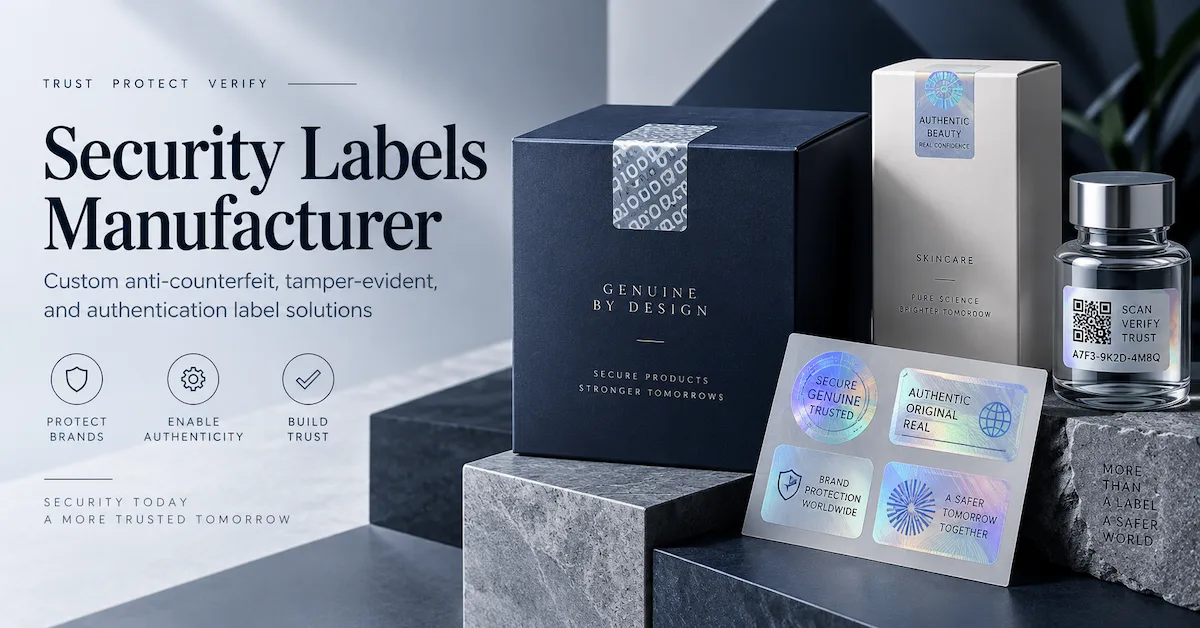
An anti counterfeit labels supplier should help a buyer define what must be protected before recommending a hologram, security seal, QR code, hidden feature, or tamper-evident construction. Counterfeit risk is not the same for every product. A cosmetics brand may need consumers to recognize a genuine package at retail, while an electronics manufacturer may be more concerned about authentic labels being removed and transferred to unauthorized products. A liquor company may need visual authentication together with evidence of bottle opening, and a distributor may need unique serial numbers to separate products, channels, or batches. The starting point should therefore be the security problem, the person performing the verification, and the expected result. Buyers can review the available HX security label products, but product selection should follow the application rather than beginning with whichever label looks most complex.
Which Buyers Need Custom Anti-Counterfeit Labels?
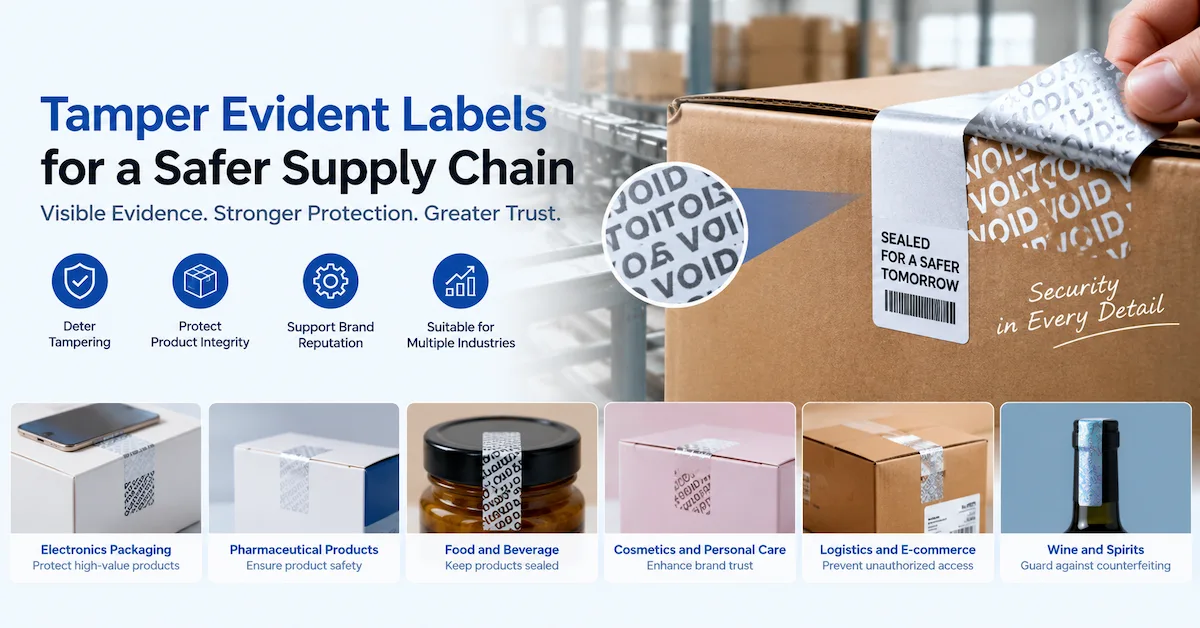
Custom anti-counterfeit labels are most useful when a company has a defined authentication, tamper, identification, or anti-transfer requirement. Typical buyers include electronics brands, wine and beverage companies, cosmetics and personal-care brands, food and tea manufacturers, pharmaceutical packaging buyers, industrial-product companies, importers, distributors, private-label businesses, e-commerce brands, and packaging converters sourcing security labels for their customers. Their purchasing priorities differ. Brand managers often care about how easily consumers can recognize genuine products, packaging engineers focus on surface compatibility and application, quality teams need clear acceptance criteria, procurement teams compare cost and supply stability, while IT or traceability teams may care about variable data and verification systems. Projects that only require decorative graphics or ordinary product information generally do not need the same security structure. A capable supplier should be able to explain when an anti-counterfeit feature adds useful protection and when it would simply add cost.
Define the Counterfeit Risk Before Selecting the Technology
Before asking for prices, describe how counterfeiting or misuse could occur. Can counterfeiters copy the visual design? Can a genuine label be peeled from one product and attached to another? Could genuine packaging be refilled? Could an unauthorized product carry a copied serial number? Does the consumer need an immediate visual check, or will trained distributors perform the verification? These questions determine whether the project needs visible, hidden, physical, or digital security. An anti counterfeit labels supplier should not treat all of these problems as one generic “anti-fake label” requirement. A strong specification connects each technology to one defined threat and one defined verification action.
Compare Authentication Technologies by What They Actually Do
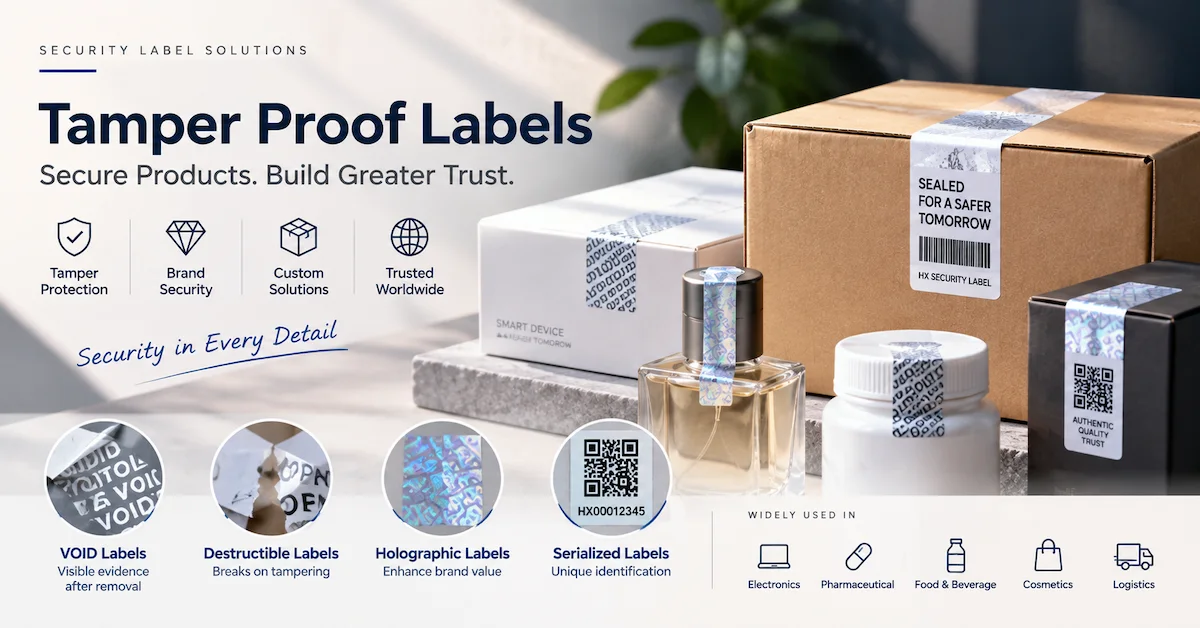
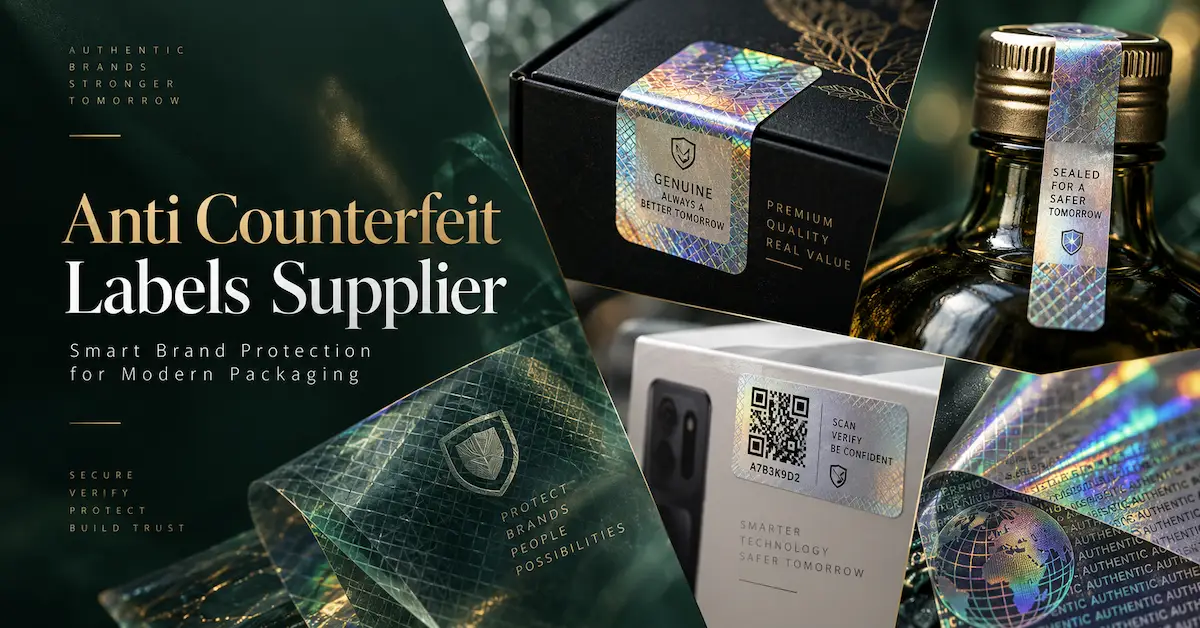
HX’s current product structure includes holographic labels, latent image labels, VOID open labels, wine tax stamp-related products, and other customized label applications. These categories represent different functions rather than interchangeable levels of security. Holographic effects can support visual authentication. Latent images or other hidden elements can provide a secondary inspection layer. VOID or destructible constructions address removal and tamper evidence. QR codes and serial numbers can support individual identification or digital verification when the corresponding data process is defined. Buyers should therefore avoid describing every feature as “anti-counterfeit” without explaining how it is used.
| Security Solution | Main Function | Typical Application | Buyer Should Confirm |
|---|---|---|---|
| Custom holographic label | Visual authentication | Cosmetics, electronics, wine, premium retail packaging | What visual effect should be observed and how it is explained |
| Latent image label | Hidden or controlled verification | Channel inspection and secondary authentication | Viewing method, inspection conditions, and authorized users |
| VOID security label | Visible evidence after removal | Electronics, cartons, equipment, closures | What message or change appears and where it remains |
| Destructible security label | Reduce intact label transfer | Product surfaces and warranty points | How the material breaks on the actual substrate |
| Serialized label | Individual identification | Products, warranty, batches, channels | Code generation, duplication control, and records |
| QR security label | Digital interaction or verification | Consumer and channel verification | What system the code connects to and who manages the data |
| Multi-layer label | Combines several security functions | Higher-risk branded products | Which layer addresses each identified risk |
Visible and Hidden Security Features Should Serve Different Users
Not every security feature needs to be visible to consumers. A retail buyer may benefit from a recognizable holographic element that can be checked without tools, while a distributor, inspector, or brand-protection team may use a secondary feature that is intentionally less obvious. This layered approach can reduce dependence on a single feature, but adding layers without a verification plan creates complexity rather than protection. Before approving a design, define who checks each feature, what normal appearance looks like, what indicates a problem, and what action follows a failed inspection. If staff cannot explain or verify a feature reliably, its practical value may be limited regardless of how technically sophisticated it appears.
Packaging Surface Can Change the Performance of a Security Label
An anti-counterfeit label is not evaluated in isolation. Coated cartons, uncoated paper, PET bottles, glass, metal, textured plastics, flexible films, varnished boxes, and curved closures can interact differently with adhesives and security materials. Buyers should provide actual packaging samples where possible and identify surface coatings, curvature, roughness, contamination risks, available bonding area, and whether the label will be applied manually or automatically. A VOID or destructible structure that works on one carton finish should not automatically be assumed to behave the same way on another. This is particularly important when the project combines authentication with tamper evidence because the label must perform during both normal handling and deliberate removal.
Create a Controlled Specification Before Comparing Suppliers
A price comparison is meaningful only when suppliers are quoting the same requirement. Sending a request such as “Please quote 100,000 anti-counterfeit stickers” leaves too many variables undefined. One supplier may quote a basic printed holographic label while another includes a custom optical feature, variable data, specialized adhesive, proofing, inspection, and roll specifications. Use a controlled requirement sheet so that quotations can be compared on an equivalent basis.
| Specification Area | What the Buyer Should Define or Confirm |
|---|---|
| Product category | Electronics, wine, cosmetics, food, industrial product, etc. |
| Security objective | Visual authentication, anti-transfer, tamper evidence, identity, or combination |
| Verification user | Consumer, distributor, quality team, retailer, inspector |
| Packaging surface | Paperboard, film, plastic, glass, metal, coated or textured material |
| Label position | Box closure, bottle neck, cap, product surface, warranty point |
| Dimensions | Width, height, shape, and available bonding area |
| Security features | Hologram, latent image, VOID, destructible material, QR, serial number |
| Artwork | Brand logo, text, graphics, colors, languages |
| Variable data | QR code, barcode, serial number, batch information |
| Application | Manual or automatic |
| Supply format | Sheet or roll, winding direction, core, spacing if applicable |
| Environment | Storage, temperature, humidity, friction, transport exposure |
| Quantity | Sample quantity, initial order, repeat-order forecast |
| Acceptance | Approved sample, inspection items, and pass/fail requirements |
Sample Approval Must Go Beyond Appearance
A digital artwork proof can confirm graphics, dimensions, text, and code position, but it cannot prove real-world label behavior. Physical samples should be applied to the actual packaging whenever the security function depends on adhesion, removal, tamper evidence, or code readability. First inspect the unopened label under normal handling. Then use separate samples for deliberate removal or opening. If a VOID message, destructive break, transfer pattern, or other visible response is required, record the expected result in advance. Where transport, moisture, abrasion, temperature change, or storage duration are relevant, repeat appropriate checks after those conditions. HX describes requirement confirmation, design, physical proofing, material selection, sample confirmation, and logistics among its service stages on the About Us page, making physical approval an important step before bulk production.
Test Authentication and Tamper Evidence Separately
A common mistake is treating one successful test as proof that every security function works. A holographic pattern may be visually recognizable but say nothing about whether the package has been opened. A destructible label may reveal removal but provide little consumer-facing authentication. A QR code may connect to a record but cannot by itself prove that the physical label was never copied or transferred. When multiple functions are combined, create separate acceptance criteria. For example, the optical feature can have a visual reference, the VOID structure can have a defined removal result, and serialized data can have a duplicate and sequence check. This makes it easier for procurement, quality, and brand-protection teams to determine whether the complete solution performs as intended.
Variable QR Codes and Serial Numbers Need Data Controls
When buyers add QR codes, barcodes, or serial numbers, the label becomes partly a data-management project. Clarify who creates the data, how number ranges are assigned, what happens to rejected labels, whether unused codes can be reissued, how duplicate codes are detected, and what records accompany the shipment. If the project requires a website, database, authentication platform, API, or traceability function, specify that separately. Printed QR codes do not automatically mean that a complete digital anti-counterfeit system is included. Buyers should test finished codes after printing and application using the intended devices and actual packaging rather than approving only a digital file.
Workmanship Affects Whether a Security Design Can Be Repeated
A strong anti-counterfeit design has little value if it cannot be manufactured consistently. Printing registration, holographic positioning, die cutting, label dimensions, variable-data placement, roll presentation, and packaging all influence the finished result. For automatic labeling, winding direction, liner width, core dimensions, label gap, roll diameter, and sensor compatibility may matter as much as the face design. Buyers should also clarify which changes require notification or renewed sample approval. If material, adhesive, artwork, optical design, die-cut geometry, or code rules change between orders without control, the repeat order may no longer match the label that was originally qualified.
Quality Control Should Be Connected to the Security Function
Instead of accepting a generic promise of “strict QC,” ask the anti counterfeit labels supplier what is inspected for the actual project. Relevant checks may include dimensions, artwork revision, print registration, appearance, die-cut accuracy, security-feature consistency, removal behavior, barcode or QR readability, serial-number sequence, roll direction, quantity, and packaging. Different products need different controls, so the inspection plan should be based on the approved specification and identified risks. Retained samples can provide a useful reference for repeat orders and dispute analysis. Where a certification or report is important to supplier qualification, verify the document holder, scope, validity, and relationship to the specific project rather than assuming a company-level certificate automatically applies to every label construction.
Regulated Applications Need Separate Qualification
Certain applications may involve requirements beyond ordinary brand-protection labels. Pharmaceutical packaging, food-related applications, official tax stamps, regulated documents, or destination-market requirements can involve specific materials, authorization, testing, or documentation. Buyers should identify those requirements at the inquiry stage and ask for exact evidence. The existence of a wine tax stamp product category, for example, should not be treated as automatic proof of authorization for every country’s government tax-stamp program. Commercial bottle-security labels and regulated fiscal documents should be discussed as separate project types unless the required authorization and scope are confirmed.
Capacity and Lead Time Should Be Discussed After the Construction Is Defined
A supplier cannot provide a meaningful delivery commitment based only on label quantity. Lead time can depend on custom holographic development, artwork approval, material preparation, special security processes, variable data, sample iterations, inspection requirements, converting, packaging, and shipping. Buyers should separate sample development time from mass-production time and confirm when the production clock begins. Repeat orders using an unchanged approved structure may follow a different timeline from a new customized project. MOQ should also be confirmed against the specific material and process rather than treated as one universal number for all security labels.
Compare Security Solutions Instead of Chasing the Most Features
For many customized projects, standardized model numbers are less useful than comparing security configurations. The following table helps buyers evaluate the commercial logic of different combinations without assuming that every project needs every available feature.
| Configuration | Key Features | Main Advantage | Best For | Main Cost Drivers |
|---|---|---|---|---|
| Visual authentication | Custom graphics or holographic effects | Easy visible recognition | Consumer-facing branded products | Optical design, materials, printing |
| Tamper-focused label | VOID or destructive response | Detects removal or opening | Cartons, electronics, equipment | Material, adhesive, die cutting |
| Authentication + tamper | Visible feature plus removal evidence | Covers two different risks | Wine, cosmetics, premium goods | Combined construction and customization |
| Serialized security label | Unique numbers or codes | Individual product identification | Warranty, channels, logistics | Data preparation and inspection |
| Visual + digital label | Holographic feature plus QR/serial data | Consumer interaction plus identity | Retail brands and export products | Printing, data, platform requirements |
| Multi-layer solution | Visible, hidden, physical, and digital elements | Addresses several defined threats | Higher-risk products | Design complexity, tooling, data, QC |
Cost Should Be Evaluated Against the Risk Being Reduced
Custom security labels can vary in cost because of material, adhesive, size, shape, printing, holographic development, hidden features, die-cut complexity, variable data, sample development, inspection, roll format, quantity, and logistics. More features do not automatically create better value. A lower-cost construction may be sufficient when the buyer only needs visible tamper evidence, while a higher-risk product may justify layered authentication. The useful purchasing question is not “Which label is cheapest?” but “Which approved configuration addresses the identified risk at an acceptable total cost?” Buyers should also consider the cost of failure: unusable inventory, packaging-line interruptions, unclear consumer verification, duplicated codes, inconsistent repeat orders, or a security feature that does not perform on the actual package.
OEM and Private-Label Projects Need Clear Ownership and Revision Control
OEM anti-counterfeit projects can include logo customization, dimensions, shapes, security graphics, custom holographic effects, hidden images, VOID messages, QR codes, serial numbers, packaging formats, and other project-specific requirements. Define who provides the artwork, who develops security elements, who owns the approved files, how design changes are authorized, and how old versions are prevented from returning to production. Where codes or databases are involved, data ownership and access should also be agreed. Buyers can use the HX product page to review available label directions before sending a project brief.
Repeat Orders Are a Test of Supplier Reliability
The first sample proves that one acceptable label can be produced. The second, fifth, and tenth purchase orders show whether the supplier can maintain the approved construction. Ask how artwork revisions, materials, security effects, die-cut files, variable-data ranges, and packaging instructions are recorded. If a change is required, determine which changes can be implemented administratively and which require new samples or testing. For distributors and private-label buyers managing multiple SKUs, revision control is especially important because similar labels can create artwork or data-mixing risks. A dependable anti counterfeit labels supplier should therefore be evaluated as a long-term supply-chain partner rather than as a one-time printing vendor.
What Should You Send HX Before Requesting a Quote?
A useful inquiry should include product type, packaging photos or physical samples, surface material, label location, required size and shape, main counterfeit or tamper risk, preferred verification method, artwork, order quantity, application method, expected use environment, destination market, and any QR code, barcode, or serial-number requirement. If several SKUs use different cartons, bottles, coatings, or surfaces, identify those differences instead of assuming a single construction will work across the complete product family. Buyers can review HX’s company information, explore common purchasing questions in the FAQ section, and then submit project information through Contact Us.
Frequently Asked Questions
1. What does an anti counterfeit labels supplier provide?
An anti counterfeit labels supplier can provide customized labels designed to support product authentication, tamper evidence, anti-transfer protection, individual identification, or combinations of these functions. The exact construction should be selected according to the product, packaging, verification method, and identified counterfeit risk.
2. Which type of anti-counterfeit label is best for branded packaging?
There is no single best construction for every brand. Holographic labels can support visual authentication, VOID or destructible structures can provide tamper evidence, latent features can support secondary verification, and serialized QR codes can add product identity. The correct combination depends on the problem being solved.
3. Are holographic labels enough to prevent counterfeiting?
A holographic label can add a recognizable security feature, but it should not automatically be treated as complete protection against copying, package opening, label transfer, or code duplication. Higher-risk projects may need additional physical, hidden, or digital layers.
4. Can anti-counterfeit labels include QR codes?
Yes, QR codes or serial data may be incorporated into suitable label projects. Buyers should separately define code generation, data ownership, duplicate control, printing inspection, and any verification platform or database requirements.
5. Can one label work on cartons, bottles, plastic, and metal?
Do not assume so. Adhesion and removal behavior can change with coating, surface energy, curvature, roughness, contamination, and environmental conditions. Important surfaces should be identified and tested before the same construction is standardized.
6. What should be checked during sample approval?
Check dimensions, artwork, visual security effects, label position, adhesion, normal handling, required removal or tamper response, code readability, variable-data accuracy, and relevant environmental or application conditions.
7. How should buyers evaluate anti-counterfeit label quality?
Quality should be judged against the approved specification rather than appearance alone. Relevant checks can include printing, die cutting, dimensions, security effects, tamper behavior, serialized data, scanning performance, roll configuration, quantity, and consistency with approved reference samples.
8. What affects the cost of custom anti-counterfeit labels?
Material, adhesive, holographic development, hidden features, dimensions, shape, printing, variable data, tooling, sample development, inspection, order volume, roll format, and logistics can all influence cost. Compare quotations using the same requirement.
9. What are the MOQ and lead time for anti-counterfeit labels?
MOQ and production timing depend on the construction, customization level, materials, order quantity, sample requirements, variable data, and production schedule. Confirm current terms only after the project specification is sufficiently defined.
10. How do I start a custom anti-counterfeit label project with HX?
Prepare packaging photos or samples, surface information, label dimensions, security objective, expected verification method, artwork, order quantity, application method, environment, and any variable-data requirements. Submit the project through the HX contact page so the appropriate construction and sample plan can be discussed.
Conclusion
Selecting an anti counterfeit labels supplier is fundamentally a brand-protection and supply-chain decision, not simply a printing purchase. Buyers should begin by identifying the real counterfeit, tamper, transfer, or identity risk; then choose the authentication technologies that address that risk, qualify the construction on actual packaging, document acceptance criteria, and carry those requirements into mass production and repeat orders. Holographic effects, latent images, VOID structures, destructible materials, QR codes, and serial numbers can each play a useful role, but their value depends on how clearly the verification process is defined and tested. For electronics, wine, cosmetics, food, industrial products, retail packaging, or private-label projects, review the HX security label range and contact HX Security Label with your packaging details, security objectives, and order requirements to discuss an appropriate custom solution.