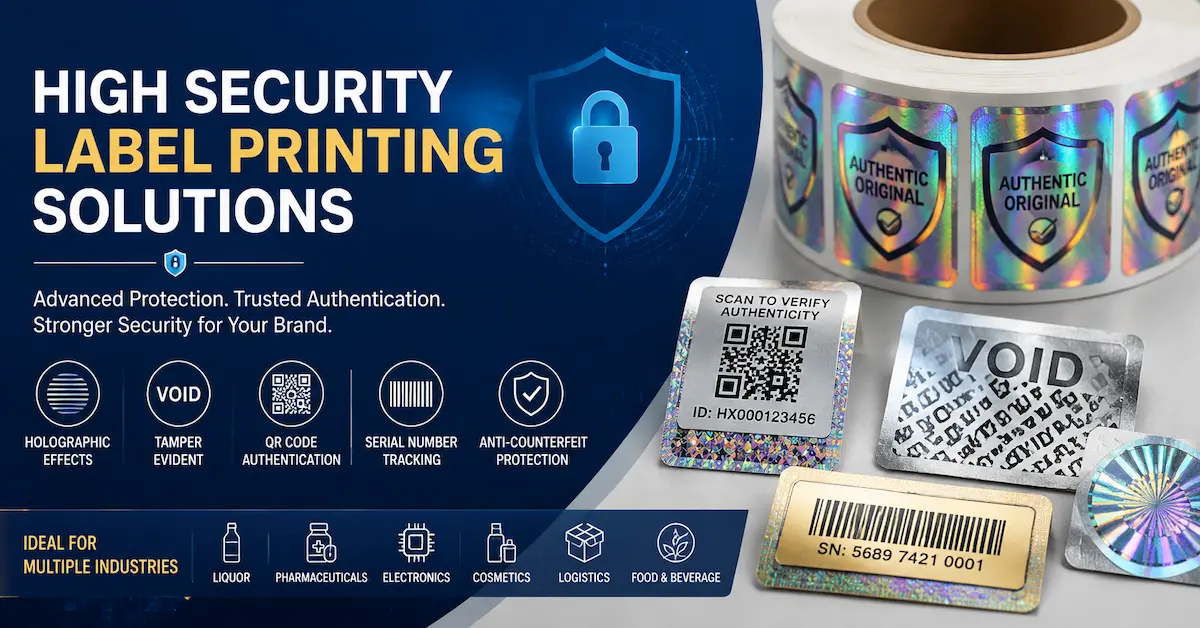

TL;DR: Choosing a customized micro nano printing label factory requires more than comparing advertised printing resolutions. Buyers should evaluate microtext legibility, fine-line reproduction, optical structure consistency, material compatibility, and functional inspection results. The finished security label must preserve its intended microscopic features after printing, lamination, die cutting, and application to the actual packaging.
For electronics manufacturers, pharmaceutical packaging companies, cosmetics brands, and international procurement teams, conventional printed logos may not provide sufficient differentiation from imitation packaging.
Micro and nano security technologies offer additional authentication possibilities through finely reproduced text, microscopic graphics, and engineered optical structures.
However, smaller features do not automatically mean better security. If microscopic lettering becomes blurred during production or cannot be recognized using the intended inspection equipment, its practical authentication value decreases.
The key is to develop a security label with measurable manufacturing requirements and repeatable verification results.
This guide explains how to specify customized micro nano printing labels, evaluate manufacturing processes, identify fine-detail defects, and approve production samples before placing bulk orders.
Explore HX Security Label's product collection for related anti-counterfeiting and brand-protection applications.
Key Takeaways
-
Micro and nano technologies are different: Microscopic printed lettering should not be confused with nanostructured optical materials.
-
Resolution is not enough: Advertised equipment DPI does not independently establish finished microtext quality.
-
Legibility matters: Fine characters and security patterns must remain recognizable under agreed magnification.
-
Material compatibility is essential: Ink behavior, film properties, coatings, and lamination can influence feature clarity.
-
Bulk production needs documented controls: Buyers should establish measurable specifications, approved reference samples, and functional acceptance criteria.
What Are Customized Micro Nano Printing Labels?
Customized micro nano printing labels are specialized security labels incorporating fine printed details, microscopic images, or engineered micro- and nanoscale structures intended to support product authentication.
Depending on the technology, a label may contain microtext, fine-line graphics, diffractive optical patterns, or additional hidden authentication features.
These elements can be integrated into branded packaging without occupying a large visible area.
What Is Microprinting?
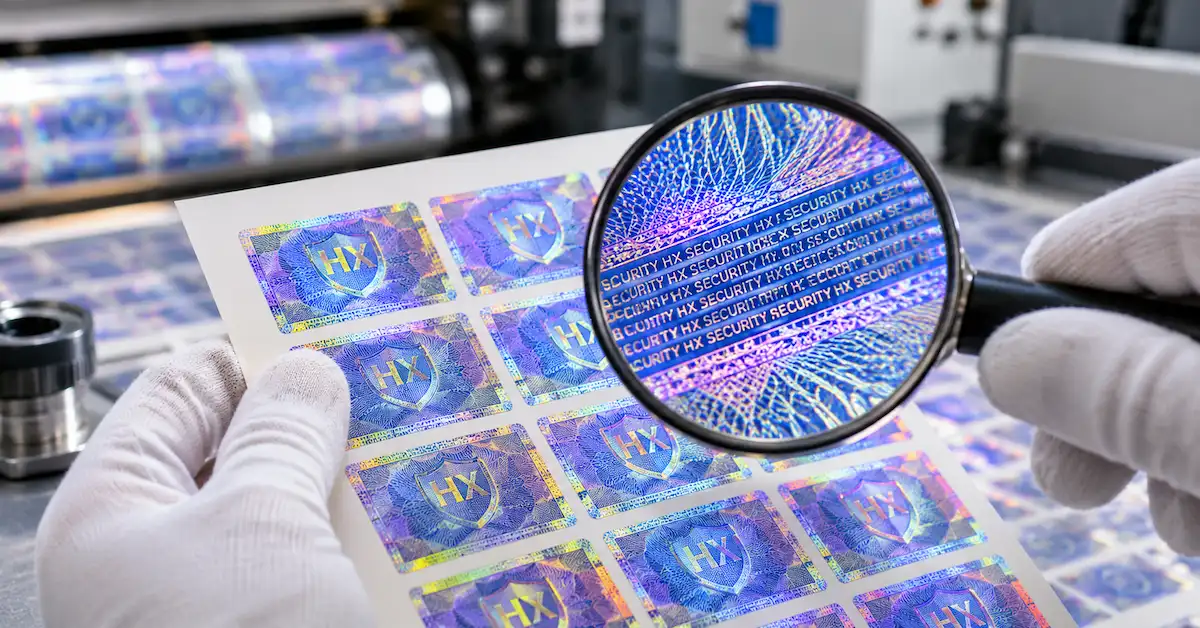
Microprinting involves reproducing extremely small text or graphics that may appear as ordinary lines or decorative patterns during unaided observation.
When examined using appropriate magnification, the intended characters become recognizable.
The European Union Intellectual Property Office's Anti-Counterfeiting and Anti-Piracy Technology Guide identifies microtext as an authentication technology suitable for products and packaging. It also describes the specialized graphic reproduction capabilities needed to produce such fine details.
What Is Nano Security Technology?
Nano security technology may involve engineered structures with dimensions at the nanometer scale.
Certain optical security films use these structures to influence the behavior of light, producing distinctive optical responses.
Unlike conventional microtext, these features are not necessarily inspected by reading individual characters under a magnifier.
Their verification method depends on the optical or material technology.
Why Is This Distinction Important?
One micrometer equals 1,000 nanometers.
Although both scales are associated with very small features, microprinting and nanoscale optical engineering involve different manufacturing and measurement requirements.
A buyer should therefore confirm whether the proposed label contains actual microprinted text, nanostructured optical features, or a combination of both.
Microprinting vs. Nano Optical Structures vs. Conventional Printing
Not every application requires the same degree of manufacturing complexity.
| Technology | Main characteristic | Verification method | Typical application |
|---|---|---|---|
| Conventional printing | Standard visible text and graphics | Visual inspection | Product information and branding |
| Microtext printing | Extremely small printed characters | Magnifier or microscope | Secondary authentication |
| Fine-line security printing | Detailed lines and graphical patterns | Visual or magnified inspection | Branded security graphics |
| Microimage printing | Miniaturized images or symbols | Suitable magnification | Controlled product inspection |
| Nano optical structures | Engineered nanoscale optical features | Technology-specific optical verification | Specialized authentication |
| Combined micro-nano labels | Multiple complementary features | Separate inspection methods | Higher-risk branded packaging |
A customized micro nano printing label factory should explain the actual technology proposed for the project instead of using the term "nano" as a general description of advanced printing.
For related optical technologies, explore HX Holographic Labels.
Which Industries Need High-Precision Micro Nano Security Labels?
Microprinting is particularly useful when brands require additional authentication features without significantly changing their packaging layout.
| Target customer | Main requirement | Potential application |
|---|---|---|
| Electronics manufacturers | Identification of genuine accessories and components | Product identification stickers |
| Cosmetics brands | Protection against imitation retail packaging | Small security features on cartons |
| Pharmaceutical packaging companies | Additional authentication elements | Selected external packaging labels |
| Luxury goods brands | Discreet brand-specific verification | Premium packaging and authenticity labels |
| Wine and spirits brands | Secondary packaging authentication | Bottle labels and security seals |
| Industrial equipment manufacturers | Inspection of replacement parts and branded equipment | Component identification labels |
| Packaging converters | Repeatable fine-detail printing | Customized security-label production |
For regulated pharmaceutical or other specialized applications, buyers must separately verify applicable material and regulatory requirements.
When Is Micro Nano Printing Unnecessary?
A highly specialized microscopic feature may not be appropriate when:
-
The label only communicates ordinary product information.
-
Consumers must verify products without inspection tools.
-
The packaging is frequently scratched or severely deformed.
-
The required inspection cost exceeds the practical security benefit.
-
A simpler visible authentication feature adequately addresses the identified risk.
ISO 22383:2020 recommends selecting authentication solutions according to product risks and performance requirements.
The most technically complex construction is not necessarily the most commercially suitable one.
Why Does Microtext Legibility Matter More Than Advertised DPI?
Printing resolution is an important manufacturing consideration, but it does not tell buyers everything about the finished label.
DPI generally describes the density of addressable dots or imaging positions. It is not a direct guarantee of the smallest consistently reproducible character, line, or security feature.
Actual reproduction also depends on:
-
Artwork preparation.
-
Imaging and printing processes.
-
Ink transfer and spreading.
-
Surface smoothness.
-
Equipment stability.
-
Registration accuracy.
-
Protective coatings and lamination.
What Should Buyers Measure Instead?
Buyers should establish requirements for the actual finished security feature.
| Measurement item | What to evaluate |
|---|---|
| Character height | Finished size of the microscopic text |
| Stroke width | Thickness of individual printed lines |
| Line spacing | Separation between neighboring graphic features |
| Character definition | Ability to distinguish individual letters |
| Edge quality | Sharpness and continuity of printed boundaries |
| Registration | Alignment between printing and optical layers |
| Image contrast | Difference between the feature and its background |
| Defect frequency | Occurrence of missing, merged, or distorted details |
The agreed inspection method should identify whether the security feature remains recognizable after all manufacturing stages.
The smallest achievable feature is not necessarily the smallest reliably manufacturable feature.
This distinction is critical for repeat orders and large-scale packaging programs.
How Should Buyers Specify Micro Nano Printing Labels?
A complete technical specification helps manufacturers evaluate the same requirements before quoting.
Recommended Technical Specification Table
| Specification | Information to confirm |
|---|---|
| Security objective | Microscopic authentication, optical verification, or combined protection |
| Microtext content | Authorized letters, words, or security graphics |
| Feature dimensions | Required character height, stroke width, and line spacing |
| Optical technology | Proposed microstructured or nanostructured feature, if required |
| Face material | Paper, polymer film, or approved composite material |
| Printing process | Method suitable for the required fine-detail reproduction |
| Ink requirements | Contrast, adhesion, and material compatibility |
| Protective finish | Lamination or coating compatible with inspection |
| Adhesive | Suitable for the actual application surface |
| Finished label size | Width, height, shape, and placement |
| Verification method | Magnification, optical reader, or other approved method |
| Production format | Roll, sheet, or individual label |
| Acceptance criteria | Approved sample and measurable inspection requirements |
These are recommended purchasing specifications rather than fixed parameters for every HX product.
Exact feature dimensions, tolerances, and manufacturing capabilities must be confirmed during sample development.
How Do Materials and Inks Affect Microprinting Quality?
High-precision security printing depends on the interaction between the printing process, ink, and supporting material.
Even well-prepared artwork may reproduce poorly on an unsuitable surface.
Paper-Based Security Labels
Paper materials can vary in smoothness, absorbency, coating, and dimensional stability.
Excessive ink absorption or spreading may reduce fine-character clarity.
A coated paper construction may provide better definition for certain printing processes, but compatibility must be verified.
PET and Other Polymer Films
Polymer films can provide suitable surfaces for detailed graphics and optical security constructions.
However, their surface treatment, ink compatibility, flexibility, and adhesive system influence finished performance.
Not every film is suitable for every microprinting technology.
Metallic and Holographic Materials
Reflective materials can support visual authentication, but strong reflections may interfere with microtext inspection.
Buyers should evaluate the contrast of the printed feature against the intended background.
Material Selection Comparison
| Material | Potential benefit | Main technical consideration |
|---|---|---|
| Coated paper | Suitable surface for selected detailed printing | Ink absorption and coating quality |
| PET film | Dimensional stability for selected applications | Ink adhesion and surface treatment |
| Transparent film | Integration with existing package graphics | Background contrast |
| Metallized film | Reflective appearance and optical differentiation | Glare and microscopic readability |
| Composite security film | Potential integration of several functions | Layer compatibility and production complexity |
The appropriate material should be selected according to the authentication objective and actual packaging environment.
How Does a Customized Micro Nano Printing Label Factory Manufacture Fine-Detail Labels?
Manufacturing procedures vary depending on whether the project uses printed microscopic graphics, optical structures, or both.
A typical development workflow may include the following stages.
1. Security Artwork Preparation
The factory reviews the authorized design, label dimensions, and required authentication features.
Fine lettering and graphic elements should be evaluated at their actual production size.
2. Imaging and Production Preparation
The selected reproduction process must be suitable for the required feature detail.
Depending on the construction, this may involve specialized printing tools, imaging systems, or optical production materials.
3. Precision Printing
The printing stage reproduces the approved graphics on the selected material.
The objective is to maintain consistent feature definition, contrast, and alignment.
4. Optical Feature Integration
Where specified, compatible holographic or other optical security elements may be incorporated.
Their functionality should be evaluated separately from printed microtext quality.
5. Protective Finishing
Lamination or protective coatings may be added where appropriate.
The finished protective layer should not reduce the required inspection capability.
6. Adhesive Integration and Converting
Labels are prepared in the required adhesive construction, dimensions, and supply format.
Die cutting and roll conversion must preserve the approved security areas.
7. Functional Quality Inspection
Finished samples are compared with authorized references.
Inspection should confirm that the microscopic or optical features remain recognizable after the complete manufacturing process.
These stages describe general manufacturing considerations, not a claim that every HX production line uses all listed processes.
What Manufacturing Defects Can Reduce Micro Nano Label Quality?
Fine-detail security graphics are sensitive to manufacturing variation.
Defects that appear minor on an ordinary printed label may significantly affect microscopic authentication.
Common Printing Defects and Their Effects
| Defect | Potential cause | Effect on authentication |
|---|---|---|
| Merged characters | Excessive ink spread or reproduction limitations | Individual letters become indistinguishable |
| Broken lines | Incomplete ink transfer or surface incompatibility | Security pattern loses continuity |
| Missing character details | Insufficient reproduction quality | Approved text becomes unreadable |
| Registration errors | Alignment variation between production stages | Security graphics become misaligned |
| Background interference | Unsuitable contrast or reflective material | Feature becomes difficult to inspect |
| Surface scratches | Handling or inadequate protection | Microscopic information is obscured |
| Lamination haze | Incompatible protective material | Image clarity decreases |
| Die-cut misalignment | Converting variation | Security feature is partially removed |
Positive vs. Reversed Microtext
Positive microtext consists of printed characters against a background.
Reversed microtext appears as unprinted or contrasting characters within a printed area.
These two designs may respond differently to ink spreading and reproduction limitations.
Buyers should approve the actual construction used in production rather than assuming that successful reproduction of one design establishes the suitability of the other.
How to Test Microtext Legibility Before Bulk Production
A practical inspection process should evaluate the finished label instead of relying exclusively on equipment specifications or digital artwork.
Step 1: Establish an Approved Reference
Approve the intended microtext content, position, feature dimensions, and visible appearance.
Retain a physical reference sample.
Step 2: Define the Inspection Method
Specify the appropriate magnification, lighting conditions, and inspection equipment.
Where dimensional measurements are required, use suitable calibrated equipment.
Step 3: Evaluate Finished Character Definition
Inspect whether the expected text can be recognized and whether neighboring lines remain separated.
Record missing strokes, merged characters, and distorted details.
Step 4: Compare Samples Before and After Finishing
Check whether lamination, coatings, or other processing stages have altered the security feature.
The finished label must meet the agreed inspection requirements.
Step 5: Inspect Labels Across Representative Production Positions
For roll-based manufacturing, evaluate representative samples from different production positions according to an agreed sampling plan.
Where relevant, include different positions across the printing web and different stages of the production run.
This helps identify variation that may not be apparent in a single demonstration sample.
Step 6: Evaluate the Actual Packaging Application
Apply representative labels to the intended product or carton.
Check whether curvature, reflection, handling, or environmental exposure affects inspection.
Step 7: Document the Acceptance Result
Record the approved construction, inspection conditions, reference images, and agreed acceptance criteria.
Use these records to support bulk production and repeat-order inspection.
Engineering Example: Microtext Security Labels for Electronic Components
Consider an electronics brand developing a small authentication label for replacement components.
This is an illustrative purchasing scenario, not a documented HX customer case.
Initial Challenge
The available label area is limited.
The brand wants to include its visible logo and a secondary authentication feature without making the finished label visually crowded.
The label must also remain readable after application to a plastic component housing.
Proposed Development Approach
The engineering team compares conventional printed identification with a microtext-enabled security construction.
It evaluates the finished microscopic characters at the actual label size and confirms whether the intended inspection tool can distinguish the approved feature.
Representative samples are applied to the production housing to evaluate adhesion, surface compatibility, and microscopic readability.
Production Approval
The buyer retains an authorized reference and establishes acceptance requirements for character definition, dimensions, material construction, and finished-label condition.
This approach provides a clearer basis for comparing future production batches than relying on an advertised resolution figure alone.
Can Micro Nano Printing Be Combined With Holograms, VOID Labels, or QR Codes?
Yes, compatible constructions may incorporate several authentication and product-protection features.
However, each feature should address a separate requirement.
| Security feature | Main purpose |
|---|---|
| Microtext | Magnified authentication |
| Nano optical feature | Specialized optical verification |
| Visible hologram | Visual brand recognition |
| VOID structure | Evidence of label removal |
| Unique serial number | Individual product identification |
| QR code | Digital information access or verification |
A microprinted feature does not automatically provide tamper evidence.
Similarly, adding a QR code does not guarantee that the product is genuine.
For projects requiring removal evidence, buyers can evaluate suitable constructions through the HX VOID Open Label category.
The feasibility of combining multiple functions must be confirmed before production.
What Quality Controls Should a Micro Nano Printing Label Factory Provide?
Quality control should extend beyond conventional printing appearance.
Recommended Quality Acceptance Matrix
| Inspection category | Acceptance objective |
|---|---|
| Artwork accuracy | Matches the approved design revision |
| Microtext legibility | Intended characters remain distinguishable |
| Fine-line integrity | Required lines remain continuous and separated |
| Feature positioning | Security graphics are correctly located |
| Optical response | Matches the approved optical reference, where applicable |
| Material consistency | Matches the authorized construction |
| Surface condition | No damage affecting authentication |
| Label dimensions | Meets agreed converting requirements |
| Adhesive compatibility | Suitable for the intended substrate |
| Batch consistency | Representative samples meet agreed functional criteria |
Acceptance tolerances, sampling procedures, and defect classifications should be defined for the specific project.
Where a required authentication feature cannot be recognized, the issue may represent a functional security defect rather than a minor cosmetic variation.
What Determines Micro Nano Printing Label Cost, MOQ, and Lead Time?
The cost of customized micro nano printing labels depends on the actual production and security requirements.
Major cost drivers include:
-
Complexity of microscopic artwork.
-
Specialized imaging or optical tooling.
-
Required reproduction quality.
-
Film, ink, and adhesive materials.
-
Protective finishing and lamination.
-
Additional authentication features.
-
Inspection and measurement requirements.
-
Label dimensions and converting format.
-
Initial and repeat-order quantities.
How Should Buyers Compare Factory Quotations?
Compare quotations using equivalent feature specifications and acceptance requirements.
A supplier quoting ordinary fine printing may have a substantially different cost structure from one proposing an original optical security construction.
Buyers should also distinguish one-time development or tooling expenses from recurring unit costs.
MOQ, sample timing, manufacturing capacity, and production lead time should be confirmed for the actual construction.
How to Evaluate a Customized Micro Nano Printing Label Factory
Before selecting a manufacturing partner, buyers should establish whether the supplier can demonstrate the required security function consistently.
Important evaluation questions include:
-
What microprinting or optical technology is being proposed?
-
How are minimum feature dimensions defined and measured?
-
Can the factory provide representative finished samples?
-
Which inspection equipment is required?
-
How are artwork and production-tool revisions controlled?
-
Can the feature remain recognizable after protective finishing?
-
How are nonconforming security labels handled?
-
What controls support repeat-order consistency?
For customized or OEM projects, buyers should also clarify artwork ownership, confidentiality, authorized production quantities, and responsibility for specialized tooling.
Read HX's Security Label Printing Factory Guide for broader manufacturing assessment considerations.
Working With HX Security Label on Customized Micro Nano Printing Projects
HX Security Label is operated by Shenzhen Huaxin Anti-Counterfeiting Technology Co., Ltd., a China-based enterprise specializing in anti-counterfeiting label research, development, and manufacturing.
Established in Shenzhen in 2008, the company describes a technical portfolio covering specialized security printing, optical authentication, and customized anti-counterfeiting technologies.
Its published development workflow includes requirements confirmation, design drafting, physical proofing, material selection, sample approval, and delivery coordination.
For micro nano security printing projects, these stages provide a framework for evaluating customized artwork and manufacturing requirements.
Buyers can learn more through the HX company profile.
Specific minimum feature sizes, optical construction options, inspection capabilities, and production tolerances should be confirmed through technical consultation and physical sample evaluation.
What Should Buyers Include in an RFQ?
| RFQ requirement | Information to provide |
|---|---|
| Product application | Electronics, cosmetics, luxury packaging, or other products |
| Security objective | Microscopic or optical authentication |
| Artwork | Authorized logo and graphic requirements |
| Fine-detail specification | Required text dimensions and inspection expectations |
| Packaging substrate | Material, coating, texture, and curvature |
| Label dimensions | Finished size and shape |
| Additional features | Holographic, VOID, or identification requirements |
| Application format | Manual application, rolls, or sheets |
| Order quantity | Samples, initial production, and repeat orders |
| Quality requirements | Reference samples and acceptance criteria |
| Delivery requirements | Destination and requested schedule |
Request Custom Micro Nano Security Label Samples and a Quotation
Share your artwork, product photographs, label dimensions, intended authentication method, and estimated order quantity to discuss suitable manufacturing options.
Frequently Asked Questions
1. What does a customized micro nano printing label factory produce?
It develops specialized security labels incorporating microscopic text, fine graphics, or engineered optical features according to project requirements. Actual technologies and production capabilities vary by manufacturer.
2. What is the difference between microprinting and nano printing?
Microprinting generally refers to extremely small printed text or graphics. Nano security technologies may use nanoscale structures to create specialized optical or material responses. Their manufacturing and verification methods are different.
3. What is the minimum microtext size a factory can print?
There is no universal minimum size suitable for every material and printing process. Buyers should request measured production samples and establish acceptable character dimensions and readability requirements.
4. Can microtext be read using a smartphone?
Some relatively large fine-detail graphics may be visible through suitable smartphone magnification. However, more specialized microtext may require an optical magnifier or microscope. The approved inspection method should match the actual feature.
5. Are micro nano security labels impossible to counterfeit?
No. Fine-detail and optical security technologies can increase reproduction difficulty and provide additional authentication features, but no label guarantees complete protection against counterfeiting.
6. Can microprinting be combined with holographic labels?
Certain compatible constructions may combine microscopic graphics with holographic optical features. Buyers should confirm material compatibility, reproduction quality, and the inspection method for each feature.
7. Does lamination affect microtext readability?
It can. Protective layers may influence contrast, optical clarity, or reflection. The finished laminated label should be inspected rather than approving only the unlaminated printing sample.
8. Can micro nano security labels be produced in rolls?
Suitable constructions may be converted into rolls for automated or manual application. Roll direction, label spacing, liner properties, and equipment compatibility should be confirmed with the manufacturer.
9. What affects customized micro nano label pricing?
Important factors include security artwork complexity, reproduction requirements, specialized materials, tooling, inspection methods, converting formats, and order quantity. A detailed technical specification helps establish a more meaningful quotation.
10. How can I request customized micro nano printing labels from HX?
Prepare your product details, artwork, label dimensions, packaging materials, authentication requirements, and expected purchasing volume. Then contact HX Security Label to discuss available technologies, sample feasibility, and quotation requirements.
Technical References
European Union Intellectual Property Office — Anti-Counterfeiting and Anti-Piracy Technology Guide: Microtexts.
Provides technical background on miniaturized text and graphics used for product and packaging authentication.
ISO 22383:2020 — Guidelines for the Selection and Performance Evaluation of Authentication Solutions for Material Goods.
Provides a risk-based framework for selecting and evaluating authentication technologies.
HX Security Label — Company Information and Security Label Manufacturing Resources.
Provides company-published information about its anti-counterfeiting business, technical directions, and customized development process.
These references support technology selection and procurement evaluation. They do not establish product-specific certification, manufacturing tolerances, or guaranteed authentication performance.
Conclusion
Selecting a reliable customized micro nano printing label factory requires more than comparing microscopic feature sizes or advertised printing resolutions.
For electronics manufacturers, cosmetics brands, packaging converters, and international procurement teams, effective precision security printing depends on recognizable fine-detail graphics, suitable materials, controlled reproduction, and repeatable functional inspection.
By distinguishing conventional microprinting from nanoscale optical technologies, establishing measurable specifications, validating finished samples, and documenting production acceptance criteria, buyers can reduce avoidable manufacturing revisions and purchasing uncertainty.
HX Security Label offers customized anti-counterfeiting label solutions for businesses evaluating precision security printing, optical authentication, and branded packaging protection.
Whether you are developing a new security label or upgrading an existing authentication design, a clear technical specification is the foundation of successful bulk procurement.
Contact HX Security Label with your artwork, packaging specifications, required microscopic security features, and estimated purchasing quantity to discuss custom label development, sample evaluation, and quotation arrangements.