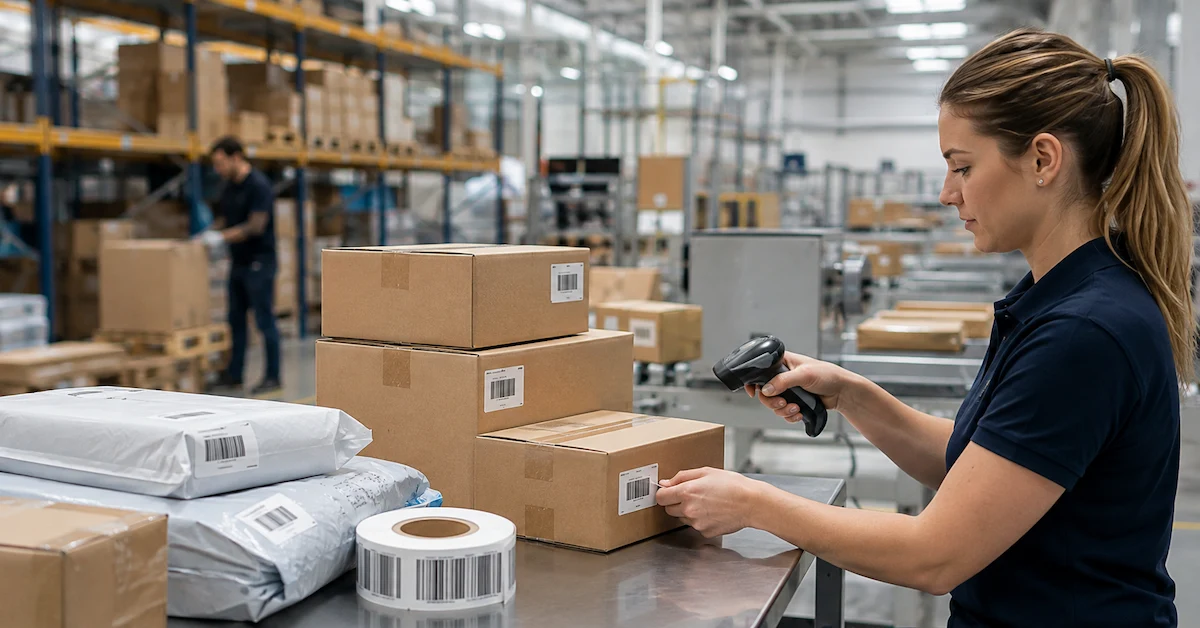

What Should Buyers Expect From a Security Label Printing Factory?
A security label printing factory should provide more than conventional sticker printing. For anti-counterfeit, tamper-evident, warranty, authentication, and traceability projects, the factory must coordinate security design, materials, adhesive behavior, printing processes, variable data, proofing, inspection, and repeat production.
That distinction matters because an attractive label can still fail as a security product.
For example, a holographic label may provide strong visual authentication but may not reveal unauthorized opening. A VOID label may provide clear tamper evidence but may not be sufficient when a brand also needs product-level digital verification.
The correct solution therefore starts with the security risk.
A buyer should first define whether the project needs to control:
- Counterfeit products
- Unauthorized package opening
- Label transfer or reuse
- Warranty fraud
- Product substitution
- Bottle refilling
- Distributor or channel identification
- Product-level serialization
- Consumer authentication
- Batch or supply-chain traceability
WIPO explains that authentication technologies can include visible and covert features and are used to help distinguish genuine goods from counterfeits. This supports a layered approach in which security features are selected according to the verification task rather than appearance alone. Read WIPO's overview of authentication technologies.

Why Factory Capability Matters More Than Printing Price
Standard labels mainly need to communicate product or brand information.
Security labels have another job: they must produce a predictable security response.
That response may include:
- A VOID message after removal
- Destruction when someone attempts to peel the label
- A holographic image visible from specific angles
- Hidden information for secondary inspection
- A unique QR code or serial number
- A traceable relationship between the physical label and a database record
This is why comparing suppliers only by price per thousand pieces can create unnecessary risk.
A low-cost label may become expensive if:
- Adhesive fails on the final surface
- Tamper evidence is inconsistent
- A holographic feature is unclear
- QR codes cannot be reliably scanned
- Serial numbers are duplicated or missing
- Die-cut dimensions are unstable
- Roll direction does not match the labeling equipment
- Repeat orders differ from approved samples
A competent security label printing factory should help prevent these problems before mass production.
What Security Technologies Should a Factory Be Able to Integrate?
Not every project requires the same level of security.
A useful factory evaluation should therefore focus on whether the supplier can combine technologies according to different risk levels.
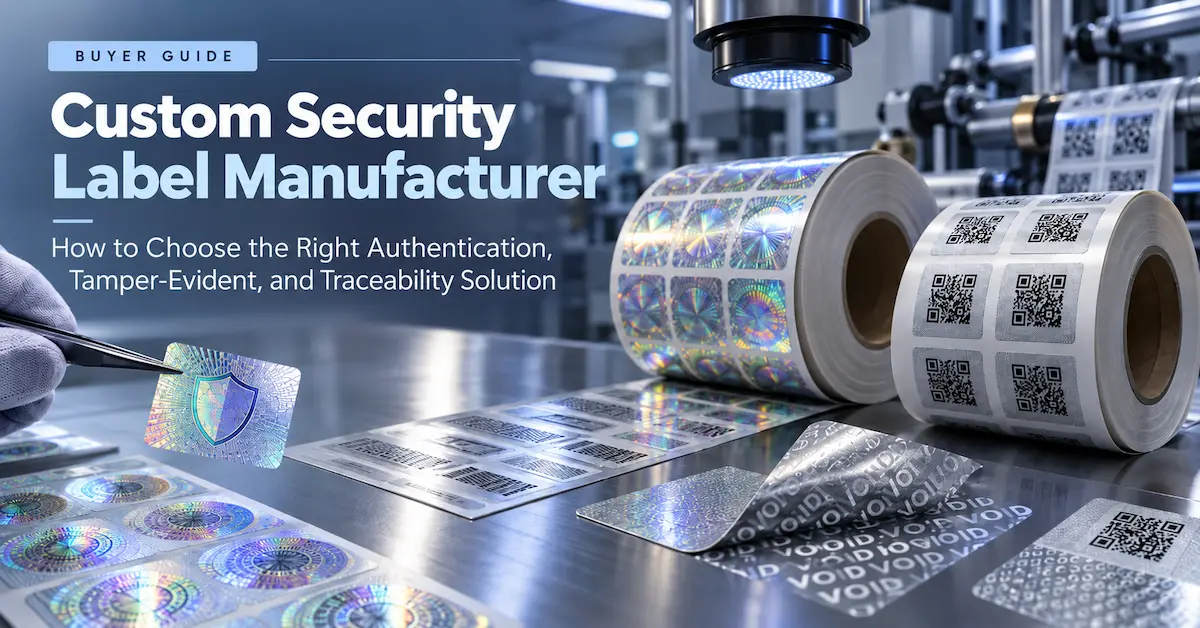
Holographic Security Features
Holographic technology is commonly used for visible authentication.
Possible elements include:
- Custom holographic patterns
- Brand-specific optical graphics
- Microtext
- Laser effects
- Rainbow effects
- Complex visual structures
These features are particularly useful when distributors, customers, inspectors, or retailers need a fast visual method to distinguish an authentic product from a suspicious one.
HX currently provides holographic label solutions within its security-label product range. Its company profile also states that its technical portfolio includes specialized optical and anti-counterfeiting technologies.
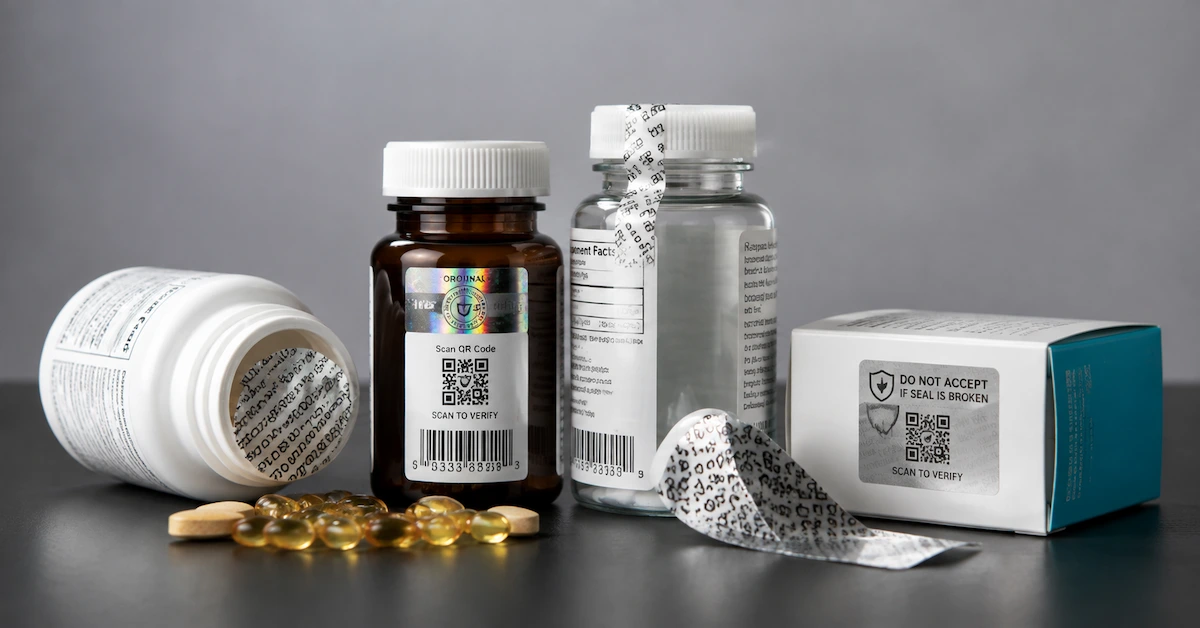
VOID Tamper-Evident Technology
VOID labels focus on evidence of removal.
Depending on the construction, attempted removal may produce:
- VOID text
- Pattern transfer
- Partial adhesive transfer
- Visible opening evidence
- Anti-reuse behavior
These labels can be useful for:
- Electronics
- Equipment housings
- Warranty seals
- Shipping cartons
- Product boxes
- Industrial components
Buyers comparing tamper-evident options can review HX's VOID label solutions.
Destructible Security Materials
A destructible label is designed to break apart during removal instead of being transferred intact.
This can be useful when the main objective is to discourage:
- Label reuse
- Warranty seal transfer
- Component substitution
- Unauthorized removal
However, destructibility must be tested on the actual substrate. A material that behaves correctly on smooth metal may perform differently on textured plastic or a coated box.
Latent and Covert Features
Some verification methods should not be immediately visible.
Latent images, fluorescent features, micro-elements, and other covert technologies can provide a secondary authentication layer for trained inspectors, brand-protection teams, distributors, or internal quality personnel.
HX lists latent image labels among its current product directions.
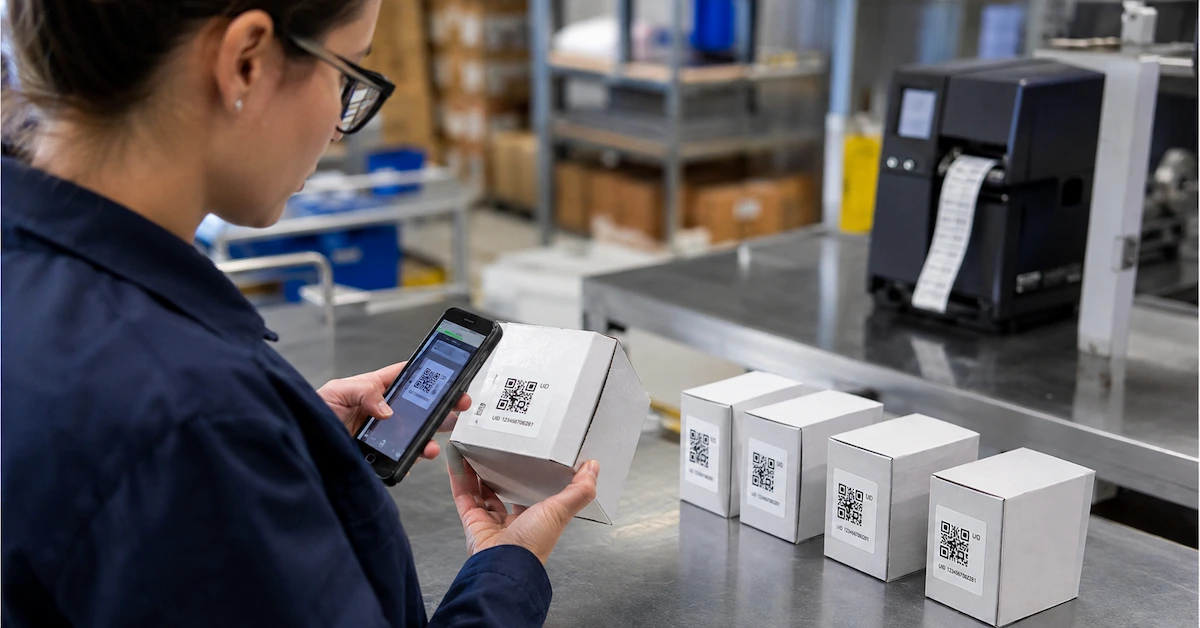
QR Codes, Barcodes and Serial Numbers
Digital identity can complement physical security.
A security label may include:
- Unique QR codes
- Serial numbers
- Barcodes
- Batch numbers
- Variable product IDs
These features can support authentication, warranty registration, batch identification, distribution management, and traceability.
However, printing a QR code is not the same as building an authentication system.
Before production, buyers should clarify:
- Who generates the codes?
- Is every code unique?
- How are duplicates controlled?
- What happens to rejected labels?
- Where is verification data stored?
- What information appears after scanning?
- How are repeat orders managed?
These questions become especially important for large-volume orders.
How Should a Security Label Printing Factory Select Materials?
Security performance depends heavily on the relationship between material, adhesive, surface, and environment.
Common security-label constructions may use:
| Material Type | Typical Function | Common Application |
|---|---|---|
| PET film | Durable printed security label | Electronics, equipment |
| Holographic film | Optical authentication | Premium packaging |
| VOID film | Tamper evidence | Warranty seals, cartons |
| Destructible material | Anti-transfer protection | Electronics, components |
| Synthetic paper | Durable printed label | Packaging applications |
| Coated paper | Cost-sensitive applications | General packaging |
The buyer should not select material only from a catalog.
The factory needs information about the actual product.
Surface Type
Specify whether the label will be applied to:
- Glass
- Smooth metal
- Painted metal
- Powder-coated metal
- ABS plastic
- PC plastic
- PE or PP surface
- Coated carton
- Flexible film
- Curved packaging
Environmental Conditions
The factory should also know whether the product will experience:
- Refrigeration
- High humidity
- Condensation
- Warehouse storage
- Long-distance shipping
- Heat
- Cold
- Dust
- Vibration
- Repeated handling
HX's published manufacturing process includes a dedicated material-selection stage followed by physical sample confirmation. Its About Us page says materials are selected according to project durability requirements and states an extreme-condition range of -50°C to 60°C for that process description. This should not be treated as a universal specification for every label; the final range should be confirmed for the selected material and adhesive. View HX's production process.
What Does the Security Label Production Process Look Like?
A reliable factory process should reduce uncertainty before large-scale printing.
HX publicly describes a six-stage workflow: requirements confirmation, design draft, physical proofing, material selection, sample confirmation, and logistics and packaging.
For procurement evaluation, these stages can be understood as follows.
Step 1: Requirement Confirmation
Before artwork preparation, the factory should understand:
- Product type
- Security risk
- Application surface
- Label size
- Quantity
- Application environment
- Required authentication method
- Manual or automatic labeling
A security supplier that immediately quotes without understanding these factors may be treating the project like ordinary sticker printing.
Step 2: Security Design
The design stage should determine both appearance and protection.
This may include:
- Logo placement
- Holographic layout
- Microtext
- VOID pattern
- QR code position
- Serial number area
- Hidden security features
- Die-cut shape
Security design should remain usable after the label is reduced to its actual finished size.
Step 3: Physical Proofing
A digital artwork file cannot show real adhesive behavior or removal performance.
A physical proof allows buyers to evaluate:
- Printing clarity
- Security effect
- Holographic appearance
- Label dimensions
- Adhesion
- Tamper response
- QR readability
- Packaging compatibility
HX specifically includes physical proof production before mass production in its published process.
Step 4: Material Verification
The material must work on the actual product surface.
Where possible, send the factory:
- Product samples
- Packaging samples
- Substrate information
- Surface treatment details
This is more reliable than testing only on generic glass or metal plates.
Step 5: Final Sample Approval
The approved sample should become the reference for production.
Important approval points include:
- Size
- Color
- Artwork
- Security effect
- Adhesion
- Removal behavior
- Code readability
- Roll or sheet format
Do not rely only on a photograph of the sample when security behavior is important.
Step 6: Production and Delivery
For mass production, the buyer should confirm:
- Quantity tolerance
- Inspection method
- Packaging format
- Roll direction
- Core specification if applicable
- Delivery schedule
- Repeat-order requirements
HX provides additional explanations of these stages in its existing security label printing guide.
What Quality Checks Matter Before Mass Production?
A strong factory should evaluate more than visual print quality.
A practical security-label QC checklist includes the following.
| QC Item | What Buyers Should Verify |
| Artwork accuracy | Logo, graphics and text match approved file |
| Label dimensions | Finished size remains within project tolerance |
| Die cutting | Clean edges and correct shape |
| Holographic effect | Security pattern is visible as intended |
| Tamper response | VOID/destructible effect works consistently |
| Adhesion | Label bonds to the real substrate |
| QR readability | Codes scan reliably |
| Variable data | No missing or repeated codes |
| Roll format | Direction and spacing match application equipment |
| Packaging | Labels arrive protected from damage |
Why Variable Data Requires Additional Control
Variable-data projects introduce risks that static printing does not have.
For example, a batch may contain visually perfect labels but still fail if:
- Two products receive the same serial number
- A number is skipped
- QR data does not match the printed serial
- Rejected labels remain active in the database
- A repeat order accidentally reuses an old sequence
For serialized projects, buyers should therefore discuss data control as part of quality control, not as a separate IT issue.
Security Label Factory vs Ordinary Label Printer
This distinction is especially useful when shortlisting suppliers.
| Evaluation Area | Ordinary Label Printer | Security Label Printing Factory |
| Standard color printing | Yes | Yes |
| Custom size and shape | Usually | Usually |
| Holographic security | Limited or outsourced | Core capability expected |
| VOID structures | May be limited | Security-focused capability |
| Destructible materials | May be available | Application-specific selection |
| Covert authentication | Usually limited | May support multiple options |
| Serial/variable data | Basic to advanced | Requires controlled workflow |
| Security design | Limited | Risk-based design |
| Tamper testing | Not always | Important |
| Authentication planning | Not core service | Important for high-security projects |
The correct choice depends on project risk.
If you only need a decorative product label, an ordinary label printer may be sufficient.
If the label must provide authentication, tamper evidence, anti-transfer protection, or serialized verification, specialized security capability becomes much more important.
How Can Buyers Audit a Security Label Printing Factory?
Factory evaluation should focus on evidence.
1. Ask What Is Produced In-House
Clarify which stages are actually handled by the factory and which are outsourced.
This matters because security projects may involve:
- Security master design
- Holographic processing
- Printing
- Variable-data printing
- Laminating
- Die cutting
- Inspection
- Packaging
Outsourcing is not automatically a problem, but buyers should understand how sensitive files, production consistency, and quality responsibility are controlled.
2. Review Real Production Samples
Ask for samples relevant to your intended application.
If you need electronics warranty protection, testing a liquor hologram does not tell you enough about VOID behavior on an electronics housing.
3. Evaluate Technical Questions
A capable factory should be able to explain why it recommends a particular:
- Film
- Adhesive
- Tamper structure
- Holographic effect
- QR size
- Roll direction
A recommendation should be connected to the application rather than presented as a generic “best material.”
4. Check Repeat-Order Control
B2B buyers rarely think only about the first order.
Ask how the factory controls:
- Artwork versions
- Security master files
- Material specifications
- Color references
- Serial ranges
- Repeat-order records
- Packaging requirements
5. Review the Factory's Security Background
HX states that Shenzhen Huaxin Anti-Counterfeiting Technology Co., Ltd. was established in 2008 and focuses on anti-counterfeiting label R&D, production, and sales. Its About Us page reports 40 anti-counterfeiting patents, including four invention patents, and more than 60 anti-counterfeiting technologies.
These company-specific claims can be reviewed directly on the HX About Us page.
For buyers, the larger principle is simple: evaluate the supplier's actual security specialization rather than assuming every printing company has equivalent anti-counterfeiting capability.
How Do Authentication Standards Help Buyers Define Requirements?
Security features should not be selected only because they look sophisticated.
ISO 22383:2020 provides guidance for selecting and evaluating authentication solutions and notes applications including anti-counterfeiting, prevention of product fraud, and prevention of diversion. View ISO 22383.
This supports a risk-based procurement process:
Threat → Authentication requirement → Security feature → Verification method → Performance evaluation
For example:
A company worried mainly about package opening might prioritize tamper evidence.
A company worried about counterfeit replacement may require authentication plus serialization.
A company facing both problems may use several layers.
The purpose is not to maximize the number of security technologies. It is to choose the appropriate combination for the real risk.
Which Industries Commonly Need Custom Security Label Printing?
HX's current FAQ identifies liquor and spirits, pharmaceuticals, electronics and high-tech products, and tea, food, and agricultural products among its service areas.
Typical applications include:
Electronics and Industrial Equipment
Common needs:
- Warranty seals
- Unauthorized opening evidence
- Serial identification
- Component authentication
Useful technologies:
- VOID labels
- Destructible labels
- QR codes
- Serial numbers
Liquor and Spirits
Common needs:
- Product authentication
- Bottle sealing
- Anti-refill protection
- Market identification
Useful technologies:
- Holographic labels
- Tax stamps
- Tamper-evident seals
- Serialized QR codes
Pharmaceuticals and Healthcare Products
Common needs:
- Packaging integrity
- Product authentication
- Batch identification
- Traceability
Security requirements should be coordinated with the applicable regulatory requirements of the destination market.
Cosmetics and Premium Consumer Goods
Common needs:
- Brand authentication
- Premium appearance
- Counterfeit deterrence
- Digital verification
Holographic and digital security layers can be combined when the application requires both visual recognition and product-level verification.
Logistics and Export Packaging
Common needs:
- Carton opening evidence
- Shipment identification
- Package replacement detection
Possible solutions include VOID seals, serialized security labels, and barcode or QR-based identification.
What Information Should You Send for an Accurate Quote?
A detailed RFQ allows the factory to recommend a more accurate solution.
Prepare:
| Information | Example |
| Product type | Electronics, liquor, cosmetics, equipment |
| Security objective | Anti-counterfeit, tamper evidence, authentication |
| Label size | Width × height |
| Application surface | Glass, plastic, metal, carton |
| Quantity | Trial order and expected bulk volume |
| Security feature | Hologram, VOID, QR, serial number |
| Environment | Indoor, refrigerated, humid, transport |
| Application method | Manual or automatic |
| Format | Roll or sheet |
| Artwork | Logo and design file |
| Delivery market | Country or region |
| Required date | Target delivery schedule |
If you are still deciding which construction to use, first review HX's security label products or its security label FAQs.
Common Mistakes When Choosing a Security Label Printing Factory
Choosing the Lowest Quote Before Testing
Two quotations may describe labels that look similar but use different materials, adhesives, security structures, or inspection requirements.
Compare specifications before comparing final price.
Treating All Surfaces as the Same
“Plastic” is not a complete substrate specification.
Surface texture, coating, surface energy, curvature, contamination, and use environment can influence adhesion.
Approving Only Digital Artwork
A PDF can confirm layout.
It cannot confirm:
- Adhesion
- Tamper response
- Destructibility
- Holographic optical behavior
- Actual scanning performance
Physical sample approval remains essential for high-risk applications.
Adding Security Features Without a Threat Model
More features do not automatically mean better protection.
Every additional technology should answer a clear question:
What risk does this feature reduce, and who will verify it?
Ignoring Repeat Production
A good first batch is not enough for long-term OEM or brand projects.
Buyers should evaluate whether the factory can consistently reproduce approved materials, design versions, codes, security effects, and packaging requirements.
FAQ About Security Label Printing Factories
1. What does a security label printing factory produce?
A security label printing factory manufactures labels intended for functions such as anti-counterfeiting, tamper evidence, product authentication, warranty protection, and traceability. Depending on the project, products may include holographic labels, VOID labels, destructible labels, serialized labels, QR security labels, and covert authentication labels.
2. How is security label printing different from normal label printing?
Normal printing mainly reproduces graphics and product information. Security label printing may additionally require special substrates, tamper structures, optical elements, serialization, covert features, and security-performance testing.
3. Can a factory combine hologram, VOID and QR technology?
Depending on the label construction and application, multiple security layers can be integrated into one project. Buyers should choose combinations according to the actual risk rather than adding features unnecessarily.
4. Should I request samples before bulk production?
Yes. A physical sample allows you to evaluate material, adhesion, dimensions, security behavior, scanning, and compatibility with the actual product or packaging.
HX's published workflow includes physical proofing and final sample confirmation before production approval.
5. What surface information should I give the factory?
Tell the supplier whether the substrate is glass, metal, painted metal, plastic, coated carton, flexible film, or another material. For critical projects, provide an actual sample of the final surface whenever possible.
6. Can every security label have a unique QR code or serial number?
Variable-data printing can support unique codes, but buyers should confirm code generation, uniqueness, verification logic, rejected-label handling, database integration, and repeat-order controls before production.
7. What affects the price of custom security label printing?
Cost can vary according to material, dimensions, quantity, security technology, artwork complexity, variable-data requirements, die cutting, adhesive requirements, proofing, inspection, and packaging format.
Therefore, quotations should be compared against equivalent specifications.
8. What should I check during a factory audit?
Review security technology capability, materials, proofing procedures, production workflow, QC, variable-data control, handling of sensitive files, repeat-order management, samples, and export capability.
9. Can HX support custom security label projects?
HX's website lists holographic labels, VOID open labels, latent image labels, and other anti-counterfeiting solutions, while its company profile describes R&D, production, proofing, material selection, sample confirmation, and global delivery capabilities.
10. How do I request a custom security label quotation?
Prepare your product type, label size, application surface, quantity, security objective, artwork, environmental conditions, variable-data requirements, and expected delivery schedule.
You can then contact HX Security Label to discuss sample development and a project-specific quotation.
Conclusion
Selecting a security label printing factory is ultimately a supplier-risk and product-protection decision, not simply a printing purchase.
Start by identifying the threat. Determine whether the product requires anti-counterfeit authentication, tamper evidence, anti-transfer protection, warranty control, serialization, or traceability.
Then evaluate whether the factory can translate that requirement into the correct combination of materials, adhesives, printing technologies, physical security features, digital identification, proofing, QC, and repeat production.
The most important evidence comes before the bulk order: technical communication, relevant samples, testing on the real product surface, and a clearly documented specification.
If you are developing holographic labels, VOID security labels, serialized labels, QR authentication labels, warranty seals, or another custom anti-counterfeit solution, browse HX Security Label's product range and contact the factory with your application details for technical evaluation and quotation.