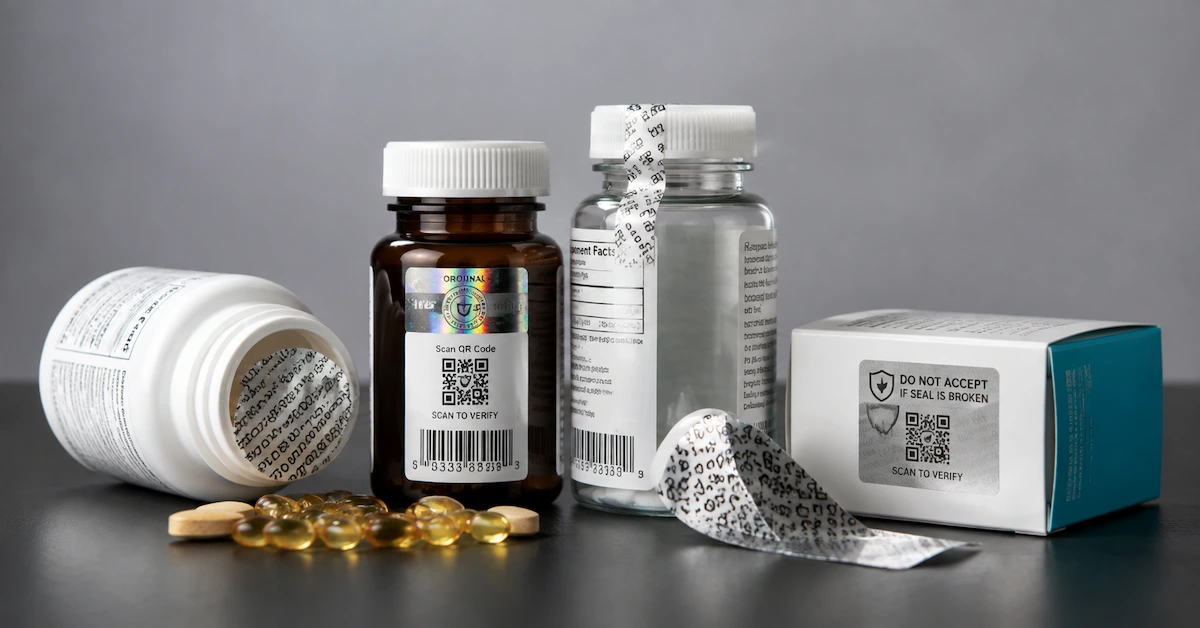

TL;DR: Choosing a custom hologram stickers manufacturer requires evaluating optical master quality, artwork reproduction, film construction, adhesive compatibility, and production consistency. A reliable custom hologram should reproduce the approved optical design, remain recognizable under intended viewing conditions, and perform correctly on the final packaging. Buyers should validate master samples and document functional acceptance criteria before bulk production.
For brand owners, packaging engineers, and international procurement teams, the main challenge is translating ordinary brand artwork into an engineered holographic security feature.
A logo that looks impressive on a computer screen may lose clarity when reproduced as a small security sticker. Likewise, a visually attractive hologram may fail to provide meaningful protection if it uses generic optical patterns or inappropriate adhesive materials.
This guide explains the optical principles, manufacturing stages, quality standards, common production defects, and approval procedures that B2B buyers should understand when developing customized holographic packaging seals.
Explore the HX Security Label holographic product collection for relevant product options.
Key Takeaways
-
Optical master quality: Custom holographic effects depend on the original optical design and its reproduction. Buyers should approve actual samples, not only digital artwork.
-
Artwork clarity: Logo details, fine graphics, viewing angles, and final label dimensions must be evaluated together.
-
Material compatibility: Film construction, adhesive selection, and packaging surface characteristics influence label performance.
-
Security functionality: A holographic design provides visual authentication cues but does not automatically provide tamper evidence.
-
Production approval: Master samples, optical consistency, defect criteria, and repeat-order controls should be documented before mass production.
Why Should Buyers Rely on This Technical Guide?
This guide organizes the technical decisions that packaging engineers and procurement teams should consider when specifying custom holographic labels.
It uses established principles of diffractive optical security features, pressure-sensitive label construction, and practical production quality control.
The evaluation approach also considers two recognized technical references:
ISO 22383:2020, which provides guidelines for selecting and evaluating authentication solutions for physical goods.
ASTM D3330/D3330M-04(2025), which describes methods for evaluating the peel adhesion of pressure-sensitive tape.
These references help establish a structured approach to product evaluation. They do not mean that a particular hologram label has automatically passed testing or received certification.
The objective is to provide buyers with a repeatable specification and approval method rather than unsupported performance claims.
What Is a Custom Hologram Sticker?
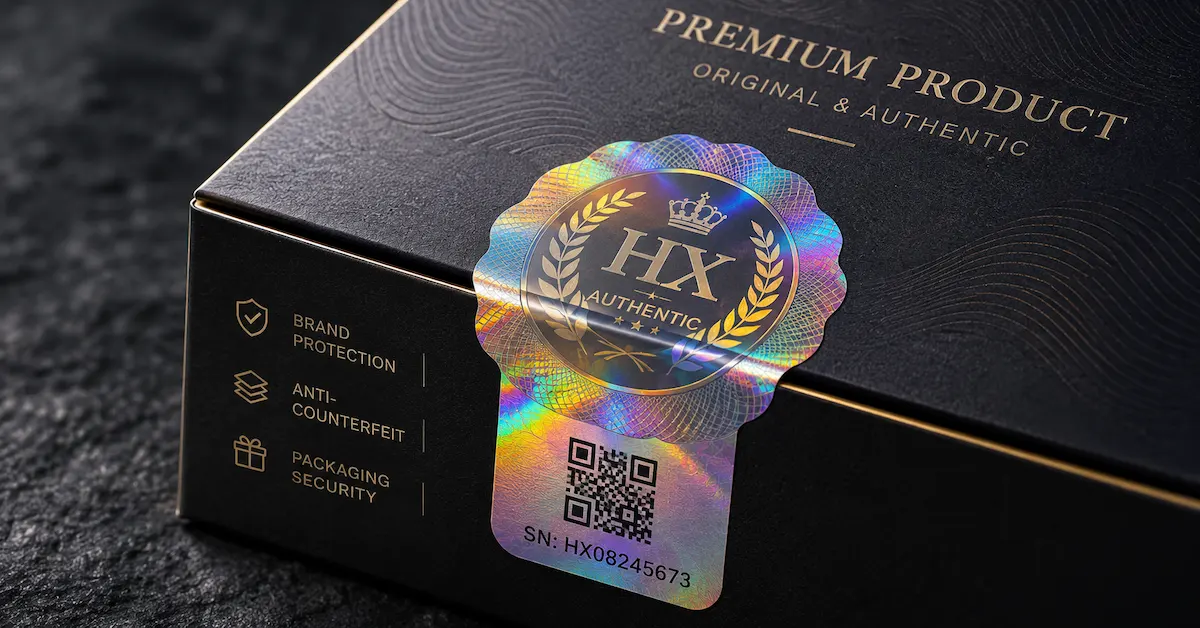
A custom hologram sticker is a label incorporating holographic optical features that can be tailored to a brand, product, or defined authentication requirement.
Unlike conventional printed stickers, embossed holographic labels use microscopic surface structures that interact with light.
These structures can produce angle-dependent colors, apparent depth, changing images, and other optical effects.
Key Technical Characteristics
Optical effect: The holographic structure changes the appearance of reflected light according to viewing and illumination conditions.
Customized artwork: Brand graphics, lettering, and selected security details can be incorporated into the design where technically feasible.
Label construction: The finished sticker combines its optical layer with suitable film, adhesive, and liner materials.
Application requirements: The construction should be compatible with the intended packaging surface and use environment.
What Is the Security Boundary?
Not every holographic-looking sticker offers the same authentication value.
A metallic foil sticker may provide decorative reflection without containing a distinctive brand-specific optical master.
A custom security hologram can incorporate more specialized visual features that inspectors compare against an approved reference.
However, a hologram does not make counterfeiting impossible.
Its value depends on design complexity, production controls, verification procedures, and the specific threats it is intended to address.
How Do Authentication Standards Apply to Custom Hologram Stickers?
Security-label selection should begin with an assessment of the risks the brand intends to address.
ISO 22383:2020 provides a framework for considering authentication elements and evaluating their suitability for material goods.
For custom hologram projects, its underlying approach can be translated into practical purchasing questions.
Four Essential Authentication Requirements
| Requirement | Engineering consideration | Buyer verification |
|---|---|---|
| Recognizability | The authentic optical design must have identifiable features | Inspect approved samples under defined conditions |
| Differentiation | The design should be distinguishable from ordinary decorative materials | Compare with generic patterns and alternative designs |
| Practical verification | Intended users need an appropriate inspection method | Define viewing conditions and reference images |
| Reproduction consistency | Authorized batches should retain the agreed features | Compare production samples with the approved master |
What Does ISO 22383 Actually Establish?
ISO 22383 provides guidance on selecting authentication technologies according to the product and the associated risks.
It does not mandate one particular holographic construction.
It also does not automatically certify a manufacturer or guarantee that a selected technology will prevent all forms of product fraud.
For packaging buyers, the central question is whether the chosen authentication feature can be reliably recognized and appropriately integrated into the broader product protection process.
How Does Hologram Master Origination Work?
The optical master is one of the most important elements of a custom hologram design.
It defines the optical information that will be reproduced in the finished label.
For embossed holographic constructions, the general process involves designing the optical features, creating an original master, developing appropriate production tooling, and reproducing the surface structure on a suitable material.
1. Artwork Preparation
The process begins with brand artwork and a defined security objective.
The buyer should provide:
-
Approved vector logo files.
-
Correct brand text and typography.
-
Final label dimensions.
-
Intended optical effects.
-
Required inspection details.
-
Packaging images showing label placement.
Vector artwork is generally preferred because it allows graphic elements to be adjusted without the pixelation associated with low-resolution bitmap images.
However, even a high-quality vector logo may require modification for optical reproduction.
2. Optical Design Development
The manufacturer translates the approved artwork into a suitable arrangement of optical features.
Depending on the selected technology, the design may incorporate angle-dependent patterns, apparent depth, microtext, or other specialized security effects.
The final result depends on the optical design system and available manufacturing capabilities.
3. Master Origination
A master containing the intended optical structure is created using the appropriate technology.
The master is then used as the source for further production preparation.
4. Tooling and Reproduction
In certain embossed hologram processes, electroforming and nickel shims are used to reproduce the optical microstructure.
The pattern can then be transferred to a compatible coating or film using controlled embossing conditions.
5. Optical Finishing
Selected holographic constructions use reflective metallization to make their optical features visible.
Other structures may use transparent or selectively reflective effects.
The chosen construction determines the available appearance and performance characteristics.
Engineering principle: A good digital design does not guarantee a good finished hologram. The optical master and physical reproduction process determine whether the intended effect survives manufacturing.
What Should Be Checked During Optical Master Approval?
Before the design enters full production, buyers should evaluate the physical master sample.
Recommended Optical Approval Parameters
| Parameter | What to inspect | Potential problem |
|---|---|---|
| Logo definition | Recognizable graphic edges and proportions | Blurred or distorted artwork |
| Optical contrast | Clear distinction between intended features | Weak or indistinct patterns |
| Viewing-angle response | Expected change under defined observation conditions | Missing or inconsistent effect |
| Fine graphics | Visibility under the intended inspection method | Loss of small design features |
| Background uniformity | Consistent optical appearance | Irregular embossing or surface defects |
| Registration | Alignment of graphics and security features | Optical and printed elements do not align |
| Finished dimensions | Correct size and shape | Important details fall outside the die-cut area |
Acceptance criteria should be based on the approved construction and inspection conditions.
A buyer should retain a physical reference sample and photographs showing the expected appearance.
What Is the Difference Between Stock Holographic Film and Custom Optical Masters?
One of the most important procurement decisions is whether the project needs a completely original optical design.
Custom printing on stock holographic film and original-master hologram production are different approaches.
Technical Comparison: Stock Hologram vs. Custom-Printed vs. Original-Master Design
| Comparison | Stock holographic film | Custom-printed holographic film | Original-master hologram |
|---|---|---|---|
| Optical pattern | Existing design | Existing design with additional printing | Specifically originated optical design |
| Brand customization | Limited | Printed logo and graphics | Brand elements can form part of the optical structure |
| Initial development | Generally simpler | Artwork and printing preparation | Optical design and master development |
| Design differentiation | Shared or generic appearance | Distinct printed graphics | Greater potential for distinctive optical features |
| Tooling needs | Depends on converting | Depends on printing and converting | May require dedicated master and reproduction tooling |
| Main application | Decorative or basic identification | Branded packaging | Projects requiring customized optical authentication |
| Key approval | Film appearance | Print registration and artwork | Master image and reproduction consistency |
Which Option Is Better?
Stock holographic film may be suitable when the primary requirement is appearance, cost control, or a relatively simple label.
Custom-printed film can be useful when branding is important but the optical background itself does not need to be exclusive.
Original-master holograms are worth evaluating when a brand requires distinctive optical features and more formal control over its authentication design.
The correct choice depends on security objectives, expected purchasing volume, budget, and design requirements.
How Do Film Materials and Adhesives Affect Hologram Sticker Performance?
Optical appearance is only one part of the finished product.
The holographic structure must be incorporated into a label suitable for the intended packaging and application process.
Depending on the construction, relevant layers can include:
-
A film or supporting substrate.
-
A holographic coating or optical structure.
-
A reflective or other functional layer.
-
A pressure-sensitive adhesive.
-
A release liner.
The arrangement varies according to the product design.
Material Selection Matrix
| Material or structure | Main engineering consideration | Potential use |
|---|---|---|
| Holographic PET film | Dimensional stability and optical appearance | Product identification and premium packaging |
| Metallized holographic film | Reflective optical presentation | Branded security stickers |
| Transparent optical construction | Visibility of underlying graphics | Selected packaging designs |
| VOID security construction | Defined removal evidence | Security closures and warranty seals |
| Destructible label structure | Material breakage during removal | Selected anti-transfer applications |
These are industry construction options, not a guarantee that HX offers every configuration in every size or format.
Why Is Adhesion Testing Necessary?
Adhesive performance depends on the actual surface.
A label that bonds successfully to smooth glass may behave differently on coated paperboard, textured plastic, or painted metal.
ASTM D3330/D3330M describes recognized approaches to measuring peel adhesion.
However, peel force alone cannot confirm that a label has the required tamper-evident response.
For security applications, the buyer should evaluate both adhesion and the intended removal behavior.
Which Packaging Surfaces Require Special Attention?
Packaging compatibility is particularly important when custom holograms are applied to finished products.
| Packaging surface | Main challenge | Recommended evaluation |
|---|---|---|
| Coated paperboard | Surface coatings and varnishes | Adhesion and appearance |
| Corrugated carton | Roughness and limited contact area | Bond stability |
| Glass bottle | Curvature and condensation | Edge adhesion and label placement |
| Plastic housing | Polymer type and surface treatment | Adhesive compatibility |
| Painted metal | Coating interaction | Label performance and finish protection |
| Flexible packaging | Bending and deformation | Wrinkling and optical appearance |
A label should be approved on representative production materials whenever possible.
For curved bottles, the final shape and placement may matter as much as the adhesive.
For premium cartons, the buyer should check whether the holographic design complements the packaging without interfering with required product information.
Which Manufacturing Defects Can Reduce Hologram Quality?
Custom holographic labels can develop defects during optical reproduction, printing, lamination, die cutting, or application.
These defects should be distinguished according to their causes and consequences.
1. Weak or Inconsistent Optical Effects
Potential cause: Inconsistent reproduction of the intended optical structure or unsuitable material processing.
Consequence: The approved holographic effect becomes difficult to recognize.
Recommended action: Compare samples with the optical reference and investigate the relevant reproduction process.
2. Misaligned Artwork
Potential cause: Printing registration or converting misalignment.
Consequence: Printed graphics do not align with the intended holographic design.
Recommended action: Establish appropriate registration criteria and inspect samples during production.
3. Scratches or Surface Damage
Potential cause: Material handling, contact with equipment, or packaging operations.
Consequence: Visible defects reduce appearance quality or interfere with optical inspection.
Recommended action: Review handling and packaging protection.
4. Adhesive Failure
Potential cause: Incompatible adhesive, contamination, uneven pressure, or unsuitable application conditions.
Consequence: Edge lifting, detachment, or inconsistent security performance.
Recommended action: Test on the actual substrate and review the application process.
5. Incorrect Tamper-Evident Response
Potential cause: The selected security construction does not behave as required on the intended surface.
Consequence: The label may be removed without producing the agreed evidence.
Recommended action: Reassess the construction and conduct documented removal testing.
Recommended Defect-Control Table
| Defect | Primary risk | Suggested inspection |
|---|---|---|
| Missing optical feature | Authentication failure | Compare against approved master |
| Incorrect brand artwork | Identity and approval error | Artwork version inspection |
| Poor die cutting | Application and appearance problem | Dimensional inspection |
| Surface scratches | Optical and cosmetic deterioration | Visual inspection |
| Insufficient adhesion | Product detachment | Substrate compatibility testing |
| Failed tamper response | Security-function failure | Controlled removal test |
The buyer and manufacturer should agree on the severity of each defect before bulk production.
How Does Hologram Design Work in Practice? An Illustrative Cosmetics Packaging Example
Consider a cosmetics brand developing a custom hologram sticker for a premium skincare carton.
This is an illustrative engineering scenario, not a documented HX customer case.
Initial Design Requirement
The brand wants a distinctive optical logo that can be recognized by distributors and consumers.
Its packaging uses a coated paperboard carton, and the sticker will be applied near the carton closure.
The brand also wants to determine whether visible evidence of opening is required.
Potential Development Challenges
The original logo includes fine lettering and several closely spaced graphic elements.
When reduced to the intended label size, some details may become difficult to inspect.
The coated paperboard may also influence adhesive bonding.
Furthermore, if the label is intended to protect the carton closure, an ordinary holographic sticker might not provide sufficient removal evidence.
Proposed Engineering Approach
First, simplify the optical artwork where necessary.
Prioritize recognizable brand features instead of forcing excessive detail into a small area.
Second, compare standard and original-master designs.
Determine whether the brand requires a distinctive optical master or whether customized printing provides sufficient differentiation.
Third, validate the physical label on the finished carton.
Check optical appearance, adhesion, and any required tamper response.
Fourth, approve a documented master sample.
Record the artwork version, optical effect, material construction, and packaging position.
Expected Procurement Benefit
This process helps the buyer identify design and material problems before bulk manufacturing.
It also creates a consistent reference for inspection and future repeat orders.
No numerical cost reduction or defect improvement is assumed without actual project data.
How Should a Custom Hologram Stickers Manufacturer Control Repeat Orders?
A successful first order does not eliminate the need for future quality control.
Repeat production should be based on a documented and authorized design.
Important Controls
Master identification: Record which optical master or design version is authorized.
Artwork version control: Ensure printed graphics match the approved files.
Material control: Confirm whether film, adhesive, or liner specifications have changed.
Production reference: Retain approved samples for comparison.
Change authorization: Require buyer approval before modifying critical design or material elements.
Security material management: Establish appropriate controls over obsolete, rejected, or unused branded security materials.
What About Master Ownership?
Custom optical master ownership should be clarified contractually.
Buyers should ask whether the master is owned by the customer or manufacturer, how it is stored, and who is allowed to authorize reproduction.
A confidentiality agreement may be appropriate for sensitive brand-protection projects.
How Do You Prepare a Production-Ready RFQ?
Before requesting a quotation, buyers should provide a complete project specification.
| RFQ item | Information required |
|---|---|
| Brand application | Cosmetics, electronics, beverage, industrial products |
| Security objective | Visual authentication, tamper evidence, or both |
| Artwork | Approved logo and editable files |
| Optical design | Standard pattern or original-master requirement |
| Label dimensions | Width, height, shape, and placement |
| Material | Intended film and adhesive requirements |
| Surface | Actual packaging substrate and finish |
| Security features | Optical effects, microtext, VOID, or other agreed options |
| Application format | Roll, sheet, or individual label |
| Production process | Manual or automated application |
| Quantity | Sample, trial, initial bulk, and repeat-order forecast |
| Quality requirements | Reference sample and inspection criteria |
| Delivery | Destination and project schedule |
What Determines MOQ and Cost?
Development cost may depend on optical master preparation, artwork complexity, tooling, materials, printing, die cutting, and production quantity.
A customized printed stock film and a newly originated optical master can involve different cost structures.
MOQ and lead time should be confirmed for the actual project rather than estimated from unrelated products.
Working With HX Security Label on Custom Hologram Projects
HX Security Label, operated by Shenzhen Huaxin Anti-Counterfeiting Technology Co., Ltd., specializes in anti-counterfeiting label research, development, and production.
Founded in 2008, the company presents a portfolio including holographic labels, VOID-related labels, latent image labels, and customized security applications.
Its published service process includes:
-
Requirements confirmation.
-
Design drafting.
-
Product proofing.
-
Material selection.
-
Sample confirmation.
-
Packaging and delivery coordination.
This process provides a practical starting point for custom hologram sticker projects.
The specific optical design, master origination requirements, material availability, production specifications, MOQ, and delivery schedule should be confirmed before ordering.
Explore the HX holographic label product category or review the company's manufacturing background.
Request Custom Hologram Sticker Samples and a Quotation
Share your artwork, packaging photos, required optical effects, label dimensions, and estimated order quantity for project evaluation.
FAQs
1. What is the difference between a custom hologram sticker and a regular holographic sticker?
A regular holographic sticker may use a standard optical pattern with or without additional printing. A custom hologram can incorporate brand-specific optical artwork and, where required, an original master. Buyers should confirm whether the optical structure itself is customized.
2. Can manufacturers convert a company logo into a hologram?
A suitable logo can often be evaluated for holographic design. The manufacturer may need to modify fine details, layout, or optical effects to suit the intended label dimensions and technology.
3. What is hologram master origination?
Master origination is the process of creating the original optical structure used for reproducing a holographic image. It is an important stage when developing a distinctive optical security design.
4. Are custom hologram stickers impossible to counterfeit?
No. Holographic features can increase design complexity and provide useful authentication cues, but no physical label should be described as impossible to reproduce. Effective protection also depends on verification and production controls.
5. Which material is commonly used for holographic security stickers?
PET film is commonly used in certain holographic label constructions, but the appropriate material depends on optical requirements, adhesive compatibility, environmental conditions, and intended application.
6. Can holographic stickers include VOID security features?
Yes, certain designs can combine holographic optical features with suitable tamper-evident constructions. The intended removal behavior should be specified and tested on the actual application surface.
7. How do buyers test hologram sticker quality?
Buyers should inspect optical clarity, logo accuracy, material appearance, dimensions, adhesion, and any required security response. Samples should be compared with an approved physical reference.
8. Who owns a custom holographic master?
Ownership depends on the commercial agreement. Buyers should clarify rights to the optical design, master files, reproduction tools, and future production before approving development.
9. What affects custom hologram sticker MOQ and lead time?
Optical design complexity, master preparation, materials, tooling, converting requirements, order quantity, and sample approval can all influence MOQ and lead time. Exact terms should be quoted for the specific project.
10. How can I request a custom hologram sticker from HX Security Label?
Prepare the brand artwork, intended packaging material, sticker dimensions, optical preferences, security requirements, and estimated quantity. Then contact HX Security Label to discuss available options and sampling.
Summary, Technical Support and References
Custom hologram sticker development should be treated as a controlled engineering and packaging project.
The optical master defines the intended holographic effect. Material selection determines how the finished label interacts with the packaging. Artwork and sample approval establish the reference against which subsequent production should be evaluated.
For B2B buyers, the most important practical controls are:
-
Define the intended security function before choosing optical features.
-
Confirm whether the project requires a new optical master.
-
Approve physical samples rather than relying only on digital artwork.
-
Test adhesion and any tamper response on the actual substrate.
-
Retain authorized artwork, master references, and repeat-order specifications.
Next-Stage Reading: Hologram Security and Packaging Applications
For additional technical and purchasing information, explore these HX resources:
Product Technology: Custom Hologram Sticker: Visual Security that Builds Brand Trust
Holographic Product Selection: HX Holographic Label Collection
Tamper-Evident Applications: HX VOID Open Labels
References & Standards
ISO 22383:2020 — Security and resilience — Authenticity, integrity and trust for products and documents — Guidelines for the selection and performance evaluation of authentication solutions for material goods.
Used as a reference for authentication-system selection and evaluation principles.
ASTM D3330/D3330M-04(2025) — Standard Test Method for Peel Adhesion of Pressure-Sensitive Tape.
Used as a reference for relevant adhesive peel-testing principles. It does not independently establish tamper-evident performance.
HX Security Label — About Us and Production Process.
Company information and the publicly described customization workflow.
HX Security Label — Holographic Label Product Collection.
Product-category information and available holographic security-label directions.
These sources support the technical evaluation approach. Product-specific performance, certification status, and commercial terms still require verification.
Conclusion
Choosing a reliable custom hologram stickers manufacturer requires more than reviewing attractive optical effects or comparing unit prices.
For brand owners and packaging engineers, the most important decisions involve defining the security objective, preparing suitable artwork, selecting the appropriate holographic master, and validating the complete label construction before bulk production.
A well-controlled development process should connect optical design, material compatibility, security functionality, physical sample approval, and repeat-order quality management.
These steps help reduce avoidable design revisions and ensure the finished holographic sticker matches its intended packaging and authentication requirements.
HX Security Label offers customized anti-counterfeiting label solutions for businesses developing branded holographic packaging and product-security applications.
Contact HX Security Label with your logo files, label dimensions, packaging material, optical design requirements, and estimated order quantity to discuss suitable custom hologram options and request a project quotation.