
What Should a Security Labels Manufacturer Actually Provide?
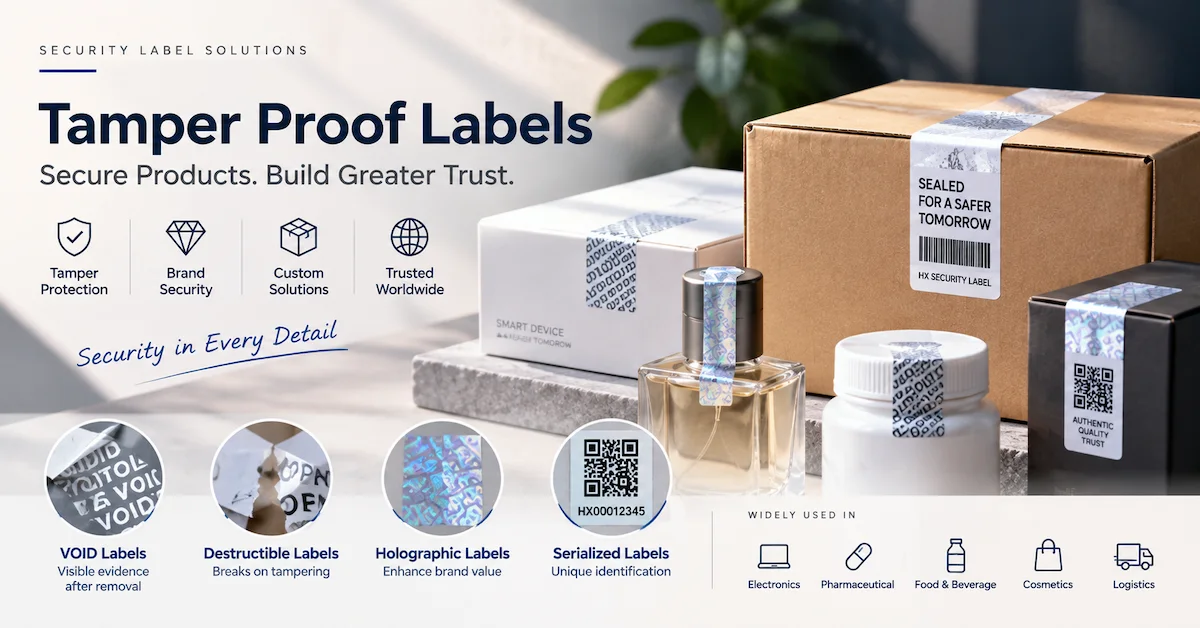
A security labels manufacturer should do more than print an attractive holographic sticker or add the word “VOID” to a label. For B2B buyers, the real task is to convert a specific security risk into a label construction that can be explained, tested, inspected, and reproduced during bulk production. That risk may involve counterfeit substitution, unauthorized opening, label transfer, warranty manipulation, package resealing, product identification, or a combination of these problems. The correct solution can therefore include visible holographic features, latent or hidden verification elements, tamper-evident structures, destructible materials, QR codes, barcodes, serial numbers, or several features working together. Buyers can first review the available HX security label product categories, but the final specification should be based on the product, package, inspection process, and threat being addressed rather than on visual appearance alone.
Which Buyers Need a Specialized Security Labels Manufacturer?
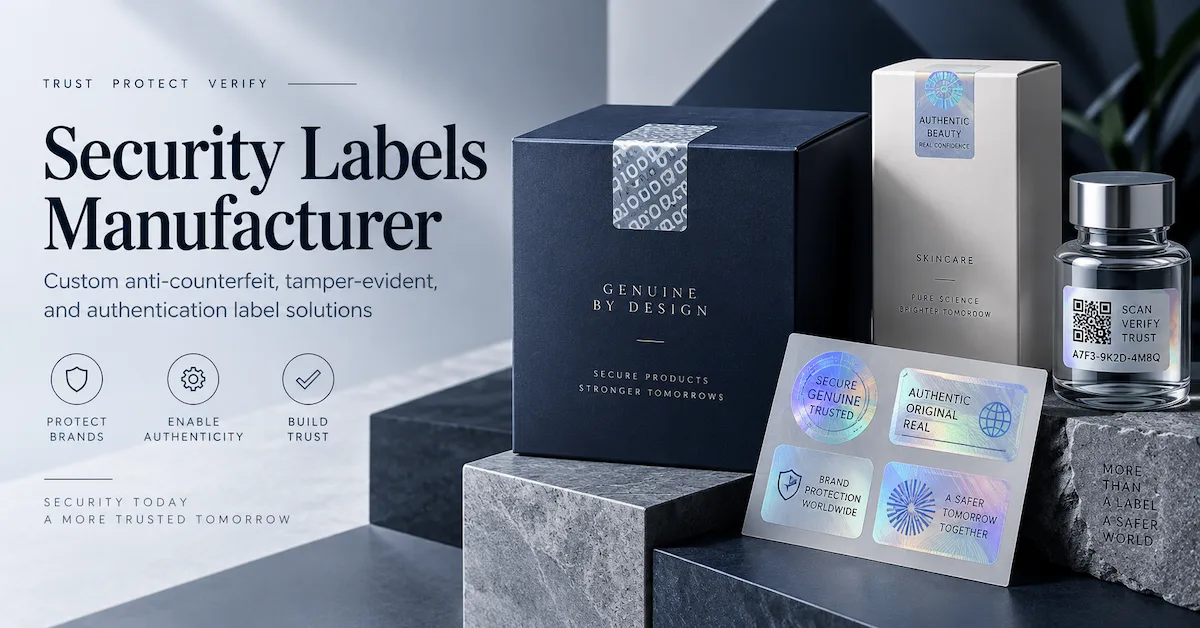
Security-label projects are especially relevant to brand owners, electronics manufacturers, liquor and beverage companies, cosmetics businesses, pharmaceutical packaging buyers, food and tea brands, industrial-equipment suppliers, importers, distributors, e-commerce sellers, and packaging converters working for third-party brands. Their needs are not identical. An electronics company may prioritize warranty seals and evidence that a housing has been opened, while a liquor brand may care about bottle closure, label reuse, and consumer-facing authentication. A packaging converter may need stable roll specifications for automatic application, and a distributor may be more concerned about repeat-order consistency and private-label customization. Buyers that only require decorative branding, promotional stickers, or ordinary product information may not need a specialized security construction. A qualified manufacturer should therefore identify when a security feature creates real value and when a simpler label would be more appropriate.
Start With the Security Problem, Not With the Printing Technology
One of the most common purchasing mistakes is starting an inquiry with “We need a hologram label” or “We need a VOID sticker” before defining the problem. A better brief explains what the buyer wants to detect. If the concern is package opening, define which closure must be monitored and what evidence should remain after opening. If the concern is authentic-label transfer, explain whether the label must break, leave residue, reveal a message, or become visibly unusable after removal. If the concern is consumer authentication, define what the consumer should observe or scan and what result confirms authenticity. If individual product identity matters, determine how serial numbers or QR codes are linked to products and records. A security labels manufacturer can then recommend a suitable combination rather than adding unnecessary technologies that increase cost without solving the actual risk.
Compare Security Label Technologies by Function
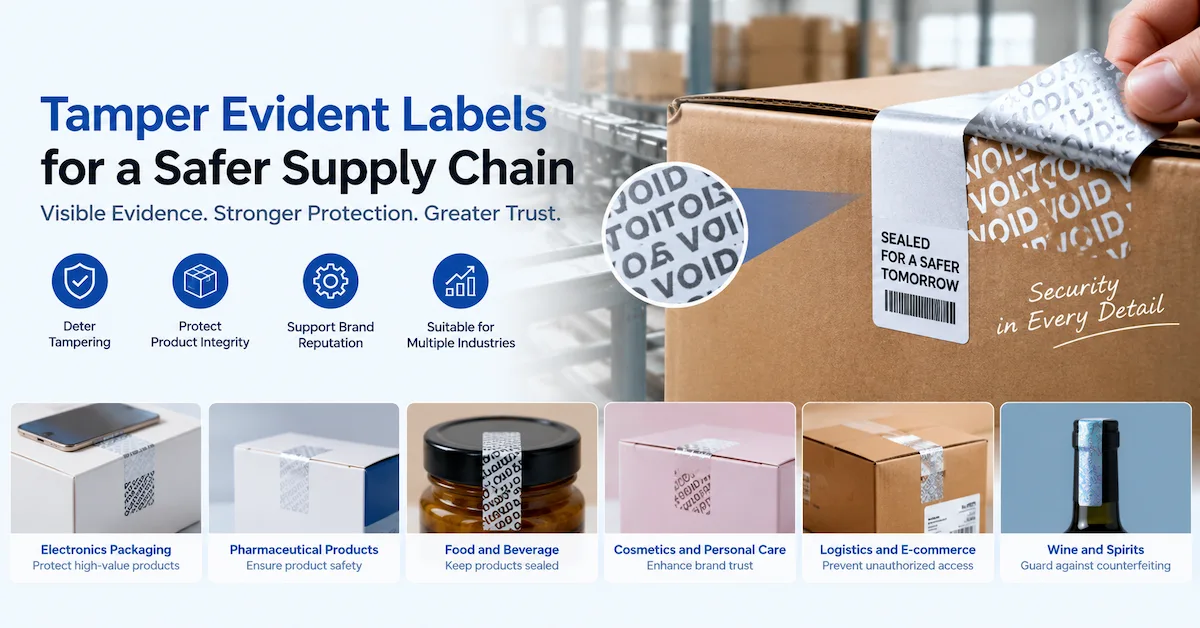
Different label technologies address different security problems, and buyers should avoid treating them as interchangeable. Holographic features can support visual authentication and make branded packaging more distinctive, but a holographic image alone does not prove that a carton or bottle has not been opened. VOID labels focus on removal evidence, while destructible constructions are intended to make intact transfer more difficult. Latent or hidden features can provide an additional verification layer for trained staff or authorized channels. Serialized QR codes or barcodes provide identity and data functions, but they should not automatically be described as physical anti-tamper protection. HX presents several of these directions through its security label product range, allowing buyers to compare the required functions before discussing customization.
| Security Solution | Main Function | Typical Buyer Need | Key Approval Question |
|---|---|---|---|
| Holographic label | Visual authentication | Brand protection and visible security | What feature should an inspector observe? |
| Latent image label | Hidden verification | Secondary or controlled inspection | Who verifies it and under what conditions? |
| VOID label | Removal evidence | Cartons, electronics, closures | What appears after removal and where? |
| Destructible label | Anti-transfer behavior | Warranty and product surfaces | How does the label break during removal? |
| Serialized label | Individual identity | Batch, warranty, channel, product records | How are codes generated and controlled? |
| QR security label | Digital interaction | Verification or information access | What system or record does the code connect to? |
| Combined security label | Multiple protection layers | Higher-risk branded products | Which feature solves which specific risk? |
Packaging Surface Is Part of the Security Specification
A label cannot be selected independently from the surface to which it will be applied. Coated paperboard, corrugated boxes, PET packaging, glass bottles, painted metal, molded plastic, flexible film, and textured surfaces can behave differently with the same adhesive or tamper construction. Buyers should send actual packaging samples whenever possible and identify coatings, varnishes, laminations, curvature, roughness, cleaning conditions, and the available bonding area. A seal that performs well on a smooth test plate may produce a different result on a coated retail carton. Similarly, a label tested on a flat glass panel may not behave identically when wrapped around a bottle neck or cap. A professional security labels manufacturer should therefore evaluate the intended substrate before final approval rather than treating adhesive selection as a generic specification.
Build a Controlled Specification Before Requesting Bulk Pricing
A meaningful quotation requires a controlled project brief. Without one, suppliers may quote different materials, security structures, data requirements, inspection levels, and roll formats, creating the illusion that one supplier is much cheaper when the quotations are not comparable. Use the following framework to prepare a security-label inquiry. The table is a buyer-side specification checklist rather than a statement that every HX product has the same material or performance.
| Specification Area | What the Buyer Should Define or Confirm |
|---|---|
| Product/application | Electronics, bottle closure, cosmetics box, shipping carton, equipment, etc. |
| Main security risk | Counterfeiting, opening, transfer, reuse, identity, or multiple risks |
| Application substrate | Paperboard, coated carton, plastic, glass, metal, film, other |
| Label position | Closure, cap, seam, warranty point, product surface |
| Size and shape | Finished dimensions, shape, available bonding area |
| Security structure | Hologram, VOID, destructible, latent image, variable data, combination |
| Expected tamper result | Message, residue, tearing, fragmentation, transfer, other approved evidence |
| Artwork | Logo, text, colors, pattern, language, security graphics |
| Variable data | QR code, barcode, serial number, batch range |
| Application method | Manual or automatic |
| Supply format | Sheet or roll, winding direction, core, spacing where applicable |
| Environment | Storage, transport, temperature, humidity, friction, other relevant exposure |
| Quantity | Sample volume, first order, forecast repeat quantity |
| Acceptance method | Approved sample, inspection criteria, code checks, packaging tests |
Materials and Components Should Be Explained in Application Terms
Buyers do not need a long material list unless they understand why each element matters. A security label normally involves a face material, adhesive system, release liner, printed or optical features, die-cut structure, and potentially variable data. The most important question is how these components interact with the intended application. A destructible face material, for example, is useful only if the complete construction produces the required removal behavior on the actual substrate. A VOID effect must remain distinguishable under the buyer’s inspection conditions. A QR code must remain readable after printing and application. Instead of asking only for a material name, buyers should ask which function the proposed construction performs, how it should be applied, what limitations exist, and which properties require physical validation.
Sample Testing Should Separate Appearance, Adhesion, and Security Performance
A digital artwork approval is not the same as a security-label approval. Buyers should evaluate physical samples on actual packaging before bulk production. First, review printed appearance, dimensions, text, security graphics, and code placement. Second, apply samples under the planned conditions and check for edge lifting, wrinkling, unintended breakage, or other problems during normal handling. Third, deliberately open, peel, or remove another set of samples and document the required tamper response. Where transport, humidity, temperature change, friction, or other environmental factors matter, repeat relevant checks after the agreed exposure. The goal is to create a repeatable comparison between an untouched package and an interfered package. HX’s published company workflow includes requirement confirmation, design preparation, physical proofing, material selection, sample confirmation, and packaging/logistics stages, which buyers can review on the About Us page.
Workmanship Matters When a Design Moves From Sample to Mass Production
The approved sample becomes commercially useful only when the manufacturer can reproduce it. Buyers should therefore review how printing, security effects, die cutting, variable data, inspection, and finished roll or sheet presentation are controlled. Misregistered die cutting can alter the usable sealing area; inconsistent print contrast can affect barcode scanning; variation in optical features may make authentication instructions harder to follow; and roll-format errors can stop an automatic labeling line even when the label itself is technically acceptable. For repeated orders, artwork revision, material construction, security pattern, and data range should be controlled so that an old version is not accidentally produced. This is where manufacturing discipline becomes more important than a single visually impressive sample.
Quality Control Should Be Linked to the Approved Specification
A buyer evaluating a security labels manufacturer should ask what is actually inspected rather than accepting a general statement such as “strict quality control.” Useful inspection items can include dimensions, print position, artwork revision, die-cut alignment, surface appearance, security effect, adhesive or removal behavior where agreed, barcode or QR readability, serial-number accuracy, quantity, roll direction, and packaging. Not every project requires every test, so inspection should be linked to the controlled specification and the risk of the application. Retaining approved reference samples can also help resolve future differences. If certificates are required for supplier qualification, buyers should verify the certificate holder, scope, issuing body, and validity instead of assuming a company-level certificate automatically proves the performance of every individual security label.
Certifications and Compliance Should Be Verified by Project Scope
Security-label buyers sometimes request certifications because of their own supplier-management requirements or destination-market rules. These requirements should be discussed at the beginning of the project and separated into company-level certification, material documentation, product-specific test reports, and regulated-market requirements. A label used on consumer packaging may involve different documentation from a label used for industrial equipment or a government-controlled tax-stamp project. Buyers should not assume that a general security-label capability automatically includes authorization for regulated documents, tax stamps, pharmaceutical compliance, food-contact use, or other market-specific requirements. Where such requirements apply, request the exact document and confirm that its scope matches the product and project being purchased.
Capacity and Lead Time Depend on More Than Order Quantity
Production capacity should be evaluated together with customization depth, material availability, printing complexity, holographic or special-security processes, variable data, inspection requirements, finishing, and packaging. Lead time should likewise be separated into artwork preparation, sample development, buyer approval, material preparation, production, inspection, dispatch, and transportation. A security labels manufacturer may process a repeat order differently from a new project requiring customized security development. Therefore, buyers should ask when the quoted production time actually begins and which approvals must be completed before scheduling. Current commercial terms, MOQ, and delivery timing should always be confirmed for the specific project rather than copied from an unrelated product or previous order.
Compare Security Configurations Instead of Invented Model Numbers
Security labels are often customized by function, which means buyers may not have standardized model numbers to compare. In that case, comparing configurations is more useful than forcing the project into a model table that does not reflect the real product structure. The following comparison shows how B2B buyers can evaluate options before requesting samples; availability and final construction should still be confirmed with the manufacturer.
| Configuration | Features | Main Advantage | Best For | Relative Cost Driver |
|---|---|---|---|---|
| Basic tamper seal | Printed security seal with defined removal response | Focused opening evidence | Cartons and packaging closures | Material, adhesive, size |
| VOID security solution | Visible message or transfer after removal | Fast visual inspection | Electronics, cartons, equipment | VOID construction and customization |
| Holographic security solution | Custom visual optical feature | Consumer-facing authentication | Branded retail and premium packaging | Optical design and production |
| Holographic + tamper solution | Visual feature plus removal evidence | Combines two security functions | Higher-value branded goods | Combined structure and tooling |
| Serialized security solution | Unique codes or serial numbers | Individual product identity | Warranty, channels, logistics | Data generation and inspection |
| Multi-layer custom solution | Physical, visual, and digital features | Addresses several defined risks | Higher-risk or customized projects | Security complexity and control requirements |
Cost Should Be Evaluated as a Risk-Control Decision
Unit price is only one part of security-label cost. The quotation may also reflect custom artwork, optical design, material construction, special adhesives, die cutting, proofing, variable data, data verification, security inspection, roll specifications, packaging, and logistics. More complex security does not automatically mean better value; it is valuable only when it addresses a real risk and can be used correctly by the buyer’s team or end customer. Conversely, a low-cost label that fails on the packaging surface, cannot run on the labeling line, or provides unclear tamper evidence can create rework, scrap, shipment delay, warranty disputes, or a false sense of security. Buyers should therefore compare suppliers against the same approved requirement rather than simply asking which company offers the lowest unit price.
OEM and Custom Security Labels Should Have Clear Responsibility Boundaries
OEM and customized projects can involve brand graphics, dimensions, shapes, hidden security features, holographic patterns, VOID messages, serial numbers, QR codes, packaging formats, and other project-specific elements. Buyers should identify which files and data they provide, what the manufacturer designs or develops, who owns customized artwork or security elements, how revisions are approved, and how future repeat orders are controlled. If digital verification is requested, code printing, database management, verification pages, system integration, and long-term data services should be defined separately rather than assumed to be included automatically. Buyers interested in a project-specific solution can start with the HX product range and use the contact page to submit packaging and security requirements for evaluation.
What Information Should You Send a Security Labels Manufacturer?
A well-prepared inquiry reduces quotation revisions and makes sample development more useful. Send the product category, packaging photos or samples, application surface, intended label position, size and shape, primary security risk, required tamper or authentication result, artwork, target market, quantity, application method, supply format, storage and transport conditions, and any QR, barcode, or serial-number requirement. If several packaging versions use different coatings or materials, identify them individually rather than assuming one label will behave identically on all of them. You can also review common purchasing questions in the HX FAQ section before discussing the project.
Frequently Asked Questions
1. What does a security labels manufacturer produce?
A security labels manufacturer develops and manufactures labels intended to support authentication, tamper evidence, anti-transfer protection, identification, or combinations of these functions. Available constructions can include holographic labels, latent image labels, VOID structures, destructible labels, QR codes, serial numbers, and other customized security features depending on the application.
2. How do I choose between holographic and VOID security labels?
Choose according to the problem being solved. Holographic features are mainly useful for visual authentication, while VOID constructions focus on visible evidence after removal. When both authentication and package-opening evidence matter, a combined solution may be evaluated rather than treating the two functions as interchangeable.
3. Can security labels be customized with our brand logo?
Brand graphics, text, dimensions, colors, security patterns, and other features can be discussed as part of a customized project. The exact options depend on the proposed construction, so artwork and physical functionality should both be confirmed during sample development.
4. Can a security label include a QR code and serial number?
Variable QR codes, barcodes, and serial numbers can be incorporated into suitable projects. Buyers should define code source, numbering rules, duplicate handling, inspection, and data responsibility. If an online authentication or traceability system is required, its scope should be confirmed separately.
5. Do security labels work on every type of packaging?
No single construction should be assumed to work identically on every substrate. Carton coatings, plastic types, glass curvature, metal finishes, surface contamination, and other conditions can affect performance. Physical testing on representative packaging is recommended before bulk approval.
6. What should be checked during sample approval?
Check artwork, dimensions, print quality, security features, placement, adhesion, normal-handling stability, the intended tamper or removal response, variable-data readability where applicable, and any environmental or packaging-line conditions that are important to the project.
7. How should buyers evaluate security label quality?
Evaluate the label against a controlled specification rather than general appearance. Important items may include dimensions, print registration, die cutting, security effect, removal behavior, QR or barcode readability, serial-number accuracy, roll presentation, packaging, and consistency with the approved sample.
8. What affects the price of custom security labels?
Cost can be influenced by materials, adhesive structure, holographic or hidden features, size, shape, printing complexity, special die cutting, variable data, sample development, inspection requirements, quantity, roll specifications, and logistics. Quotations should therefore be compared using the same project specification.
9. What are typical MOQ and lead-time requirements?
MOQ and lead time vary by material, security structure, customization, order quantity, proofing, data requirements, and production schedule. Request current project-specific terms after the design and construction are sufficiently defined rather than relying on a generic number.
10. How do I start a custom project with HX Security Label?
Prepare packaging photos or samples, application surface, label size and position, security objective, artwork, quantity, application method, environmental conditions, and data requirements. Review the HX company information and submit the project through Contact Us so the security structure and sampling requirements can be discussed around the actual application.
Conclusion
Choosing a security labels manufacturer is not simply a printing-supplier decision; it is a packaging-security, quality-control, and repeatability decision. B2B buyers should first define the threat they need to address, then select the appropriate authentication, tamper-evident, anti-transfer, or identification functions, qualify the construction on real packaging, document acceptance criteria, and carry those requirements into mass-production inspection and future orders. Cost, MOQ, delivery, customization, and digital features should all be evaluated against the same controlled project scope rather than as isolated marketing claims. For electronics, liquor, cosmetics, food, industrial equipment, logistics, or other branded packaging projects, review the HX security label solutions and contact HX Security Label with your packaging details and required security outcome to discuss a suitable sample and customization approach.