
TL;DR: Choosing a reliable wine bottle security sticker manufacturer requires evaluating more than holographic appearance or adhesive strength. The right bottle security seal must fit the closure geometry, remain stable during intended storage and handling, and produce recognizable tamper evidence when disturbed. Wineries and packaging buyers should validate neck-seal construction, condensation resistance, ice-bucket exposure, and labeling-line compatibility before approving bulk orders.
For wineries, spirits brands, importers, and bottling companies, packaging security presents an unusual engineering challenge.
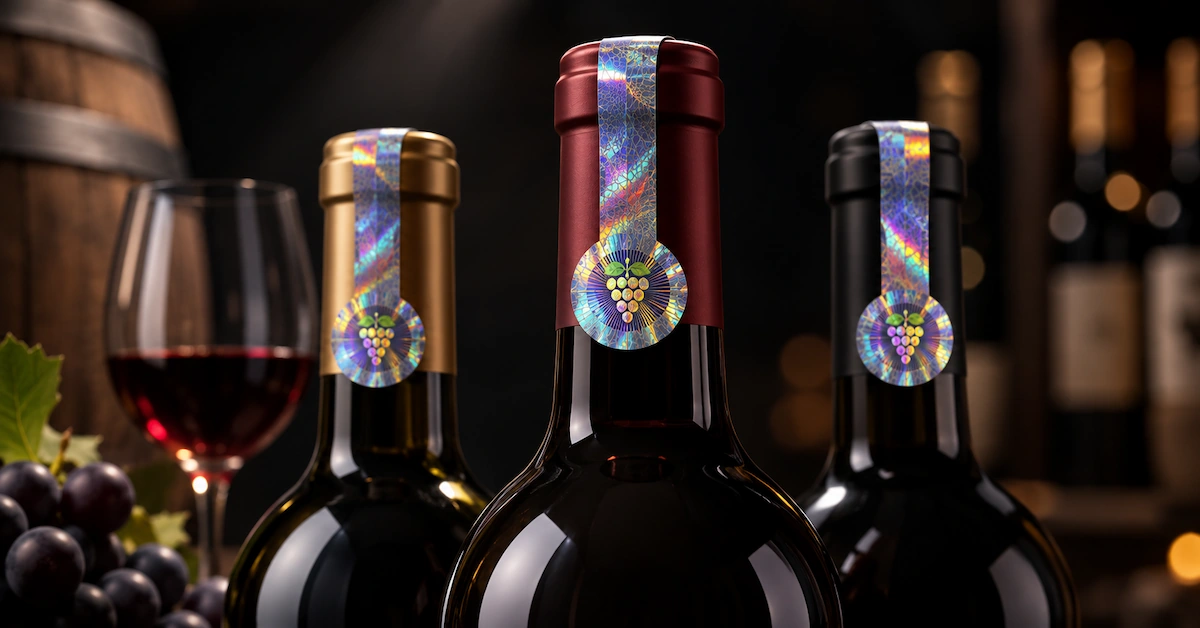
A wine bottle security sticker may need to bridge a glass neck and a metal capsule, withstand refrigeration, remain visually attractive, and reveal possible opening without activating during normal transportation.
A label that looks flawless on a flat sample may lift at the edge of a curved capsule. Another may maintain excellent adhesion but fail to produce the intended removal evidence.
The most reliable purchasing approach is to specify the bottle closure, required security response, application conditions, and inspection criteria before choosing the label construction.
This guide explains wine bottle security sticker technologies, bottle-neck design, materials, environmental testing, manufacturing quality control, and the technical information buyers should provide when requesting custom security labels.
Explore HX Security Label's Wine Tax Stamp product category for its related alcohol-packaging security product direction.
Key Takeaways
-
Bottle geometry matters: Neck diameter, taper, capsule material, and opening mechanism affect seal design.
-
Tamper evidence is not the same as authentication: A hologram can support visual inspection, while VOID or destructible structures can reveal interference.
-
Cold and wet conditions require testing: Refrigeration, condensation, and ice-bucket immersion create different stresses.
-
Application timing matters: Adhesive performance can depend on bottle temperature, surface condition, and bonding time.
-
Bulk production requires validation: Approved samples, accurate die cutting, compatible rolls, and repeat-order controls reduce procurement risk.
What Is a Wine Bottle Security Sticker?
A wine bottle security sticker is an adhesive security label designed for a wine bottle, its closure, or associated packaging.
Depending on its construction, it may provide visual authentication, tamper evidence, product identification, or a combination of these functions.
Unlike an ordinary decorative bottle label, a security sticker should have a clearly defined inspection purpose.
Common Security Functions
Tamper evidence: Reveals a specified removal, opening, or interference event.
Visual authentication: Uses recognizable features such as custom holographic patterns.
Anti-transfer protection: Makes intact removal and reuse more difficult through a suitable material structure.
Product identification: Uses printed batch numbers, serial numbers, or QR codes to support identification.
A single sticker does not automatically perform all four functions.
The appropriate design depends on what the winery wants to protect and how the bottle will be inspected.
Where Should Security Stickers Be Placed on Wine Bottles?
Security-label placement directly affects the ability to reveal opening.
The preferred position depends on the bottle closure and the event that must be detected.
Bottle-Neck and Closure Applications
| Application position | Main objective | Key design consideration |
|---|---|---|
| Across capsule and bottle neck | Reveal disturbance of the closure area | Label must bridge the intended opening interface |
| Across screw cap and glass | Indicate cap movement or seal removal | Cap rotation and relative movement |
| Over a capsule tear area | Reveal interference with the capsule | Controlled tearing or material separation |
| On bottle body | Provide visual authentication or identification | Does not necessarily reveal opening |
| On outer carton | Indicate opening of secondary packaging | Protects the carton rather than the bottle closure |
Cork-Finished Wine Bottles
Many still wines use a cork closure covered by a decorative capsule.
A sticker placed only on the capsule surface may remain visually unchanged if it does not interact with the area that must move or break during opening.
Buyers should identify the actual opening method and test whether the selected seal reliably responds to it.
Screw-Cap Bottles
Screw caps introduce rotational movement.
A security sticker that bridges the cap and stationary bottle surface must accommodate the difference between normal transportation and intentional opening.
The label should not release prematurely, but it should produce the agreed evidence when the protected interface moves.
Sparkling Wine Bottles
Sparkling wine closures have different geometries, including foil, wire cages, and cork assemblies.
A standard neck label may not be appropriate for these components.
The manufacturer should evaluate closure shape, safe opening access, label placement, and the intended security response.
A bottle security seal must be designed around the actual closure—not simply the outside diameter of the bottle neck.
Which Wine Bottle Security Sticker Construction Is Best?
Several security-label constructions may be evaluated for wine packaging.
Each provides a different visual or physical response.
Security Construction Comparison
| Construction | Primary function | Potential advantage | Important limitation |
|---|---|---|---|
| Holographic security sticker | Visual authentication | Distinctive optical appearance | Does not automatically reveal opening |
| Full-transfer VOID label | Leaves security evidence on the surface | Original package retains visible evidence | Residue may affect appearance |
| Partial-transfer VOID label | Creates evidence on both surfaces | Two inspection points | Requires controlled transfer behavior |
| Destructible security label | Breaks during removal | Discourages intact reuse | Must withstand normal handling |
| Tear-evident closure seal | Fractures across a protected opening | Can reveal closure interference | Depends on accurate placement |
| Serialized security sticker | Individual identification | Supports product-level records | Does not prevent copying by itself |
When Should You Choose a Holographic Label?
Custom holographic effects may be suitable for premium wine packaging where visual authentication and brand identity are important.
A recognizable optical design can help distributors or consumers compare the label with an approved reference.
However, the label needs a separate tamper-evident function if the objective is to identify possible opening.
Explore HX Holographic Security Labels for related optical security options.
When Is a VOID Security Sticker Better?
VOID materials are relevant when the buyer requires visible evidence after label removal.
The required transfer pattern and residue behavior must be tested on the actual capsule or glass surface.
Review HX VOID Open Labels for this type of security-label application.
Can Security Labels Prevent Bottle Refilling?
A properly positioned tamper-evident seal can help reveal interference with the protected closure.
However, a sticker alone cannot guarantee that a genuine bottle will never be refilled or reused.
Security effectiveness depends on the whole closure system, label construction, inspection procedure, and potential methods of interference.
How Do Bottle Geometry and Capsule Materials Affect Label Performance?
A wine bottle's neck is not always a simple cylindrical surface.
Necks may taper, include raised glass features, or connect to capsules made from different materials.
These characteristics influence both adhesion and label stress.
Critical Design Factors
Neck curvature: A relatively stiff label may resist wrapping around a narrow diameter.
Capsule surface: Foil, lacquered metal, and polymer capsules may present different bonding characteristics.
Surface transitions: A label bridging two materials must respond to different surface properties.
Label orientation: Certain shapes and orientations may be more prone to lifting or wrinkling.
Opening movement: The security design must account for how the capsule or cap moves.
Why Is Face Material Flexibility Important?
Avery Dennison's Wine and Spirits Labeling Guidelines identifies flexible face materials as important for neck labeling.
Stiff constructions can develop stresses when wrapped around tight curves.
For wine bottle security stickers, a suitable construction should balance optical appearance, flexibility, and the intended tamper-evident response.
A more rigid or heavily embellished material is not automatically a better security choice.
Which Adhesive Properties Matter for Wine Bottle Security Labels?
Adhesive selection is a major technical consideration for wine bottles.
The adhesive must bond to the intended surface without causing premature lifting during normal handling.
For tamper-evident constructions, it must also support the required removal behavior.
Key Adhesive Requirements
| Property | Why it matters |
|---|---|
| Initial tack | Helps the sticker make contact during application |
| Final adhesion | Supports attachment after the intended bonding period |
| Surface compatibility | Accounts for glass coatings and capsule materials |
| Cold application suitability | Important when bottles are labeled at reduced temperatures |
| Moisture resistance | Relevant to condensation and wet handling |
| Conformability | Helps the label follow neck curvature |
| Tamper response | Supports the agreed security effect during removal |
Application Temperature vs. Service Temperature
These two conditions should not be confused.
Application temperature describes the conditions when the label is first attached.
Service temperature describes the environment the label encounters after application.
A sticker that withstands refrigeration after proper bonding may not necessarily be suitable for application to a cold, wet bottle.
The supplier should confirm both conditions separately.
What About Bottle Surface Coatings?
Glass bottles may have surface treatments that affect friction and adhesive bonding.
A label that performs well on one bottle supplier's glass may behave differently on another bottle with a different coating.
Testing should use representative production bottles rather than assuming that all glass surfaces are identical.
How to Test Wine Bottle Security Stickers Against Condensation and Ice-Bucket Exposure
Cold and wet performance is one of the most important practical considerations for wine packaging.
However, refrigeration, condensation, and immersion are different exposures and should not be treated as one test.
Test 1: Refrigerated Storage
Apply the security stickers under the intended production conditions.
After the agreed bonding period, expose the bottles to representative refrigerated storage.
Inspect for edge lifting, wrinkling, label movement, and unintended security activation.
Test 2: Condensation Exposure
Move representative bottles through the expected temperature transition.
Observe the formation of surface condensation and evaluate whether the label remains appropriately bonded.
Check that the security function still performs as intended after exposure.
Test 3: Ice-Bucket Immersion
Ice-bucket testing is relevant when the finished product is expected to experience water-and-ice immersion.
Avery Dennison's Wine and Spirits Labeling Guidelines describes an example test using a 50% water and 50% ice mixture.
Its procedure includes allowing labels to bond before immersion and inspecting samples at defined intervals.
The guide discusses a minimum 24-hour bonding period and recommends evaluating adhesion after 72 hours where appropriate.
These figures are part of a published material-testing approach, not universal acceptance limits for every wine security sticker.
Why Does the Test Procedure Need to Be Agreed?
There is no single universally applicable ice-bucket test protocol for all wine-label constructions.
Buyers should establish the exposure conditions, duration, application method, and acceptance criteria for their product.
For a tamper-evident wine seal, testing should address two separate questions:
-
Does the security sticker remain intact during the intended normal exposure?
-
Does it still produce the specified security evidence when deliberately removed afterward?
Both outcomes matter.
A label that detaches during normal use may generate false alarms. A label that remains attached but loses its tamper-evident function may also fail the project requirements.
What Should Be Included in a Wine Bottle Security Sticker Specification?
A detailed specification helps manufacturers select and evaluate appropriate constructions.
Technical Specification Checklist
| Specification | Information to provide |
|---|---|
| Wine product | Still, sparkling, premium, or other relevant category |
| Bottle closure | Cork and capsule, screw cap, or other design |
| Bottle geometry | Neck dimensions, taper, and application position |
| Capsule material | Metal, foil, polymer, or coated construction |
| Security function | Tamper evidence, authentication, identification |
| Security construction | VOID, destructible, holographic, or approved alternative |
| Label dimensions | Width, height, shape, and placement |
| Adhesive requirements | Actual substrates and application conditions |
| Environmental exposure | Refrigeration, condensation, immersion, transportation |
| Artwork | Logo, colors, optical features, security message |
| Application format | Roll, sheet, or other approved supply form |
| Production method | Manual or automatic application |
| Acceptance criteria | Reference sample and required inspection results |
These are recommended RFQ fields rather than standard specifications for all HX products.
The final material, security effect, and manufacturing options must be confirmed through sample development.
How to Qualify Security Stickers on an Automatic Bottling Line
Security stickers intended for automated application need additional production testing.
A label can pass manual application tests yet create problems when dispensed at production speed.
Step 1: Confirm the Application Equipment
Identify whether the security label will be applied by a dedicated tamper-seal station, a pressure-sensitive labeler, or another process.
Provide the manufacturer's equipment requirements.
Step 2: Approve the Roll Configuration
Confirm label orientation, winding direction, core dimensions, label spacing, and liner compatibility.
The specified construction must dispense correctly without unintended tearing or separation.
Step 3: Run a Representative Trial
Apply labels to actual bottles and closures under normal production conditions.
Observe placement accuracy, wrinkling, edge lifting, and any unintended activation of the security feature.
Step 4: Check Positioning Across Multiple Bottles
Small differences in bottle geometry or capsule position may affect label alignment.
The trial should include representative production variation.
Step 5: Verify Security Performance After Application
Inspect finished bottles after the agreed bonding period.
Perform controlled opening or removal tests to confirm that the required evidence appears.
Step 6: Retain the Approved Reference
Document the accepted label position, construction, roll format, and security response.
These records can support future inspection and repeat orders.
What Quality-Control Requirements Should a Wine Bottle Security Sticker Manufacturer Meet?
Quality control should cover both packaging performance and the security function.
Recommended Inspection Matrix
| Quality item | Acceptance objective |
|---|---|
| Artwork | Matches approved branding and graphics |
| Dimensions | Meets agreed size and shape |
| Bottle-neck fit | Acceptable placement without excessive stress |
| Initial adhesion | No unacceptable lifting after application |
| Cold exposure | Remains stable under specified conditions |
| Condensation resistance | No unacceptable loss of adhesion |
| Tamper-evident response | Produces specified evidence during removal |
| Holographic effect | Matches approved optical reference |
| Roll consistency | Supports intended application equipment |
| Batch consistency | Matches approved material and construction |
Acceptance limits should be agreed between the buyer and manufacturer.
Common Failure Modes
Premature edge lifting: May relate to inadequate bonding, surface contamination, stiffness, or curvature.
Wrinkling: May indicate unsuitable conformability or application conditions.
Weak transfer evidence: May result from material or adhesive incompatibility with the substrate.
False tamper activation: May indicate that the security structure is too sensitive to normal application or handling.
Inconsistent placement: May involve bottle geometry, applicator setup, or roll-converting requirements.
These observations help determine what should be investigated during sample development.
Wine Bottle Security Stickers for Different Commercial Applications
Different beverage businesses prioritize different operating conditions.
Premium Still Wine
Premium wine brands may prioritize elegant holographic appearance, discreet label placement, and recognizable tamper evidence.
For these applications, the security construction should not unnecessarily interfere with the package design.
Chilled White Wine and Sparkling Wine
These products may encounter refrigeration, condensation, and wet handling.
Material compatibility and the finished seal's performance after environmental exposure become particularly important.
Export Wine and International Distribution
Export-oriented brands may require consistent identification and packaging integrity across long-distance shipping.
Security labels may incorporate serial numbers or other identification elements, provided that any digital verification service is appropriately specified.
Wine Gift Boxes and Secondary Packaging
A security seal placed on an outer carton can help identify interference with the carton.
However, it should not be treated as equivalent to a seal protecting the actual bottle closure.
The intended security boundary must be clear.
Wine Bottle Security Stickers vs. Official Wine Tax Stamps
Commercial security stickers and legally regulated tax stamps are not necessarily the same product.
A commercial security sticker may be developed by a winery to support branding, authentication, or tamper evidence.
An official excise tax stamp may be subject to government requirements involving authorization, printing controls, security specifications, and distribution procedures.
Some markets may impose specific requirements, while others use different alcohol-tax or product-control systems.
The correct approach depends on the destination market.
A supplier's ability to manufacture commercial bottle security labels does not automatically establish authorization to produce government-issued tax stamps.
HX maintains a Wine Tax Stamp product category, but buyers requiring regulated excise products should verify the applicable legal requirements and supplier authorization separately.
What Affects Wine Bottle Security Sticker Cost, MOQ, and Lead Time?
Pricing depends on the selected security structure and the commercial requirements of the project.
Important cost factors include the label material, adhesive, holographic artwork, tamper-evident construction, custom die-cutting, variable printing, tooling, roll configuration, and order quantity.
A stock holographic sticker may involve a different setup process from a custom bottle-neck seal with an engineered fracture pattern.
Why Should Buyers Consider Total Application Cost?
The cheapest label may not be the most economical choice if it creates bottling-line interruptions, excessive waste, or failed inspections.
Total purchasing cost should consider:
-
Initial artwork and tooling.
-
Sample development and testing.
-
Production quantity.
-
Labeling-line compatibility.
-
Inspection and rejected-label handling.
-
Repeat-order consistency.
-
Packaging and international shipping.
MOQ and lead time should be confirmed for the actual design rather than inferred from unrelated security products.
Working With HX Security Label on Wine Bottle Security Sticker Projects
HX Security Label, operated by Shenzhen Huaxin Anti-Counterfeiting Technology Co., Ltd., specializes in anti-counterfeiting label development, manufacturing, and customized security solutions.
Established in 2008, the company serves industries including wine, liquor, electronics, pharmaceuticals, and consumer products.
Its published product portfolio includes holographic security labels, VOID-related labels, wine tax stamp-related products, and other anti-counterfeiting applications.
According to its official company information, the customization process includes requirements confirmation, design drafting, physical proofing, material selection, sample confirmation, and delivery coordination.
For wine bottle security sticker projects, buyers should provide actual bottle and capsule specifications and define the required tamper response before requesting a production quotation.
What Should Buyers Send With an RFQ?
A practical inquiry should include bottle photographs, closure dimensions, capsule materials, label placement, artwork, expected quantity, application equipment, intended storage conditions, and the required security effect.
Where possible, representative bottles or capsules should be provided for sample evaluation.
The exact availability of specific neck-seal constructions, adhesive options, holographic features, MOQ, and delivery terms should be confirmed directly with HX.
Request Custom Wine Bottle Security Sticker Samples and a Quotation
Share your bottle specifications, intended security features, environmental requirements, and estimated bulk quantity to discuss suitable options and sample validation.
Frequently Asked Questions
1. What is a wine bottle security sticker?
A wine bottle security sticker is a label designed to support bottle authentication, tamper evidence, or product identification. Depending on its construction, it may include holographic features, VOID materials, destructible layers, or printed codes. Its precise function should be defined before purchasing.
2. Where should security stickers be applied on wine bottles?
Placement depends on the closure and the security objective. For tamper evidence, a sticker may need to bridge a relevant opening interface. A sticker placed only on the bottle body generally provides identification or visual authentication rather than direct opening evidence.
3. Can wine bottle security stickers prevent refilling?
A correctly positioned tamper-evident construction can help reveal interference with a protected closure. However, it cannot guarantee that refilling or counterfeit reuse will never occur. The complete bottle closure and inspection process determine the protection offered.
4. Which security sticker is best for wine bottle necks?
The appropriate construction depends on neck curvature, capsule material, opening mechanism, appearance requirements, and desired security response. VOID, destructible, and holographic options may be considered, but samples should be tested on the actual closure before approval.
5. Can wine security labels withstand refrigeration?
Some label constructions are designed for refrigerated conditions, but compatibility is not universal. Buyers should distinguish between applying labels at low temperature and storing already-labeled bottles in a refrigerator. Both situations may require separate tests.
6. Are wine bottle security stickers waterproof?
Water resistance depends on the specific label construction, printing, coating, and adhesive. A label that tolerates condensation may not necessarily withstand prolonged ice-bucket immersion. Buyers should specify the intended exposure conditions and evaluate finished samples.
7. Can holographic wine stickers include custom logos?
Custom holographic artwork may be possible depending on the selected optical technology and manufacturing process. Buyers should provide approved artwork, dimensions, and desired effects. The finished optical appearance should be confirmed through physical samples.
8. Can wine bottle security stickers be applied automatically?
Suitable constructions may be supplied in compatible roll formats for automatic application. Buyers should confirm winding direction, liner characteristics, label spacing, dispensing performance, and bottle-positioning requirements through a production-line trial.
9. What is the MOQ for custom wine bottle security stickers?
MOQ depends on materials, custom artwork, tooling, security construction, label format, and production arrangements. A specific minimum quantity should be confirmed after the manufacturer reviews the project's technical requirements.
10. How can I request wine bottle security stickers from HX?
Prepare photographs of your bottle and closure, label dimensions, required security response, application method, expected storage conditions, artwork, and estimated quantity. Then contact HX Security Label to discuss available constructions and sample development.
Technical References and Further Reading
The following sources support the technical evaluation methods discussed in this article.
Avery Dennison — Wine and Spirits Labeling Guidelines. Technical guidance on adhesive selection, neck-label flexibility, bottle coatings, and ice-bucket evaluation.
ISO 22383:2020 — Guidelines for the Selection and Performance Evaluation of Authentication Solutions for Material Goods. Guidance for evaluating authentication elements according to identified product-security risks.
HX Security Label — Company Information and Wine Packaging Applications. Published company background, security-label categories, and customization workflow.
For related applications, read HX's Wine Anti-Counterfeit Label Guide and Tamper Evident Wine Seal Factory Guide.
These references provide technical guidance. They do not establish that a particular HX label has passed a specific environmental test or received certification.
Conclusion
Choosing the right wine bottle security sticker manufacturer requires more than evaluating attractive holographic designs or comparing label prices.
For wineries, spirits brands, importers, and packaging procurement teams, successful sourcing depends on bottle-neck geometry, capsule compatibility, adhesive performance, the intended tamper-evident response, and reliable application under production conditions.
Cold storage, condensation, and ice-bucket exposure introduce additional requirements that should be validated using representative bottles and agreed testing procedures.
A well-defined specification, approved physical sample, and documented quality criteria can reduce production uncertainty and improve repeat-order consistency.
HX Security Label provides customized anti-counterfeiting label solutions for businesses evaluating wine packaging security and branded product protection.
Contact HX Security Label with your bottle specifications, closure details, artwork, environmental requirements, and estimated order quantity to discuss suitable wine bottle security sticker options and request a quotation.