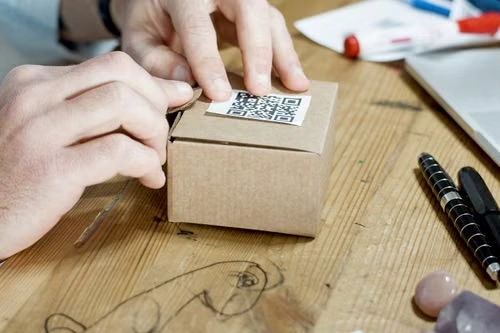

TL;DR: Choosing a hidden image security sticker factory requires evaluating both authentication technology and manufacturing security. Buyers should confirm how confidential artwork, optical masters, authorized production quantities, rejected labels, and repeat orders are managed. A well-controlled manufacturing process helps reduce the risk of unauthorized reproduction and supports consistent product authentication throughout the supply chain.
For premium brands, electronics manufacturers, cosmetics companies, and packaging converters, hidden image security stickers provide a discreet method of product authentication.
However, developing a sophisticated concealed image is only part of an effective brand-protection program.
If confidential designs are distributed without authorization, production quantities are not reconciled, or rejected security labels are handled improperly, genuine authentication features may become available outside the intended supply chain.
Unlike ordinary decorative stickers, custom security labels require attention to both manufacturing quality and production authorization.
This guide explains how international B2B buyers can specify hidden image security stickers, evaluate factory controls, protect confidential designs, manage production quantities, and establish reliable repeat-order procedures.
Explore HX Security Label's Latent Image Label collection for related authentication products.
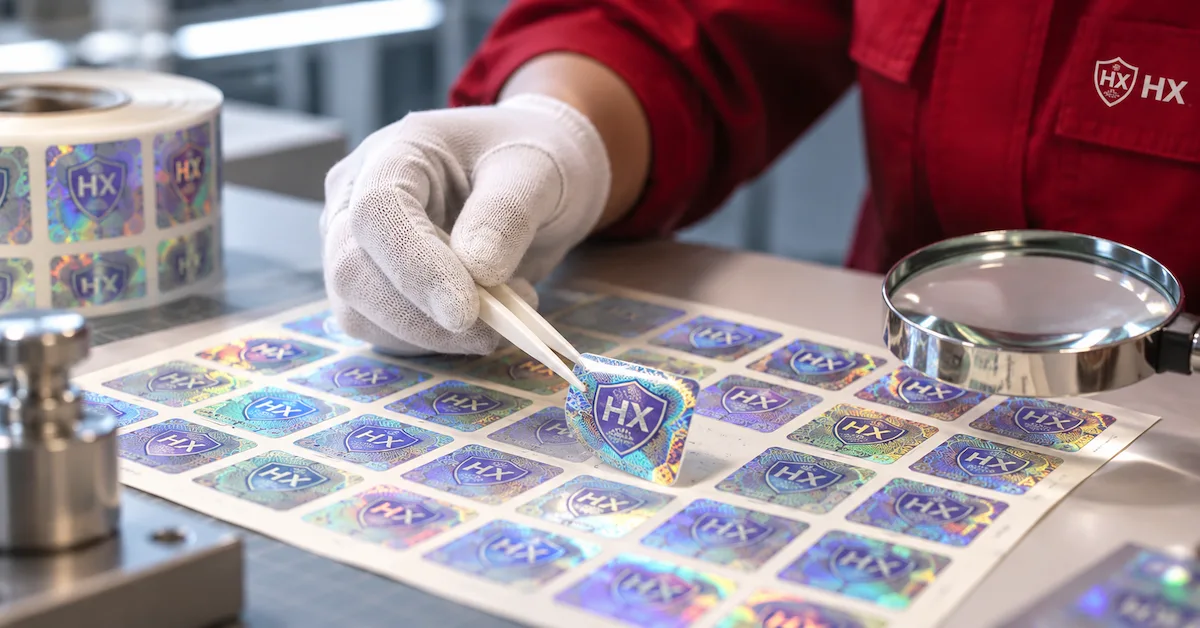
Key Takeaways
-
Manufacturing security matters: A sophisticated hidden image cannot compensate for inadequate control of authorized production.
-
Artwork and master ownership: Buyers should establish who controls original designs, production tooling, and future reproduction rights.
-
Quantity accountability: Finished labels, samples, rejected material, and authorized surplus should be accounted for.
-
Functional quality control: Every production batch should reproduce the approved concealed-image response.
-
Repeat-order management: Design revisions, material changes, and additional production quantities should require documented authorization.
What Is a Hidden Image Security Sticker?
A hidden image security sticker incorporates a concealed optical image, symbol, text, or graphic intended to support controlled product authentication.
Depending on the technology, the feature may become recognizable under defined viewing angles, compatible optical filters, or designated decoding equipment.
Unlike an ordinary printed logo, the hidden feature may require specialized materials or optical production techniques.
What Makes Custom Hidden Images Valuable?
A brand-specific concealed image can provide an additional authentication reference for authorized distributors, inspectors, and brand protection teams.
Potential benefits include:
-
Discreet authentication without dominating the packaging design.
-
Additional verification alongside visible security graphics.
-
Brand-specific optical identification.
-
Controlled inspection of suspicious products.
-
Integration with other compatible security features.
However, concealed images do not guarantee complete protection against counterfeiting.
Their effectiveness depends on the selected technology, verification method, manufacturing controls, and protection of sensitive design information.
For additional technical background, read HX's Hidden Image Security Sticker Guide.
Why Is Factory Security Important for Hidden Image Labels?
A custom security sticker is different from an ordinary branded label because its authentication feature may carry commercial security value.
Unauthorized access to security artwork, production masters, or finished labels could undermine the intended verification process.
Common Manufacturing Security Risks
| Manufacturing risk | Potential commercial consequence |
|---|---|
| Unauthorized artwork access | Exposure of confidential security designs |
| Uncontrolled master reproduction | Unauthorized production of optical features |
| Excess production | Genuine labels entering unauthorized channels |
| Improper rejected-label handling | Usable security material remaining outside approved inventory |
| Unauthorized repeat orders | Additional production without brand approval |
| Unapproved subcontracting | Reduced control over sensitive production stages |
| Incorrect shipment allocation | Security labels delivered to unintended recipients |
These risks should be considered during supplier qualification and commercial agreement preparation.
The objective is not simply to purchase an authentic-looking sticker. It is to maintain control over who can authorize, manufacture, receive, and use the genuine security feature.
Which Industries Need Controlled Hidden Image Sticker Manufacturing?
Manufacturing security becomes particularly important when labels protect valuable products, sensitive brand designs, or regulated distribution programs.
| Target customer | Main security concern | Potential application |
|---|---|---|
| Cosmetics brands | Unauthorized reproduction of premium packaging | Concealed authentication stickers on retail cartons |
| Electronics manufacturers | Counterfeit accessories and replacement components | Product identity and secondary verification |
| Pharmaceutical packaging companies | Unauthorized use of branded security materials | Selected external packaging applications |
| Wine and spirits brands | Imitation packaging and unauthorized label reuse | Bottle and gift-box authentication |
| Luxury goods manufacturers | Exposure of exclusive authentication designs | Premium product packaging |
| Packaging converters | Confidential designs belonging to multiple customers | Authorized custom label manufacturing |
| International distributors | Control of brand-specific security-label inventory | Authorized distribution and inspection programs |
For regulated industries, applicable legal and material requirements must be verified separately.
When Is a Simpler Security Label More Appropriate?
A standard holographic sticker may be sufficient when the main objective is decorative branding or basic visual identification.
A customized hidden-image construction becomes more relevant when the buyer requires a controlled secondary authentication feature.
The appropriate investment should reflect the actual counterfeit risk, product value, and intended inspection process.
Stock Security Stickers vs. Customized Hidden Image Stickers
Before selecting a hidden image security sticker factory, buyers should determine how much control they need over the security design.
| Comparison | Stock holographic sticker | Custom-printed security sticker | Custom hidden image sticker |
|---|---|---|---|
| Optical design | Existing pattern | Existing pattern with custom graphics | Project-specific concealed feature |
| Brand customization | Limited | Printed logo and text | Potential custom optical artwork |
| Verification method | Visual comparison | Visual or defined additional checks | Specified optical verification |
| Development requirements | Relatively simple | Artwork and printing preparation | May require specialized design and tooling |
| Confidentiality requirements | Generally limited | Brand artwork protection | Controlled security artwork and production references |
| Repeat-order priority | Standard supply consistency | Artwork consistency | Authorized design and security-feature consistency |
| Typical cost structure | Standard production | Printing and converting costs | Potential development, tooling, and verification costs |
Custom hidden-image stickers may involve additional investment, but their value lies in providing a security feature aligned with the buyer's authentication requirements.
For projects primarily requiring visible optical authentication, explore HX Holographic Labels.
What Should Buyers Know About ISO 14298 and Secure Printing?
ISO 14298:2021, Graphic Technology — Management of Security Printing Processes, establishes management-system requirements for security printers.
It provides a relevant reference for organizations evaluating how security printing activities are managed.
For hidden image sticker procurement, buyers can use the broader principles of controlled manufacturing to develop purchasing questions concerning authorized production, confidential information, material accountability, and security responsibilities.
ISO 14298 vs. ISO 22383
| Standard | Main focus | Purchasing relevance |
|---|---|---|
| ISO 14298:2021 | Security printing management systems | Evaluating manufacturing security management |
| ISO 22383:2020 | Selection and performance evaluation of authentication solutions | Evaluating whether authentication features address identified risks |
These standards address different aspects of product protection.
Neither should be interpreted as a guarantee that a particular security sticker cannot be counterfeited.
Buyers requiring formal certification should request current certificates, confirm their validity, and check whether the certification scope covers the relevant manufacturing activities.
The procurement recommendations in this article are practical evaluation suggestions, not a complete ISO certification checklist.
How Should a Hidden Image Security Sticker Factory Protect Confidential Artwork?
Security artwork may include both visible brand graphics and concealed authentication information.
These two types of information do not necessarily require the same level of access.
Separate Public and Restricted Information
| Information type | Recommended management approach |
|---|---|
| Public brand logo | Use approved brand files |
| Visible label artwork | Maintain authorized production revisions |
| Concealed security image | Restrict access according to project requirements |
| Optical master information | Establish controlled ownership and reproduction rights |
| Verification instructions | Distribute only to intended inspection users |
| Customer production records | Protect commercially sensitive information |
Buyers should avoid publishing detailed covert authentication instructions in public product catalogs or unrestricted promotional materials.
Public marketing can explain the value of the technology without revealing sensitive project-specific details.
Establish Artwork Version Control
Every approved security design should have an identifiable revision.
Changes to brand graphics, concealed images, dimensions, or material construction should be reviewed before production.
A repeat order should reference the approved version rather than relying on informal instructions such as "make it the same as last time."
Should Buyers Request a Confidentiality Agreement?
For original hidden-image projects, a confidentiality agreement can help clarify how sensitive information may be used.
Relevant contractual topics may include permitted use, authorized recipients, subcontracting arrangements, intellectual-property ownership, and handling of confidential materials when the project ends.
The exact agreement should reflect the commercial relationship and applicable law.
Who Owns the Optical Master and Production Tooling?
Some custom optical security constructions require an original master or dedicated production tooling.
The master defines the authorized optical information reproduced in the finished security sticker.
Paying a tooling or development charge does not necessarily establish ownership of the physical master.
Ownership and usage rights depend on the commercial agreement.
Important Master Management Questions
Before approving development, buyers should establish:
-
Who owns the original security artwork?
-
Who owns or controls the physical optical master?
-
Who can authorize production from that master?
-
Can manufacturing be transferred to another facility?
-
How are design revisions approved?
-
What happens to the master when the commercial relationship ends?
-
How are obsolete production tools handled?
These questions are particularly important for brands expecting long-term supply, exclusive designs, or multiple product releases.
For repeat orders, the authorized master and approved material specification should remain clearly identifiable.
How Are Hidden Image Security Stickers Manufactured?
The manufacturing process varies according to the optical technology and finished label construction.
For selected embossed optical designs, the general workflow may include optical artwork development, master preparation, pattern reproduction, film finishing, lamination, adhesive integration, and precision converting.
Manufacturing Control Points
| Production stage | Quality objective | Security management objective |
|---|---|---|
| Artwork development | Correct concealed image | Authorized design access |
| Master preparation | Approved optical reference | Controlled tooling authorization |
| Optical reproduction | Consistent optical response | Approved production scope |
| Printing | Correct visible graphics | Authorized artwork revision |
| Lamination | Preserve authentication performance | Material specification control |
| Die cutting | Correct label dimensions | Accountable finished output |
| Final inspection | Approved functional performance | Segregation of rejected material |
| Packaging and delivery | Correct supply format | Authorized shipment and quantity |
This is a general industry workflow. The actual manufacturing method and applicable security controls must be confirmed with the selected factory.
HX publishes information about optical master development and security-label manufacturing in its technical resources.
How Should Buyers Specify Custom Hidden Image Security Stickers?
A complete specification should define the physical product, authentication function, and commercial production controls.
Technical and Security Specification Table
| Specification | Information to confirm |
|---|---|
| Product application | Electronics, cosmetics, wine, luxury packaging, or other products |
| Authentication feature | Approved concealed image or optical pattern |
| Visible artwork | Brand graphics and authorized design revision |
| Verification method | Agreed optical viewing or decoding procedure |
| Face material | Suitable optical film or composite construction |
| Protective finish | Compatible laminate or coating |
| Adhesive | Suitable for the intended application surface |
| Finished dimensions | Width, height, shape, and placement |
| Supply format | Roll, sheet, or individual stickers |
| Authorized quantity | Commercial order and permitted allowances |
| Tooling ownership | Agreed master ownership and reproduction rights |
| Inspection requirements | Functional acceptance and reference samples |
| Rejected material | Agreed handling and disposal responsibilities |
| Delivery requirements | Approved recipient and shipment destination |
These are recommended project specifications rather than published fixed parameters for every HX product.
The actual film, adhesive, optical construction, and commercial terms should be confirmed during sample development.
How Do Materials Affect Hidden Image Sticker Reliability?
The complete label construction must preserve both its authentication feature and its ability to remain attached to the packaging.
Depending on the selected technology, relevant materials may include supporting polymer films, optical functional layers, reflective or masking layers, protective laminates, pressure-sensitive adhesives, and release liners.
| Application surface | Main consideration |
|---|---|
| Glossy cosmetics carton | Reflection, coating compatibility, and adhesion |
| Glass perfume bottle | Curvature and optical visibility |
| Plastic electronics housing | Surface energy, texture, and bonding |
| Metallic packaging | Optical contrast and surface compatibility |
| Coated paperboard | Adhesive behavior and finish integrity |
Buyers should test representative packaging samples before approving production.
Where removal evidence is also required, the authentication sticker may need a compatible tamper-evident construction.
Explore HX VOID Open Labels for related security applications.
How to Control Production Overruns and Security Label Waste
Production overruns occur when manufacturing output exceeds the quantity required for an order.
In ordinary commercial printing, limited additional production may be acceptable.
For customized security stickers, however, surplus labels can have additional security implications.
Define Permitted Production Quantities
The purchase agreement should distinguish between:
-
Authorized commercial order quantity.
-
Approved development and inspection samples.
-
Permitted manufacturing allowances.
-
Rejected or nonconforming labels.
-
Approved surplus inventory.
-
Material designated for disposal.
The buyer and factory should agree on how each category will be recorded and handled.
Illustrative Batch Reconciliation Example
Consider a hypothetical order for 10,000 custom hidden-image security stickers.
| Production category | Quantity |
|---|---|
| Total finished and countable security stickers produced | 10,400 |
| Accepted labels shipped to buyer | 10,000 |
| Authorized reference and inspection samples | 40 |
| Approved surplus retained under agreed controls | 60 |
| Rejected labels recorded and destroyed | 300 |
| Unaccounted finished labels | 0 |
This example illustrates quantity reconciliation. It is not an actual HX production record or a prescribed manufacturing allowance.
Actual procedures should account for additional relevant material categories, including identifiable security-bearing production waste.
The important purchasing principle is that additional production quantities should have an agreed purpose and documented disposition.
How Should Rejected Security Stickers Be Managed?
Rejected security labels may still contain recognizable optical information, even when their appearance or adhesive performance does not meet the approved specification.
Therefore, rejected material should not automatically be treated as ordinary printing waste.
Buyers should clarify how the supplier identifies nonconforming labels, separates them from approved production, records their disposition, and provides appropriate disposal evidence when required.
The same considerations may apply to obsolete designs, development proofs, and unused branded security material.
Specific handling and disposal requirements should be agreed according to the project's security classification and applicable requirements.
What Quality-Control Checks Should a Hidden Image Security Sticker Factory Perform?
Manufacturing security and product quality are complementary requirements.
An authorized label is still unsuitable if its concealed authentication feature fails to perform correctly.
Recommended Quality Acceptance Matrix
| Inspection item | Acceptance objective |
|---|---|
| Artwork accuracy | Matches the authorized revision |
| Hidden-image response | Approved feature is recognizable under defined conditions |
| Optical consistency | Matches the approved physical reference |
| Material construction | Meets the agreed specification |
| Label dimensions | Meets approved converting requirements |
| Adhesion | Suitable for the intended packaging surface |
| Protective finish | Does not interfere with authentication |
| Roll or sheet format | Compatible with application requirements |
| Batch identification | Supports production and shipment records |
| Quantity reconciliation | Finished labels have documented disposition |
Inspection criteria, tolerances, sampling procedures, and documentation requirements should be established before bulk production.
A missing or incorrect authentication feature may constitute a critical functional defect rather than a cosmetic printing problem.
Engineering Example: Protecting a Premium Electronics Brand's Authentication Design
Consider an electronics manufacturer developing a customized hidden-image sticker for replacement accessories distributed internationally.
This is an illustrative scenario, not a documented HX customer case.
The company requires a concealed optical symbol for authorized service centers while retaining a simple visible logo for customers.
Its proposed order-control framework includes:
Design approval: Establish an authorized optical image and confidential production reference.
Sample development: Confirm that the feature can be inspected on the actual packaging.
Manufacturing authorization: Define the order quantity and approved allowances.
Batch acceptance: Compare representative finished labels with the approved reference and reconcile production quantities.
Repeat production: Require a new authorized purchase order linked to the approved design.
This approach addresses both functional authentication and the commercial risks associated with unauthorized security-label production.
How Should Buyers Manage Repeat Orders?
Repeat orders introduce an additional challenge: maintaining the approved security feature while preventing unauthorized changes or production.
Recommended Repeat-Order Controls
| Control point | What buyers should confirm |
|---|---|
| Design revision | Current authorized artwork |
| Optical reference | Approved master or equivalent production reference |
| Material changes | Buyer approval for critical substitutions |
| Production quantity | New authorized purchase order |
| Quality requirements | Continued use of agreed acceptance criteria |
| Inventory | Accountable retained samples and surplus |
| Delivery | Confirmed authorized recipient |
When a security design is discontinued, the buyer should also establish how remaining labels, artwork, and dedicated tooling will be managed.
Long-term supply relationships benefit from documented procedures rather than dependence on informal arrangements.
What Determines Hidden Image Sticker Cost, MOQ, and Lead Time?
A custom hidden-image security label may involve several cost components beyond ordinary printing.
These can include optical artwork development, master preparation, specialized films, protective layers, converting, inspection equipment, sample development, production quantities, and agreed security documentation.
A standard optical construction with customized printing may require less initial investment than an original concealed-image master.
Buyers should request an itemized quotation distinguishing one-time development charges from recurring production costs.
MOQ, manufacturing capacity, sampling time, and delivery schedules should be confirmed for the actual project.
For more general bulk purchasing considerations, read HX's Bulk Security Labels Supplier Guide.
Working With HX Security Label on Customized Hidden Image Projects
HX Security Label is operated by Shenzhen Huaxin Anti-Counterfeiting Technology Co., Ltd., a Shenzhen-based company established in 2008.
The company specializes in anti-counterfeiting label research, development, production, and customized product-security applications.
Its official portfolio includes latent-image labels, holographic labels, VOID-related products, and other security-label solutions.
According to the HX company profile, its published customization workflow includes:
-
Requirements confirmation.
-
Design drafting.
-
Physical product proofing.
-
Material selection.
-
Sample confirmation.
-
Packaging and delivery coordination.
This workflow provides a starting point for developing customized hidden-image authentication projects.
Buyers should discuss project-specific confidentiality arrangements, optical master ownership, production quantity controls, disposal requirements, and manufacturing documentation directly with HX.
These controls should be confirmed rather than assumed.
What Should You Include in Your RFQ?
| RFQ requirement | Information to provide |
|---|---|
| Product category | Intended product and target market |
| Security objective | Secondary optical authentication |
| Packaging material | Actual substrate and surface finish |
| Label dimensions | Size, shape, and application position |
| Artwork requirements | Visible branding and proposed hidden feature |
| Verification requirement | Intended inspection users and method |
| Confidentiality | Required design and information controls |
| Order quantity | Samples, bulk orders, and repeat-order forecast |
| Manufacturing controls | Production authorization and quantity records |
| Delivery | Destination and requested schedule |
For an initial consultation, buyers can provide nonconfidential product specifications before arranging the secure exchange of sensitive artwork.
Request a Custom Hidden Image Security Sticker Quotation
Share your packaging requirements, desired authentication function, estimated order quantity, and project security expectations to discuss suitable construction options and sample development.
Frequently Asked Questions
1. What does a hidden image security sticker factory manufacture?
It develops and produces security stickers containing concealed authentication features according to project requirements. Depending on its capabilities, these may involve optical structures, specialized films, custom graphics, and additional security functions.
2. Can hidden security images be customized with a company logo?
Yes, custom logos and other graphics may be suitable for selected concealed-image technologies. Feasibility depends on the optical design, available label area, and manufacturing process.
3. Are hidden image security stickers impossible to copy?
No. Concealed authentication features can increase reproduction difficulty and support controlled verification, but no physical label guarantees complete protection against counterfeiting.
4. Does every custom hidden image require a new optical master?
Not necessarily. The need for a dedicated master depends on whether the buyer requires an original optical feature or customization of an existing construction.
5. Who owns the custom holographic or hidden-image master?
Ownership depends on the commercial agreement. Buyers should clarify rights to artwork, physical masters, tooling, and authorized reproduction before approving development.
6. Why should buyers control production overruns?
Surplus security stickers may contain genuine authentication features. Uncontrolled additional production can create risks involving unauthorized distribution or use.
7. How should rejected security labels be handled?
They should be identified, separated, and managed according to agreed project procedures. Buyers may request documented disposal or other appropriate evidence where necessary.
8. Can hidden image stickers include tamper-evident features?
Certain compatible constructions may combine concealed authentication with VOID or destructible structures. The optical and tamper-evident functions should be tested separately.
9. What affects the MOQ of custom hidden image security stickers?
MOQ depends on optical development, material availability, tooling, label dimensions, converting formats, and manufacturing arrangements. Project-specific terms should be confirmed with the factory.
10. How can I request custom hidden image stickers from HX?
Provide your packaging material, label dimensions, general authentication requirements, estimated quantity, and intended application. Then contact HX Security Label to discuss technical feasibility, sample evaluation, confidentiality arrangements, and pricing.
Technical References
ISO 14298:2021 — Graphic Technology: Management of Security Printing Processes. Establishes security printing management-system requirements.
ISO 22383:2020 — Guidelines for the Selection and Performance Evaluation of Authentication Solutions for Material Goods. Provides guidance on selecting and evaluating authentication technologies according to product-security risks.
These references support procurement evaluation and manufacturing security discussions. They do not establish that HX holds a particular certification or that every recommended control has been independently verified.
Conclusion
Selecting a reliable hidden image security sticker factory requires more than evaluating optical effects, adhesive performance, and unit prices.
For brands investing in customized concealed authentication features, manufacturing authorization, confidential artwork protection, optical master management, production quantity accountability, and repeat-order consistency are important elements of long-term product protection.
A clearly defined technical specification and commercial security agreement can help reduce procurement uncertainty and protect the value of original authentication designs.
HX Security Label offers customized anti-counterfeiting label solutions covering latent-image, holographic, and related brand-protection applications.
Whether you are developing an exclusive security sticker or improving an existing product authentication program, a structured development and manufacturing agreement can provide a more reliable foundation for bulk purchasing.
Contact HX Security Label with your packaging specifications, authentication requirements, and estimated order quantity to discuss suitable hidden image security sticker options, sample development, and a customized quotation.