
TL;DR: Selecting an invisible image anti counterfeit label supplier requires more than choosing a hidden pattern. Buyers must define which security image should appear, how authorized inspectors will reveal it, what equipment is required, and how finished labels will be tested. A reliable project combines an approved security design, practical inspection procedures, packaging compatibility, and documented quality control before bulk production.
Invisible image security labels provide brands with an additional way to inspect potentially counterfeit products without displaying every authentication feature to the public.
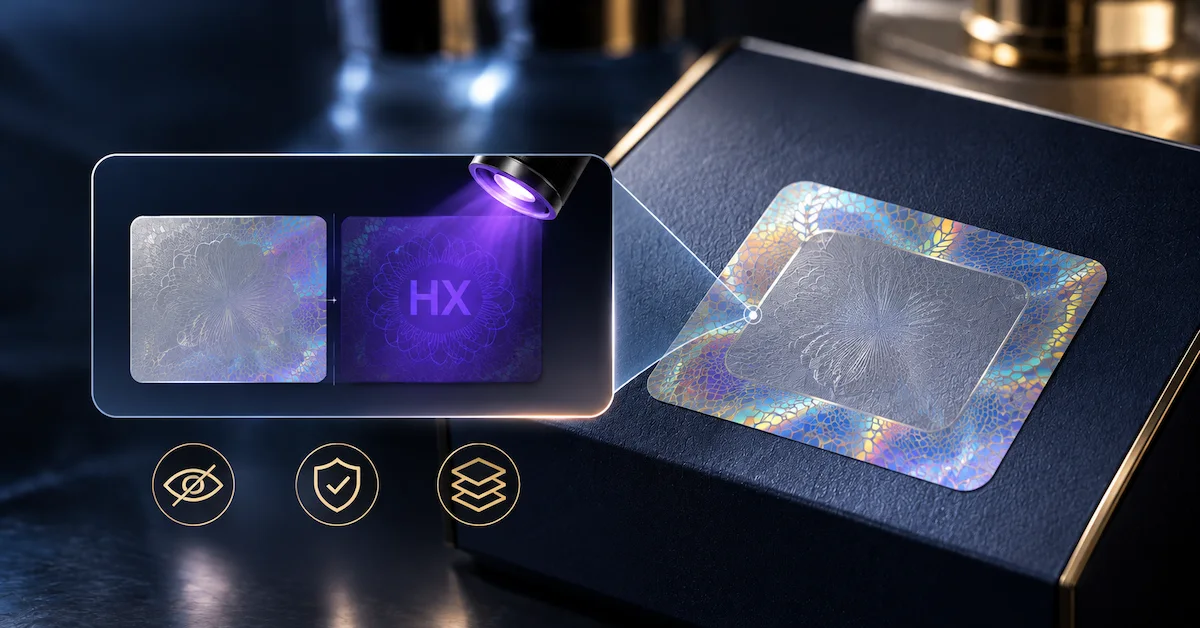
Unlike ordinary printed logos or visible holographic designs, certain hidden security elements become recognizable only under defined viewing conditions or with appropriate inspection tools.
However, not all invisible images use the same technology. Some optical patterns appear when tilted, while other markings require a polarized filter, ultraviolet illumination, or specialized detection equipment.
For packaging engineers, brand protection managers, and international procurement teams, this distinction influences the label specification, inspection process, production cost, and long-term authentication strategy.
This guide explains how hidden image security technologies differ, how to establish an inspector-ready verification protocol, and what buyers should confirm before purchasing customized labels.
Explore HX Security Label's Latent Image Label category for related security-label applications.
Key Takeaways
-
Hidden images require defined inspection conditions: The correct feature, viewing method, and expected result must be documented.
-
Latent and invisible technologies differ: Angle-dependent images, polarized features, UV markings, and infrared inks should not be treated as interchangeable.
-
Inspector training matters: A technically sophisticated feature is of limited use if authorized personnel cannot verify it reliably.
-
Sample validation is essential: Approved labels should be tested on actual packaging under representative inspection and storage conditions.
-
Manufacturing consistency supports security: Artwork, hidden-feature positioning, material construction, and repeat-order controls should be verified before bulk production.
What Are Invisible Image Anti-Counterfeit Labels?
An invisible image anti-counterfeit label contains a security image, symbol, pattern, or marking intended to remain concealed or difficult to recognize under ordinary observation.
The security element becomes detectable under specified conditions.
Depending on its construction, the hidden feature may use optical effects, specialized inks, controlled viewing filters, or other authentication technologies.
How Do Invisible Images Support Product Authentication?
A conventional printed brand logo can usually be photographed and reproduced using ordinary printing methods.
An engineered hidden feature may require additional materials, optical structures, or inspection techniques to reproduce accurately.
This can provide a second verification method for trained inspectors.
For example, a brand may use a visible holographic logo for consumer recognition and a less obvious feature for distributor inspections.
The two features serve different users and purposes.
Are Invisible Labels Impossible to Copy?
No.
Hidden security features can increase the difficulty of unauthorized reproduction, but no physical authentication technology should be described as impossible to counterfeit.
Their effectiveness depends on the selected technology, design controls, authorized inspection procedures, and measures protecting sensitive production information.
The objective is to create a practical authentication process that responds to identifiable risks.
Invisible Image vs. Latent Image vs. UV and Infrared Security Features
One of the most important purchasing decisions is identifying the correct hidden-image technology.
The phrase invisible image is often used broadly in commercial marketing, but several distinct technical approaches exist.
Hidden Security Technology Comparison
| Technology | How the feature is revealed | Inspection equipment | Main consideration |
|---|---|---|---|
| Angle-dependent latent image | Tilt or view under defined illumination | May require no dedicated reader | Viewing angle and image clarity |
| Polarized hidden image | View through a suitable polarizing filter | Compatible optical filter | Filter compatibility and alignment |
| UV fluorescent marking | Illuminate with an appropriate UV source | UV inspection lamp | Ink response and background interference |
| Infrared-sensitive marking | Inspect using a compatible infrared detection method | Appropriate IR reader | Reader and ink compatibility |
| Microtext or microimage | Examine very fine printed details | Magnifier or suitable inspection device | Reproduction resolution and legibility |
These are different technology categories, not confirmed specifications for every HX security-label product.
What Is an Optical Latent Image?
A latent image is designed to reveal a feature under particular viewing conditions.
Some latent images become recognizable when the label is tilted or the illumination angle changes.
Because these can be checked without dedicated electronic equipment, they are not necessarily classified as covert features.
What Are UV Invisible Images?
Certain specialized inks contain markings that are difficult to detect under normal illumination but become visible under suitable UV light.
The behavior depends on the ink formulation and inspection wavelength.
Some UV-sensitive security features are already visible in daylight and merely change appearance under UV illumination.
Therefore, a buyer should specify the actual required response instead of requesting generic "UV invisible ink."
How Do Infrared Security Images Differ?
Infrared-responsive markings require compatible detection equipment.
An ordinary smartphone camera or visible-light inspection does not automatically provide reliable authentication of these features.
The buyer should confirm the exact reading method with the selected technology provider.
The correct choice is determined by who performs verification, what tools are available, and how reliably the genuine feature can be distinguished from an imitation.
Who Should Use Invisible Image Security Labels?
Hidden image technologies are especially relevant when brands require a verification method for authorized personnel.
| Target customer | Authentication concern | Potential application |
|---|---|---|
| Cosmetics brands | Imitation retail packaging | Hidden authentication on branded cartons |
| Electronics manufacturers | Counterfeit accessories or replacement parts | Product and packaging inspection |
| Wine and spirits brands | Packaging imitation and product substitution | Secondary bottle or carton authentication |
| Luxury packaging companies | Reproduction of visible brand graphics | Controlled inspection of premium packaging |
| Industrial equipment manufacturers | Unauthorized product identification markings | Equipment labels and inspection records |
| Distributors and importers | Difficulty confirming product origin | Receiving inspections and channel verification |
When Are Invisible Images Not the Best Choice?
Hidden features may be less appropriate when every consumer needs to verify the product without any additional equipment or instructions.
A visible holographic authentication feature, for example, may provide a simpler first-level inspection method.
A hidden image can still supplement that feature when authorized distributors or inspectors need additional evidence.
The correct design depends on the intended verification audience.
How Should Buyers Specify Invisible Image Labels?
A complete technical specification should define both the physical label and the inspection procedure.
Requesting "custom invisible anti-counterfeit stickers" without identifying the detection method leaves important requirements unresolved.
Recommended Technical Specification Table
| Specification | Buyer should confirm |
|---|---|
| Authentication objective | Product identity, packaging verification, or secondary authentication |
| Hidden-feature type | Optical latent image, UV, IR, polarized, or another approved option |
| Expected image | Logo, symbol, text, or defined security pattern |
| Inspection method | Viewing conditions and required equipment |
| Detection reference | Approved genuine image and inspection result |
| Label dimensions | Width, height, shape, and usable inspection area |
| Substrate material | Paperboard, film, glass, plastic, or metal |
| Adhesive | Compatibility with intended application surface |
| Printing | Brand graphics, image positioning, and registration |
| Supply format | Roll, sheet, or individual labels |
| Environment | Temperature, humidity, light, handling, and storage |
| Quality acceptance | Approved sample, inspection criteria, and defect limits |
Why Is the Detection Method the Most Important Requirement?
A hidden image without an agreed reading method can create uncertainty.
If the supplier demonstrates the feature using a specialized optical device but the buyer's inspectors use a different reader, the finished label may not be practical to verify.
Buyers should confirm equipment requirements during development rather than after receiving bulk inventory.
How to Build an Inspector-Ready Verification Protocol
An inspection protocol describes how authorized personnel determine whether a security feature matches the approved reference.
Its objective is to make verification repeatable.
Step 1: Define the Inspection User
Identify who will perform the check.
Possible users include warehouse receiving teams, brand protection personnel, distributors, quality inspectors, or authorized service centers.
Their training, inspection environment, and access to equipment may differ.
Step 2: Approve the Authentication Feature
Confirm what the genuine hidden image should display.
Record the intended pattern, image orientation, position, and distinguishing features.
The reference should be specific enough to support consistent inspection.
Step 3: Define the Reading Conditions
Specify the appropriate illumination, viewing method, or inspection equipment.
For tool-assisted authentication, document the approved device type and operating procedure.
Sensitive technical parameters may need to remain in controlled documentation rather than public instructions.
Step 4: Establish Genuine Reference Samples
Retain physical samples representing the approved construction.
Reference photographs may help, but they should not replace physical inspection where the authentication feature depends on optical behavior or specialized illumination.
Step 5: Test Representative Samples
Inspect several genuine labels under the intended conditions.
Include samples applied to the final packaging whenever the substrate or surface finish may affect visibility.
Record whether inspectors can identify the expected feature consistently.
Step 6: Introduce Negative Controls
Where practical, compare genuine samples with test pieces missing the required feature or containing deliberately incorrect patterns.
This helps determine whether the procedure distinguishes expected results from obvious nonconformities.
It is not a guarantee that the system will detect every counterfeit.
Step 7: Define an Inconclusive Result
An inspector may be unable to identify a hidden image because of lighting, damaged packaging, incorrect equipment, or a defective label.
An inconclusive inspection should trigger a defined follow-up process rather than an automatic accusation of counterfeiting.
Step 8: Document the Final Procedure
Record the approved reference, equipment requirements, inspection steps, acceptance criteria, and escalation process.
This documentation provides a consistent starting point for training and repeat orders.
An effective hidden-image security label needs both a reproducible security feature and a practical way to inspect it.
How Do Packaging Materials Affect Invisible Image Verification?
The application surface may influence both adhesive performance and the visibility of specialized security features.
Coatings, printing, reflectivity, texture, and environmental exposure can alter the finished inspection result.
Packaging Compatibility Matrix
| Surface | Potential challenge | Recommended evaluation |
|---|---|---|
| Glossy paperboard | Glare or coating interference | Optical visibility and adhesion |
| Matte coated carton | Ink and coating interaction | Hidden-image response |
| Metallic packaging | Reflective background | Feature contrast and recognition |
| Transparent film | Background interference | Detection conditions |
| Plastic housing | Surface texture and adhesive compatibility | Bonding and inspection access |
| Glass container | Curvature and reflections | Viewing angle and placement |
| Flexible packaging | Wrinkling and distortion | Image recognition after handling |
What Happens When a Label Is Laminated?
Lamination may change optical behavior or interfere with the excitation or detection of certain hidden features.
For example, a protective layer may influence UV transmission or the appearance of an angle-dependent optical image.
This does not mean lamination is inherently unsuitable.
It means the complete finished construction must be tested.
Why Does Label Position Matter?
A hidden image placed over a sharply curved surface may be difficult to inspect at the intended angle.
A feature located beneath folds, secondary packaging, or other obstructions may also become inaccessible.
The label location should match the actual inspection procedure.
What Quality-Control Tests Should a Supplier Perform?
Quality control must verify the hidden authentication function, not only the label's printed appearance.
A label may have accurate dimensions and attractive branding while its concealed feature is insufficiently visible under the approved conditions.
Invisible Image Label Quality-Control Matrix
| Inspection item | Acceptance objective |
|---|---|
| Visible artwork | Matches approved graphics |
| Hidden image | Correct approved pattern is detectable |
| Detection conditions | Feature responds under agreed inspection settings |
| Image registration | Hidden feature is positioned correctly |
| Reproduction consistency | Production samples match approved references |
| Label dimensions | Finished size meets specification |
| Adhesive performance | Suitable for the intended substrate |
| Environmental stability | Maintains required function after agreed exposure |
| Roll configuration | Compatible with application equipment |
| Batch identification | Supports production and repeat-order records |
These are recommended inspection requirements, not universal industry acceptance limits.
How Can Inspectors Reduce False Results?
Two potential errors should be considered.
False acceptance: A nonconforming or suspicious sample is incorrectly accepted as genuine.
False rejection: A genuine label is incorrectly rejected because its feature cannot be observed under the inspection conditions.
A clear inspection method, approved reference samples, suitable equipment, and trained personnel can help manage these risks.
The buyer and supplier should agree on practical performance criteria rather than relying on descriptions such as "highly secure" or "easy to identify."
How Do Hidden Image Labels Compare With Holographic and VOID Labels?
Invisible authentication is not a replacement for every other security technology.
Different features solve different problems.
| Feature | Primary purpose | Typical verification | Main limitation |
|---|---|---|---|
| Invisible image | Controlled secondary authentication | Defined reader or viewing method | Requires correct inspection conditions |
| Visible hologram | Visual recognition | Human visual inspection | Does not automatically show opening |
| VOID label | Tamper evidence | Inspect removal response | Does not independently confirm authenticity |
| Destructible label | Evidence of label removal | Inspect material damage | Performance depends on substrate |
| Serialized QR label | Individual identification | Scan and check associated data | Codes can be copied |
A brand may combine visible and hidden features when the risks justify the additional complexity.
For example, a premium cosmetics carton could use a recognizable holographic image for consumers and a separate hidden feature for authorized channel inspectors.
However, adding an invisible image does not automatically create tamper evidence.
If removal detection is required, the buyer should also evaluate an appropriate construction from the HX VOID Open Label category.
What Are the Common Mistakes When Sourcing Hidden Image Labels?
Mistake 1: Treating All Invisible Features as the Same Technology
UV, infrared, polarized, and angle-dependent images can require different materials and readers.
A supplier quotation should identify the actual construction.
Mistake 2: Approving Only a Digital Artwork Proof
A digital file cannot establish the finished optical or ink-response performance.
Physical sample approval is essential.
Mistake 3: Ignoring Inspection Equipment
If authorized users cannot access the appropriate reading tools, the feature may provide limited operational value.
Mistake 4: Testing Only on a Demonstration Board
The feature may behave differently after application to a printed, coated, curved, or laminated package.
Mistake 5: Failing to Protect Sensitive Artwork
Security image masters, controlled design files, and inspection instructions should be managed according to agreed authorization procedures.
Mistake 6: Assuming Hidden Features Prevent Every Type of Fraud
Invisible images primarily support authentication.
They do not automatically prevent unauthorized opening, product diversion, or counterfeit copying.
What Determines Invisible Image Label Cost, MOQ, and Lead Time?
Pricing depends on the selected hidden-image technology, materials, production method, and project requirements.
Important cost factors may include:
-
Security artwork and specialized feature development.
-
Optical master or printing preparation.
-
Functional ink or optical materials.
-
Label dimensions and shape.
-
Inspection equipment requirements.
-
Material and adhesive selection.
-
Printing and registration complexity.
-
Sample testing and approval.
-
Production volume and roll configuration.
-
Repeat-order security controls.
A simple latent-image construction may have different costs from a project requiring specialized detection equipment or multiple security technologies.
Should Buyers Include Reader Costs in the Budget?
Yes, when the technology requires a dedicated inspection device.
The complete project cost may involve purchasing readers, developing instructions, training inspectors, and maintaining approved reference materials.
Comparing only label unit prices can hide these operational requirements.
MOQ, sampling timelines, reader availability, and production lead time should be confirmed for the chosen construction.
How Should Manufacturers Control Hidden Security Artwork?
Custom invisible image projects may involve security information that should not be broadly distributed.
Buyers should define how the original artwork, optical master, approved reference samples, and production revisions are managed.
Recommended Controls
-
Identify authorized artwork owners.
-
Establish approved design revisions.
-
Limit access to sensitive inspection instructions.
-
Retain a controlled genuine reference.
-
Define procedures for obsolete or rejected security material.
-
Require approval before changing critical materials or security features.
-
Confirm how repeat orders are matched to the original specification.
These controls help maintain consistency and reduce unnecessary exposure of sensitive design information.
Working With HX Security Label on Invisible Image Projects
HX Security Label, operated by Shenzhen Huaxin Anti-Counterfeiting Technology Co., Ltd., specializes in anti-counterfeiting label research, development, and manufacturing.
Established in 2008, the company describes expertise in holographic security, specialized printing, and customized authentication-related technologies.
Its official product portfolio includes Latent Image Labels, Holographic Labels, and other security-label categories.
HX has also published a guide discussing hidden image security stickers and controlled authentication.
The company's published customization process includes requirements confirmation, design drafting, physical proofing, material selection, sample approval, and delivery coordination.
What Should Buyers Confirm With HX?
For a specific invisible image project, ask HX to confirm the available hidden-feature construction, required reading method, sample demonstration, substrate compatibility, production format, and quantity requirements.
The availability of UV, IR, polarized, or specialized decoding technologies should be verified separately rather than assumed from the general latent-image product category.
For further company information, visit the HX About Us page.
What Should You Include in Your RFQ?
A detailed RFQ helps the manufacturer evaluate technical feasibility and provide a more meaningful quotation.
| RFQ field | Information to provide |
|---|---|
| Product application | Cosmetics, electronics, beverages, industrial products |
| Main risk | Counterfeit packaging, product substitution, unauthorized reproduction |
| Hidden-image requirement | Optical, UV, IR, polarized, or another defined method |
| Verification user | Distributor, quality inspector, service team |
| Reading equipment | Required or available inspection tools |
| Expected image | Logo, security symbol, text, or other feature |
| Substrate | Material, coating, texture, and curvature |
| Label dimensions | Finished size and shape |
| Additional security | Visible hologram, VOID feature, serial number |
| Environment | Storage, humidity, temperature, handling |
| Quantity | Samples, initial production, repeat orders |
| Approval method | Reference sample and inspection procedure |
Where possible, supply packaging samples and describe how inspectors will use the labels.
Request Custom Invisible Image Security Label Samples
Share your packaging specifications, preferred verification method, security requirements, and estimated quantity to discuss available options and project-specific sampling.
Frequently Asked Questions About Invisible Image Anti-Counterfeit Labels
1. What is an invisible image anti-counterfeit label?
An invisible image anti-counterfeit label incorporates a hidden or difficult-to-observe security feature designed for verification under specified conditions. Depending on the construction, the feature may require a particular viewing angle, optical filter, illumination source, or detection device.
2. How are invisible security images detected?
The detection method depends on the technology. Some latent images are revealed by tilting, while other designs require polarized filters, UV illumination, or infrared readers. Buyers should confirm the actual equipment and procedure before approving samples.
3. Are invisible images and UV security inks the same?
No. Invisible images describe a broader group of hidden security features. UV-sensitive inks represent one possible technology. Optical latent images, polarized features, and infrared markings operate differently and should be specified separately.
4. Can invisible security labels be used on cosmetics packaging?
They may be suitable for cosmetics cartons or other branded packaging when the construction is compatible with the material and inspection process. The selected feature should be tested on the actual packaging surface before bulk production.
5. Do invisible image labels require special equipment?
Some do, while others can be inspected through defined viewing conditions. The requirement depends on the technology. Buyers should specify equipment availability, inspection procedures, and user training during project development.
6. Can invisible images be combined with holographic labels?
Certain constructions may combine hidden features with visible holographic elements. The technical feasibility depends on the optical design, materials, label dimensions, and manufacturing process. Physical sample approval is recommended.
7. Can an invisible image label prevent unauthorized opening?
Not automatically. Invisible images primarily support authentication. If opening or removal evidence is required, the label needs a suitable tamper-evident construction, such as an approved VOID or destructible structure.
8. How should buyers evaluate invisible image label quality?
Evaluate physical samples using the approved reading method and reference image. Check hidden-feature recognition, artwork accuracy, substrate compatibility, reproduction consistency, and relevant environmental performance.
9. What affects the MOQ and cost of invisible image security labels?
MOQ and cost depend on the selected authentication technology, artwork complexity, specialized materials, tooling, sampling requirements, production format, and quantity. Projects requiring readers or additional inspection systems may have separate costs.
10. How can I request custom invisible image labels from HX?
Provide your application, packaging material, preferred hidden-image function, inspection requirements, dimensions, artwork, and estimated order quantity. Then contact HX Security Label to confirm available technologies and discuss samples and quotation terms.
Technical References
ISO 22383:2020 — Security and Resilience: Guidelines for the Selection and Performance Evaluation of Authentication Solutions for Material Goods.
Provides principles for selecting authentication technologies according to identified product-security risks and evaluating their effectiveness.
European Union Intellectual Property Office — Anti-Counterfeiting and Anti-Piracy Technology Guide.
Provides information about optical authentication, invisible inks, UV-sensitive features, infrared markings, and other anti-counterfeiting technologies.
HX Security Label — Hidden Image Security Sticker and Latent Image Label Resources.
Company-published descriptions of hidden-image applications and available security-label categories.
These references support technical selection and evaluation. They do not establish that any specific HX product has been certified under a particular standard or supports every described detection technology.
Conclusion
Selecting a reliable invisible image anti counterfeit label supplier requires more than approving an attractive label or a hidden graphic.
For brand owners, packaging engineers, and international procurement teams, the most important requirements are the intended authentication function, the conditions needed to reveal the image, the availability of inspection tools, and the consistency of the finished construction.
Optical latent images, UV-responsive markings, infrared features, and polarized designs provide different verification approaches. The correct solution depends on who will inspect the product, how the inspection will be performed, and which counterfeit risks must be addressed.
A documented inspection protocol, approved physical samples, appropriate packaging tests, and controlled security artwork can make the verification process more repeatable and commercially practical.
HX Security Label offers a product portfolio covering latent-image-related and other customized security-label applications. Specific hidden-image constructions and verification methods should be confirmed during project evaluation.
Contact HX Security Label with your product specifications, packaging materials, inspection requirements, and estimated order quantity to discuss suitable invisible image anti-counterfeit label options and request a quotation.