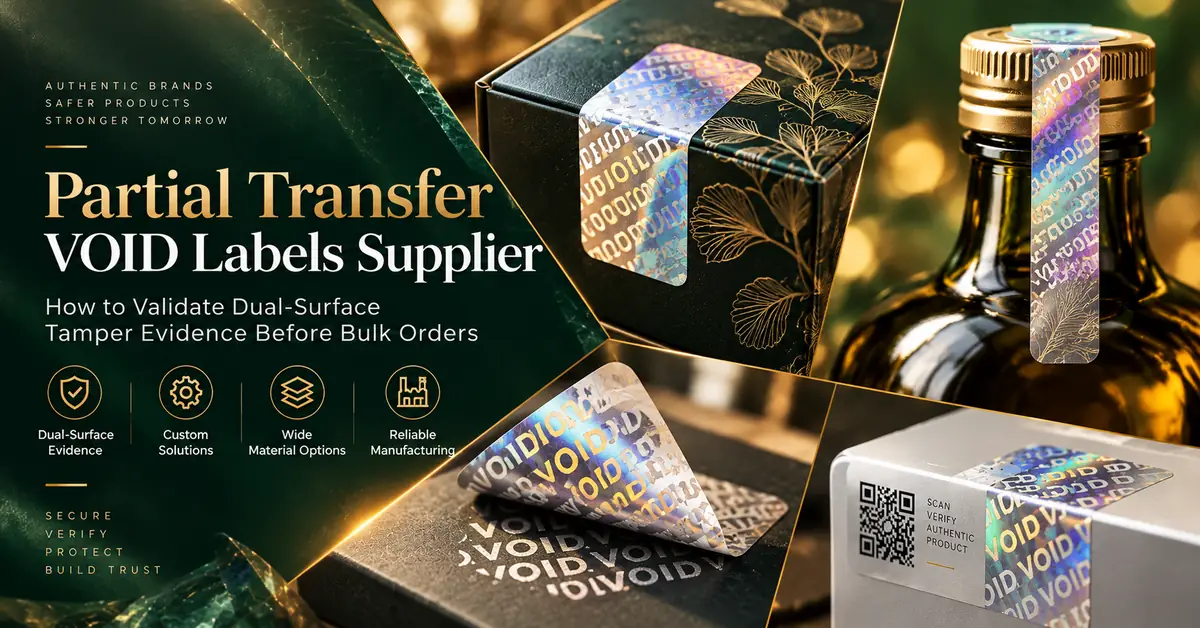

TL;DR: Choosing an optical hidden security label supplier requires evaluating how effectively a concealed image remains hidden during normal observation and becomes recognizable under its intended optical verification conditions. For glossy and metallic packaging, buyers must consider light reflection, optical contrast, film construction, graphic registration, adhesive compatibility, and production consistency before approving custom security labels.
Premium packaging often incorporates metallic foils, reflective coatings, glossy laminates, and sophisticated printed graphics. Although these finishes enhance brand presentation, they can also make optical authentication more challenging.
A concealed security image that appears clearly on a flat demonstration sample may become difficult to recognize after application to reflective packaging.
The challenge is therefore not simply creating a hidden image. It is engineering an optical security feature that works reliably within the finished packaging design.
This guide explains the optical principles, material selection, manufacturing requirements, and purchasing considerations that B2B buyers should understand before developing custom hidden-image labels.
Explore HX Security Label's Latent Image Label collection for related product applications.

Key Takeaways
-
Two-state optical performance: A hidden image should remain appropriately concealed under normal viewing conditions and become distinguishable during authorized verification.
-
Optical technology selection: Diffraction, polarization, and optical decoding provide different authentication effects.
-
Packaging compatibility: Metallic finishes, glossy coatings, transparent films, and curved surfaces can influence image recognition.
-
Manufacturing consistency: Optical master reproduction, lamination, printing alignment, and converting quality affect finished-label performance.
-
Procurement risk control: Buyers should approve complete label constructions on representative packaging before authorizing bulk production.
What Is an Optical Hidden Security Label?
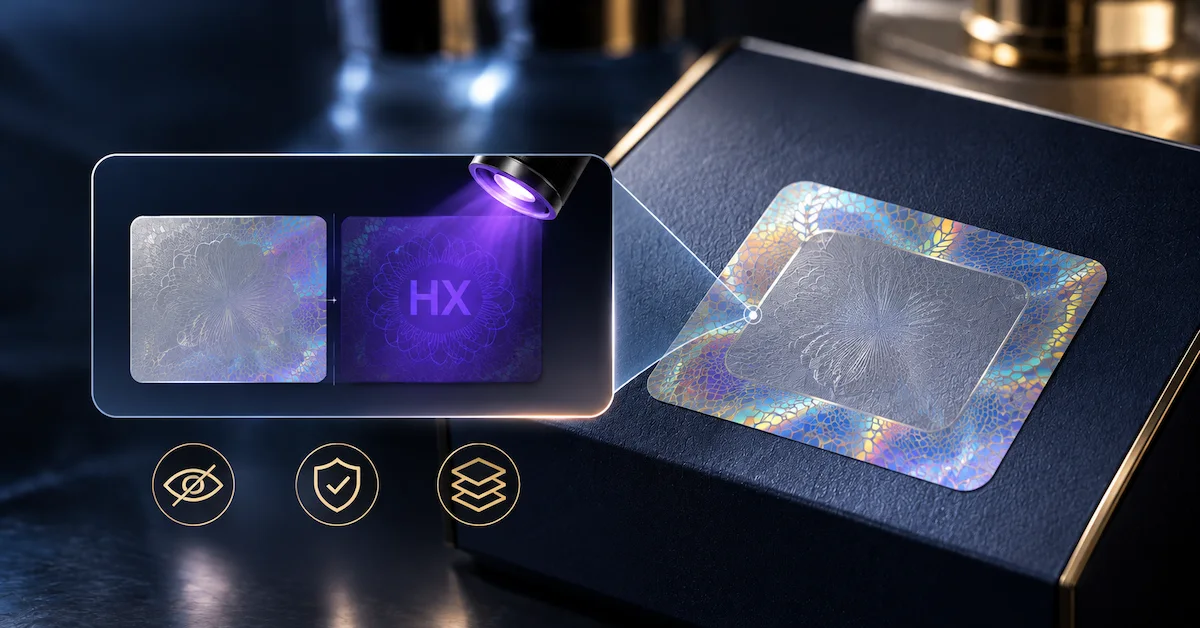
An optical hidden security label incorporates an engineered image or pattern that becomes recognizable under specified optical conditions.
Unlike an ordinary printed security sticker, its authentication effect depends on the interaction between light and a specially designed optical structure.
Depending on the technology, the concealed information may appear when the viewing angle changes, when a compatible polarization filter is used, or when the label is examined through a designated optical decoding device.
The hidden feature may contain a brand symbol, graphic, text, or another authorized authentication reference.
How Does Optical Authentication Differ From Conventional Printing?
Conventional printing creates visible information through inks, pigments, and printed graphic elements.
Optical security structures manipulate light through mechanisms such as diffraction, polarization, reflection, or optical interference.
A photograph may capture the visible appearance of a security label without reproducing its complete optical behavior.
This difference can increase the difficulty of unauthorized reproduction.
However, an optical security feature is not inherently impossible to imitate. Its protection value depends on the design, production controls, and verification process.
Why Use Hidden Optical Images?
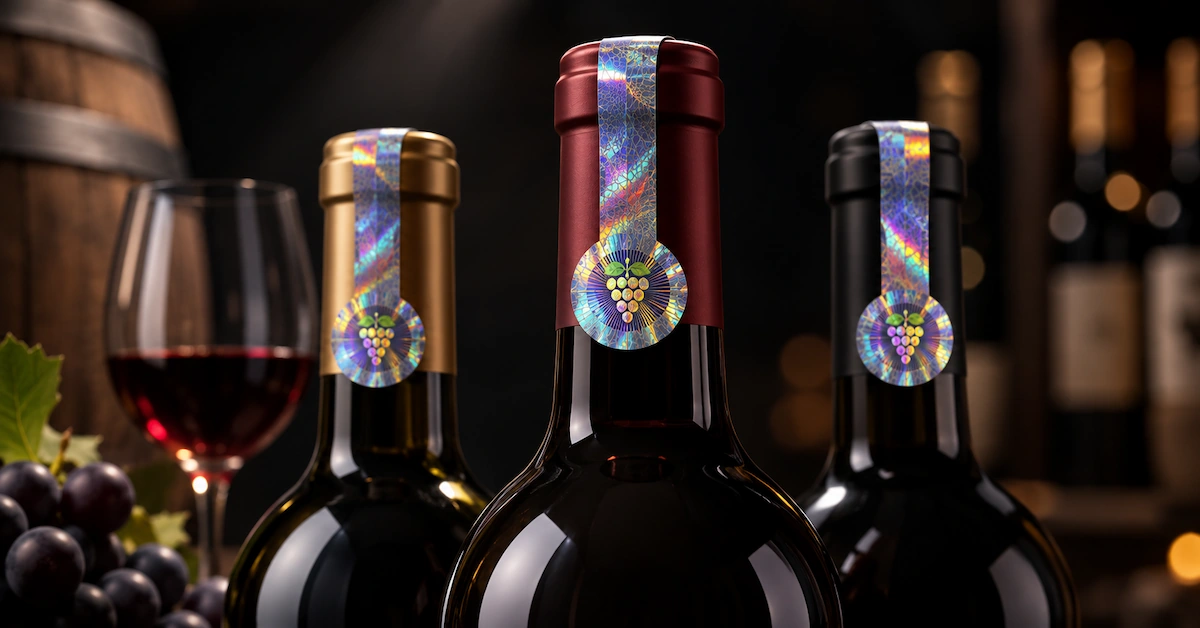
Hidden optical features are particularly relevant when brands want to maintain an attractive packaging appearance without publicly exposing every authentication element.
They can support:
-
Secondary product authentication.
-
Controlled distributor verification.
-
Brand-specific security artwork.
-
Premium packaging identification.
-
Additional protection alongside visible holograms.
-
Inspection of suspicious products.
For many projects, hidden images work most effectively as part of a broader brand-protection strategy rather than as an isolated security feature.
How Do Diffraction and Polarization Create Hidden Security Images?
An experienced optical hidden security label supplier should explain which optical principle is used and how it influences the finished label.
Different technologies can produce visually similar effects while requiring different materials and verification methods.
1. Diffractive Optical Structures
Diffractive optical structures interact with light through fine engineered surface patterns.
These structures can create changes in image appearance, color, brightness, or contrast as illumination and viewing conditions vary.
Selected designs can incorporate a secondary image that becomes distinguishable under particular optical conditions.
The European Union Intellectual Property Office's Anti-Counterfeiting and Anti-Piracy Technology Guide describes security holograms as devices that can use variable diffractive images for authentication.
Complex holographic constructions may also incorporate concealed information alongside visible optical features.
2. Polarization-Based Hidden Images
Polarization-based authentication uses the way light interacts with optical materials that respond differently to polarization conditions.
In certain constructions, an image that is difficult to distinguish during ordinary observation becomes recognizable through a compatible optical filter.
The exact appearance depends on the optical material, image structure, illumination, and decoding method.
A general-purpose polarizing filter should not automatically be assumed compatible with every hidden-image design.
3. Optical Decoding Features
Some security labels incorporate information designed to be examined using a designated optical reader or decoding element.
The authentication feature may remain unobtrusive during ordinary packaging inspection.
These solutions require buyers to consider both the physical label and the corresponding verification equipment.
Optical Technology Comparison
| Technology | Optical principle | Verification approach | Main design consideration |
|---|---|---|---|
| Angle-dependent latent image | Directional optical response | Defined viewing conditions | Image contrast and viewing geometry |
| Diffractive hidden image | Interaction of light with fine optical structures | Specified illumination or decoding method | Reproduction quality and optical consistency |
| Polarized hidden image | Polarization-dependent optical response | Compatible optical filter | Material and filter compatibility |
| Encoded optical image | Controlled optical information | Designated decoding tool | Reader compatibility and authorized access |
| Combined holographic and hidden image | Visible and concealed optical features | Visual and secondary verification | Separation of optical functions |
These are general technology categories. The feasibility of each construction must be confirmed for the actual project.
Why Is Optical Contrast the Most Important Design Requirement?
A hidden security image must perform under two different conditions.
During normal observation, the image should remain concealed or sufficiently unobtrusive.
During authorized verification, it should become recognizable.
Achieving one result does not automatically guarantee the other.
The Two-State Performance Model
| Performance condition | Required result | Potential failure |
|---|---|---|
| Normal observation | Hidden feature remains appropriately concealed | Image becomes unintentionally visible |
| Authorized optical verification | Intended image becomes recognizable | Weak or incomplete image |
| Applied to final packaging | Expected optical behavior remains functional | Packaging reflections interfere |
| After normal handling | Authentication feature remains usable | Scratches or deformation reduce clarity |
An attractive optical feature may still be unsuitable if its concealed image is difficult to distinguish from background reflections.
Conversely, an easily visible image may not satisfy the project's confidentiality requirements.
How Should Optical Contrast Be Evaluated?
Buyers should establish a reference showing the expected normal appearance and the authorized verification result.
The evaluation can include image definition, background interference, brightness differences, and consistency between samples.
Instrument-based measurements may be appropriate for projects requiring quantified optical acceptance criteria.
However, the measurement method must be agreed for the selected technology. There is no universal contrast threshold that applies to every hidden optical security label.
Why Are Glossy and Metallic Packaging Surfaces More Challenging?
Premium packaging frequently incorporates reflective decorative elements.
These materials can compete visually with an optical security feature or alter the conditions under which the hidden image is observed.
Common Packaging Challenges
| Packaging finish | Potential optical problem | Recommended design approach |
|---|---|---|
| High-gloss laminate | Specular glare | Evaluate optical feature under representative lighting |
| Gold or silver foil | Competing metallic reflections | Define a suitable security-label area |
| Metallized film | Strong reflective background | Evaluate image-to-background contrast |
| Transparent packaging | Changing background colors | Test the complete applied construction |
| Textured plastic | Uneven surface and image distortion | Confirm conformability and optical clarity |
| Curved glass | Changing viewing geometry | Evaluate label size, placement, and curvature |
Glossy Cosmetic Cartons
Cosmetic cartons may use high-gloss coatings, metallic logos, and decorative foils.
A hidden optical image placed near a strongly reflective graphic can become difficult to distinguish during inspection.
Creating a suitable authentication area and evaluating representative packaging samples can help identify this problem before production.
Metallic Electronics Packaging
Metallic finishes can provide a premium appearance but may produce reflections that interfere with optical verification.
Buyers should distinguish the optical security feature from surrounding decorative graphics.
The finished label should be evaluated after application rather than only on its original release liner.
Curved Bottles and Containers
Curvature changes the relationship between illumination, the optical feature, and the observer.
A design that performs well on a flat surface may show a different response when wrapped around a container.
For these applications, label dimensions and placement should be considered together with optical construction.
Which Material Layers Determine Hidden-Image Label Performance?
A typical optical security label can incorporate several functional layers.
The exact arrangement varies according to the selected technology.
Optical Label Construction
| Component | Main function | Purchasing consideration |
|---|---|---|
| Protective film or coating | Protects the optical feature | Clarity and compatibility with verification |
| Optical functional layer | Produces the intended image response | Reproduction consistency |
| Reflective or masking layer | Influences image visibility and contrast | Compatibility with the optical design |
| Supporting film | Provides dimensional and mechanical support | Flexibility and surface fit |
| Pressure-sensitive adhesive | Bonds the label to packaging | Substrate compatibility |
| Release liner | Supports storage and application | Compatibility with dispensing equipment |
HX's published Hidden Image Security Sticker technology guide describes optical structures, image-masking layers, protective materials, and security-label manufacturing processes.
For a new project, buyers should confirm the actual construction rather than treating general technical descriptions as fixed product specifications.
Can Protective Lamination Affect Hidden Images?
Yes.
A protective layer may improve resistance to ordinary handling, but it can also influence reflectivity, transmission, polarization behavior, or image clarity.
A film that is suitable for one optical technology may not be appropriate for another.
The complete laminated construction should therefore be evaluated before the material specification is finalized.
How Should Buyers Develop Custom Optical Security Artwork?
Hidden-image artwork requires a different design approach from conventional packaging graphics.
The objective is to create a recognizable authentication feature without unnecessarily revealing its appearance during normal observation.
Step 1: Define the Authentication Objective
Determine whether the hidden feature is intended for authorized distributors, internal quality teams, service personnel, or specialized brand-protection inspectors.
This influences the optical design and verification requirements.
Step 2: Select an Appropriate Security Image
The image should contain recognizable details suitable for the intended label dimensions.
A complicated brand logo may require adaptation when reproduced in a small optical area.
Step 3: Coordinate Visible and Hidden Graphics
Decorative elements should not interfere with the concealed image.
The designer should consider surrounding foil, print registration, packaging colors, and reflective finishes.
Step 4: Approve Physical Optical Proofs
Digital artwork confirms the layout but cannot fully demonstrate light-dependent behavior.
The optical hidden security label supplier should provide a physical demonstration of the proposed construction where feasible.
Step 5: Evaluate the Finished Packaging
Apply the approved samples to representative packaging materials.
Confirm that both ordinary appearance and authorized image recognition meet the agreed requirements.
Step 6: Establish an Authorized Production Reference
Record the approved artwork, optical construction, material specification, and sample revision.
This reference supports future production checks and repeat orders.
How Are Optical Hidden Security Labels Manufactured?
Depending on the technology, optical security label manufacturing may involve optical design preparation, master development, reproduction, printing, lamination, adhesive integration, and precision converting.
For embossed optical constructions, the general workflow may include the following stages.
| Manufacturing stage | Main quality objective |
|---|---|
| Optical artwork preparation | Translate the intended security graphic into a suitable design |
| Master development | Establish the original optical reference |
| Optical reproduction | Maintain the approved image behavior |
| Film finishing | Achieve the intended optical appearance |
| Printing and lamination | Preserve optical functionality and artwork alignment |
| Die cutting and converting | Meet label dimensions and supply-format requirements |
| Final inspection | Confirm the approved visual and functional characteristics |
Different optical technologies may require different manufacturing processes.
Buyers should confirm which stages the supplier performs and which processes, if any, are handled by authorized manufacturing partners.
For related optical-label applications, explore the HX Holographic Label collection.
What Manufacturing Defects Can Reduce Optical Security Performance?
Optical security features must be assessed beyond ordinary cosmetic printing quality.
A label may appear acceptable in normal light while failing its intended authentication function.
Common Optical Label Defects
| Defect | Possible contributing factor | Recommended investigation |
|---|---|---|
| Hidden image visible during normal observation | Inappropriate masking or optical construction | Compare against approved normal-state appearance |
| Weak image during verification | Optical reproduction or material variation | Review optical reference and complete film construction |
| Distorted image | Material deformation or unsuitable application geometry | Evaluate flat and applied samples |
| Graphic misalignment | Printing or converting registration issues | Inspect artwork positioning |
| Excessive glare | Surface finish or illumination interaction | Review packaging finish and label placement |
| Scratched optical surface | Handling or inadequate protection | Assess protective layer and packaging procedures |
| Edge lifting | Adhesive or substrate incompatibility | Conduct application-specific bonding tests |
The supplier and buyer should establish which defects affect the security function and which are acceptable cosmetic variations.
A missing required authentication image should be treated differently from a minor visual imperfection that does not influence performance.
How Should Buyers Specify Optical Hidden Security Labels Before Bulk Production?
A complete technical specification allows suppliers to evaluate equivalent requirements.
It also reduces the risk of approving a sample that cannot be reproduced consistently.
Recommended Technical Specification
| Specification | Required information |
|---|---|
| Security objective | Controlled optical authentication |
| Optical technology | Diffractive, polarization-based, or another approved construction |
| Visible appearance | Approved normal-state design |
| Hidden image | Authorized graphic or authentication reference |
| Optical response | Expected result under defined verification conditions |
| Packaging surface | Material, gloss level, coating, and geometry |
| Label construction | Functional film, protective layer, and adhesive |
| Finished dimensions | Width, height, shape, and placement |
| Supply format | Roll or sheet configuration |
| Environmental exposure | Relevant storage, handling, light, and humidity conditions |
| Quality acceptance | Approved references and agreed inspection criteria |
| Production quantity | Trial, bulk, and repeat-order requirements |
These are recommended purchasing fields rather than specifications for a particular HX product.
Actual optical performance, tolerances, and material properties require project-specific confirmation.
Engineering Example: Hidden Optical Labels for Premium Perfume Packaging
Consider a perfume brand developing a security label for a metallic silver gift box with a glossy protective coating.
This is an illustrative engineering scenario, not a documented HX customer case.
The brand wants to maintain a minimalist packaging design while giving authorized distributors a secondary authentication feature.
Initial Challenge
A standard holographic security sticker creates strong rainbow reflections that compete with the metallic packaging.
The proposed concealed image is difficult to distinguish when examined under certain lighting conditions.
Proposed Solution
The development team evaluates a dedicated optical authentication area and compares alternative film constructions.
The visible branding and hidden security graphic are assessed separately.
Physical samples are then applied to representative gift boxes to evaluate optical contrast, adhesion, and the intended verification response.
Expected Procurement Value
This approach allows the buyer to identify potential conflicts between decorative packaging and security functionality before approving the production order.
It also provides a controlled reference for subsequent manufacturing.
No specific cost savings, authentication accuracy, or performance improvements should be claimed without actual project data.
Optical Hidden Images vs. Other Anti-Counterfeit Label Technologies
Different authentication technologies address different product-security risks.
| Security technology | Main function | Suitable purchasing objective |
|---|---|---|
| Optical hidden image | Controlled secondary authentication | Discreet brand verification |
| Visible hologram | Recognizable optical appearance | Consumer-facing identification |
| UV security marking | Illumination-dependent inspection | Specialized ink-based authentication |
| VOID security label | Evidence of removal | Packaging and enclosure protection |
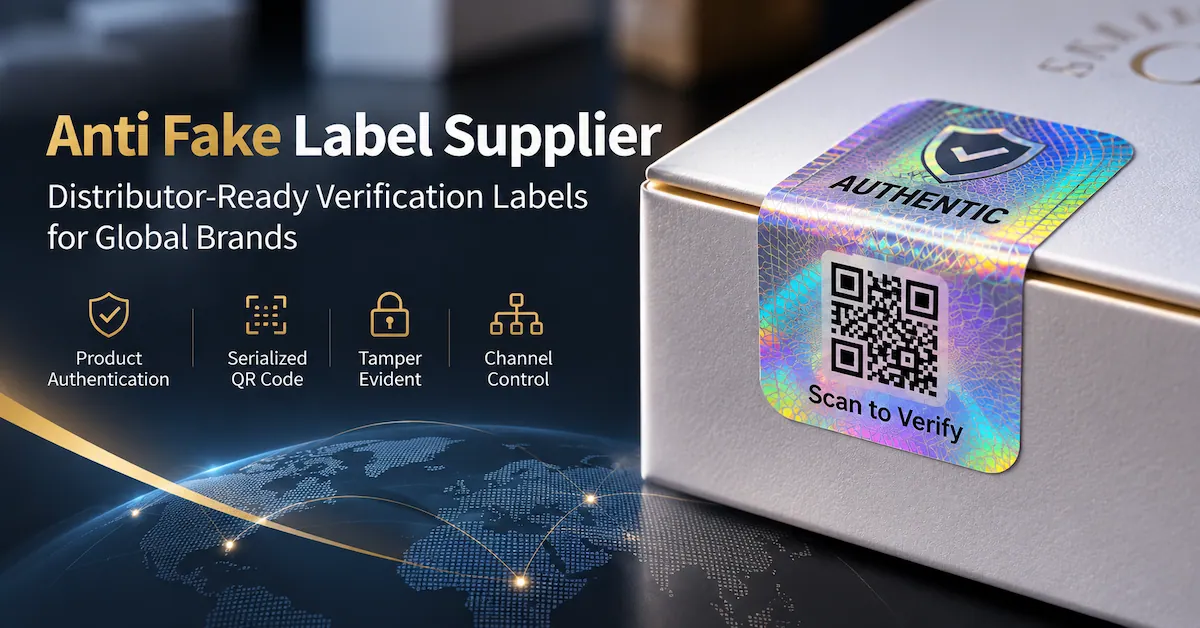
| Serialized QR code | Product-level identification | Digital verification and record management |
An optical hidden image does not automatically provide evidence of package opening.
For projects requiring both authentication and tamper evidence, buyers may evaluate compatible security structures alongside optical features.
Visit HX VOID Open Labels for related tamper-evident product options.
What Determines Optical Hidden Security Label Cost and Lead Time?
The cost of custom optical security labels depends on the design and manufacturing requirements.
Major cost drivers may include:
-
Optical artwork complexity.
-
Original master and tooling requirements.
-
Specialized functional film materials.
-
Protective layers and adhesive construction.
-
Printing and converting requirements.
-
Optical verification equipment, where needed.
-
Sample development and testing.
-
Production quantity and repeat-order arrangements.
A standard optical material with customized printed graphics may require less development than a newly originated concealed optical image.
Buyers should compare quotations using equivalent authentication requirements and production specifications.
MOQ, tooling charges, reader costs, sampling timelines, and production lead times should be confirmed directly with the optical hidden security label supplier.
How to Evaluate an Optical Hidden Security Label Supplier
A supplier evaluation should focus on the ability to deliver the specified optical response consistently.
Before placing an order, confirm whether the supplier can:
-
Explain the proposed optical technology and its intended authentication effect.
-
Demonstrate the feature using representative physical samples.
-
Evaluate compatibility with the actual packaging surface.
-
Define suitable optical and manufacturing acceptance criteria.
-
Control authorized artwork and optical master revisions.
-
Clarify tooling ownership and confidentiality requirements.
-
Maintain an approved reference for repeat production.
-
Provide project-specific commercial terms and manufacturing requirements.
ISO 22383:2020 provides a useful risk-based framework for selecting and evaluating authentication solutions.
Its principles support choosing technologies according to the actual product-security requirement rather than assuming that the most complex feature is automatically the most effective.
Working With HX Security Label on Custom Optical Security Projects
HX Security Label is operated by Shenzhen Huaxin Anti-Counterfeiting Technology Co., Ltd., a China-based manufacturer specializing in anti-counterfeiting label research, development, and production.
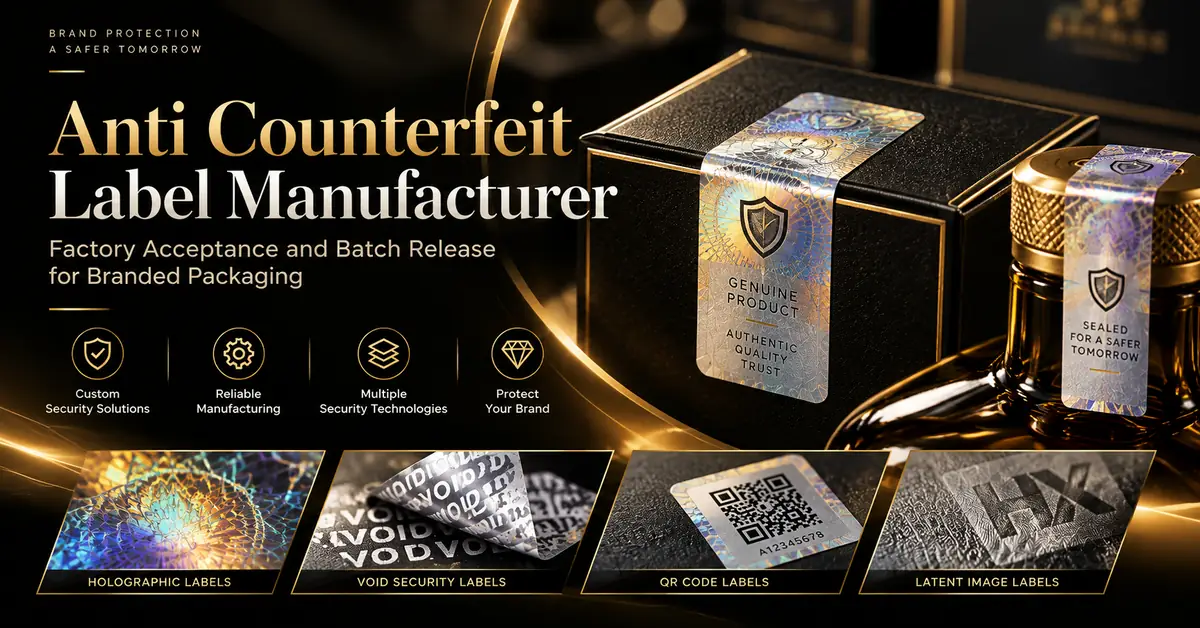
Established in 2008, the company presents a product portfolio covering holographic labels, latent-image labels, VOID-related products, and customized security-label applications.
Its published customization process includes requirements confirmation, design drafting, physical proofing, material selection, sample approval, and delivery coordination.
For optical hidden-image projects, this workflow provides a starting point for discussing suitable optical designs and packaging requirements.
Specific optical technologies, material configurations, verification equipment, production tolerances, and commercial terms should be confirmed during project development.
Learn more about the company's published capabilities on the HX About Us page.
What Should You Include in Your RFQ?
| RFQ information | Details to provide |
|---|---|
| Product application | Perfume, cosmetics, electronics, luxury packaging, or other products |
| Security requirement | Intended optical authentication function |
| Packaging finish | Glossy, metallic, transparent, matte, or textured |
| Artwork | Authorized logo and design requirements |
| Label dimensions | Finished size, shape, and location |
| Optical preferences | Desired visible and hidden effects |
| Additional functions | Holographic, tamper-evident, or identification features |
| Application process | Manual or automatic |
| Order quantity | Samples, trial orders, and bulk requirements |
| Delivery | Destination and project schedule |
Request Custom Optical Hidden Security Label Samples and a Quotation
Provide your packaging samples, artwork, optical requirements, and estimated purchasing volume to discuss suitable label constructions.
Frequently Asked Questions About Optical Hidden Security Labels
1. What is an optical hidden security label?
It is a security label containing a concealed or unobtrusive image that becomes recognizable under specified optical conditions. The feature may use diffraction, polarization, or another optical decoding technology.
2. How does an optical hidden image differ from a visible hologram?
A visible hologram provides recognizable optical effects during ordinary observation. A hidden optical image is designed for secondary authentication under defined conditions. Some constructions combine both functions.
3. Can optical hidden security labels be used on metallic packaging?
Yes, suitable constructions may be developed for metallic packaging. Buyers should evaluate background reflections, optical contrast, material compatibility, and final label placement before production.
4. Do all optical hidden images require a polarizing filter?
No. Some images respond to viewing-angle changes, while others require compatible polarization filters or specialized optical decoding devices.
5. Can protective lamination reduce hidden-image visibility?
Certain protective layers may affect optical performance. The complete finished label should be tested to confirm that the intended hidden-image response remains recognizable.
6. Can a hidden optical image include a custom brand logo?
Custom graphics may be possible depending on the selected optical design technology and label dimensions. The finished image should be approved through physical samples.
7. Are optical hidden security labels impossible to counterfeit?
No. Engineered optical features can increase reproduction difficulty and support controlled authentication, but no label guarantees complete protection against counterfeiting.
8. Can hidden optical labels include tamper-evident features?
Certain compatible constructions may combine optical authentication with VOID or destructible security structures. Both functions must be evaluated separately.
9. What affects the cost of custom optical hidden security labels?
Important factors include optical artwork, master preparation, functional materials, protective layers, converting requirements, verification equipment, and purchasing volume.
10. How can I request custom optical hidden security labels from HX?
Prepare your packaging details, artwork, optical requirements, label dimensions, and estimated order quantity. Then contact HX Security Label to discuss available technologies, samples, and quotation requirements.
Technical References
ISO 22383:2020 — Guidelines for the Selection and Performance Evaluation of Authentication Solutions for Material Goods.
Provides a framework for selecting and evaluating authentication elements according to product-security risks.
European Union Intellectual Property Office — Anti-Counterfeiting and Anti-Piracy Technology Guide: Security Holograms and Complex Holograms.
Provides technical background on diffractive optical authentication devices and combined visible and concealed security features.
HX Security Label — Hidden Image Security Sticker Technology Guide.
Provides company-published background on hidden optical structures and customized security-label applications.
These references support technical evaluation and purchasing decisions. They do not establish product-specific certification or guarantee authentication performance.
Conclusion
Selecting the right optical hidden security label supplier requires a detailed understanding of optical image behavior, material construction, packaging reflectivity, and manufacturing consistency.
For premium cosmetics, electronics, luxury goods, and other branded products, the challenge is achieving a concealed authentication feature that remains compatible with sophisticated packaging finishes while providing a recognizable optical response during authorized verification.
By evaluating diffraction or polarization-based technologies, defining normal and verification-state appearance, testing finished packaging, and maintaining controlled production references, B2B buyers can reduce unnecessary design revisions and procurement uncertainty.
HX Security Label offers customized anti-counterfeiting label solutions covering latent-image, holographic, and related product-security applications.
Whether you are developing a new premium packaging design or upgrading an existing authentication feature, a project-specific optical evaluation is an important step toward reliable bulk production.
Contact HX Security Label with your packaging materials, artwork, desired optical security features, and estimated purchasing quantity to discuss custom label development, sample evaluation, and quotation arrangements.